

4.2 Introduction to Prodrugs for Triple or Higher Action …
133
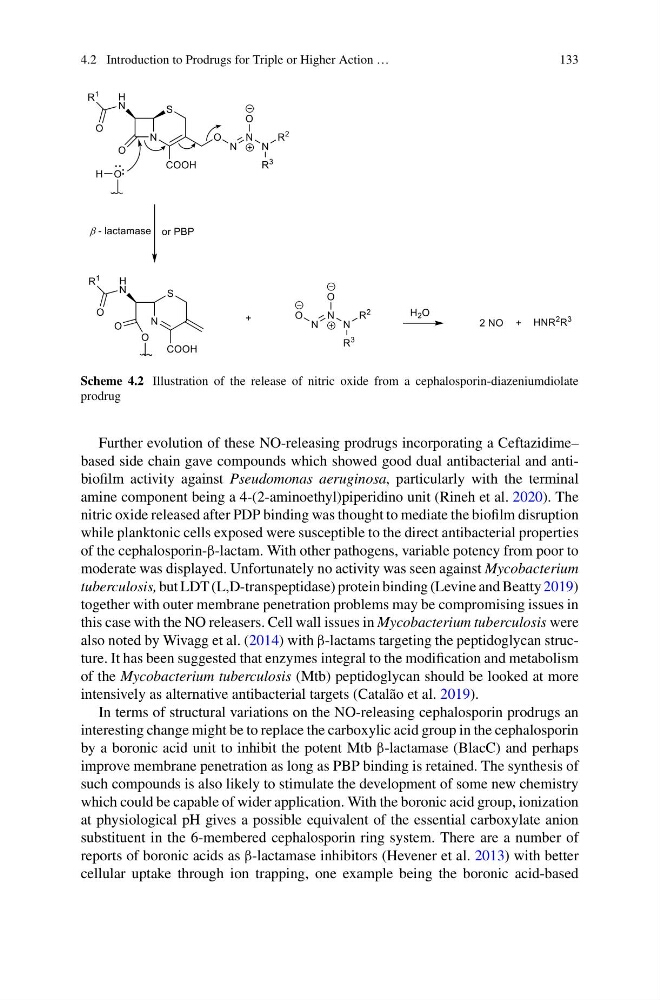
Scheme 4.2 Illustration of the release of nitric oxide from a cephalosporin-diazeniumdiolate
prodrug
Further evolution of these NO-releasing prodrugs incorporating a Ceftazidime–
based side chain gave compounds which showed good dual antibacterial and antibiofilm activity against Pseudomonas aeruginosa, particularly with the terminal
amine component being a 4-(2-aminoethyl)piperidino unit (Rineh et al. 2020). The
nitric oxide released after PDP binding was thought to mediate the biofilm disruption
while planktonic cells exposed were susceptible to the direct antibacterial properties
of the cephalosporin-β-lactam. With other pathogens, variable potency from poor to
moderate was displayed. Unfortunately no activity was seen against Mycobacterium
tuberculosis, but LDT (L,D-transpeptidase) protein binding (Levine and Beatty 2019)
together with outer membrane penetration problems may be compromising issues in
this case with the NO releasers. Cell wall issues in Mycobacterium tuberculosis were
also noted by Wivagg et al. (2014) with β-lactams targeting the peptidoglycan structure. It has been suggested that enzymes integral to the modification and metabolism
of the Mycobacterium tuberculosis (Mtb) peptidoglycan should be looked at more
intensively as alternative antibacterial targets (Catalão et al. 2019).
In terms of structural variations on the NO-releasing cephalosporin prodrugs an
interesting change might be to replace the carboxylic acid group in the cephalosporin
by a boronic acid unit to inhibit the potent Mtb β-lactamase (BlacC) and perhaps
improve membrane penetration as long as PBP binding is retained. The synthesis of
such compounds is also likely to stimulate the development of some new chemistry
which could be capable of wider application. With the boronic acid group, ionization
at physiological pH gives a possible equivalent of the essential carboxylate anion
substituent in the 6-membered cephalosporin ring system. There are a number of
reports of boronic acids as β-lactamase inhibitors (Hevener et al. 2013) with better
cellular uptake through ion trapping, one example being the boronic acid-based
133
Scheme 4.2 Illustration of the release of nitric oxide from a cephalosporin-diazeniumdiolate
prodrug
Further evolution of these NO-releasing prodrugs incorporating a Ceftazidime–
based side chain gave compounds which showed good dual antibacterial and antibiofilm activity against Pseudomonas aeruginosa, particularly with the terminal
amine component being a 4-(2-aminoethyl)piperidino unit (Rineh et al. 2020). The
nitric oxide released after PDP binding was thought to mediate the biofilm disruption
while planktonic cells exposed were susceptible to the direct antibacterial properties
of the cephalosporin-β-lactam. With other pathogens, variable potency from poor to
moderate was displayed. Unfortunately no activity was seen against Mycobacterium
tuberculosis, but LDT (L,D-transpeptidase) protein binding (Levine and Beatty 2019)
together with outer membrane penetration problems may be compromising issues in
this case with the NO releasers. Cell wall issues in Mycobacterium tuberculosis were
also noted by Wivagg et al. (2014) with β-lactams targeting the peptidoglycan structure. It has been suggested that enzymes integral to the modification and metabolism
of the Mycobacterium tuberculosis (Mtb) peptidoglycan should be looked at more
intensively as alternative antibacterial targets (Catalão et al. 2019).
In terms of structural variations on the NO-releasing cephalosporin prodrugs an
interesting change might be to replace the carboxylic acid group in the cephalosporin
by a boronic acid unit to inhibit the potent Mtb β-lactamase (BlacC) and perhaps
improve membrane penetration as long as PBP binding is retained. The synthesis of
such compounds is also likely to stimulate the development of some new chemistry
which could be capable of wider application. With the boronic acid group, ionization
at physiological pH gives a possible equivalent of the essential carboxylate anion
substituent in the 6-membered cephalosporin ring system. There are a number of
reports of boronic acids as β-lactamase inhibitors (Hevener et al. 2013) with better
cellular uptake through ion trapping, one example being the boronic acid-based