

134
4 Design Principles and Development of Prodrugs for Multiply …
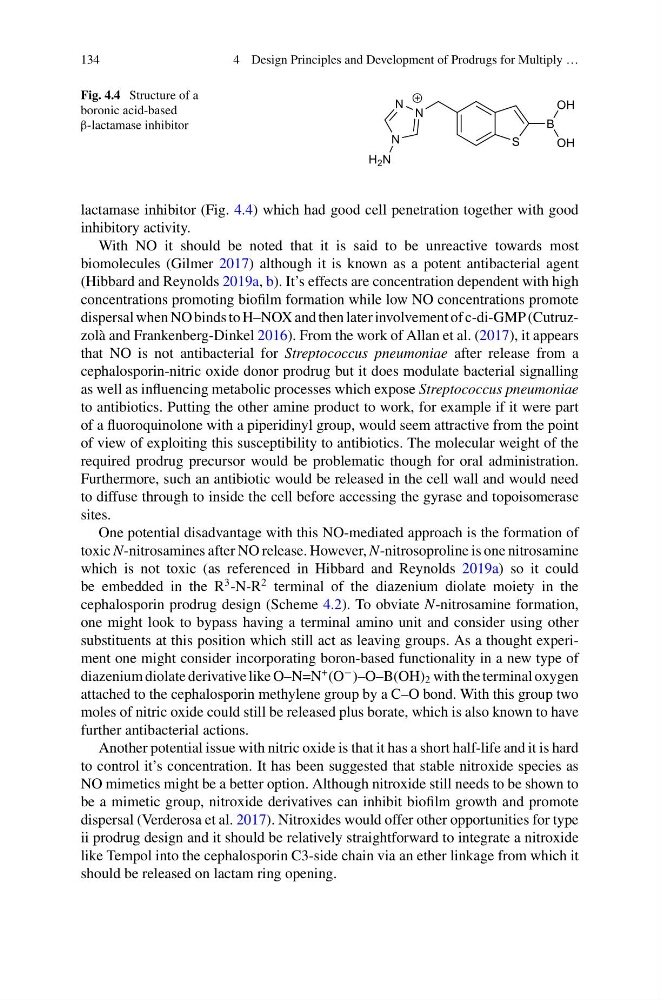
Fig. 4.4 Structure of a
boronic acid-based
β-lactamase inhibitor
lactamase inhibitor (Fig. 4.4) which had good cell penetration together with good
inhibitory activity.
With NO it should be noted that it is said to be unreactive towards most
biomolecules (Gilmer 2017) although it is known as a potent antibacterial agent
(Hibbard and Reynolds 2019a, b). It’s effects are concentration dependent with high
concentrations promoting biofilm formation while low NO concentrations promote
dispersal when NO binds to H–NOX and then later involvement of c-di-GMP (Cutruzzolà and Frankenberg-Dinkel 2016). From the work of Allan et al. (2017), it appears
that NO is not antibacterial for Streptococcus pneumoniae after release from a
cephalosporin-nitric oxide donor prodrug but it does modulate bacterial signalling
as well as influencing metabolic processes which expose Streptococcus pneumoniae
to antibiotics. Putting the other amine product to work, for example if it were part
of a fluoroquinolone with a piperidinyl group, would seem attractive from the point
of view of exploiting this susceptibility to antibiotics. The molecular weight of the
required prodrug precursor would be problematic though for oral administration.
Furthermore, such an antibiotic would be released in the cell wall and would need
to diffuse through to inside the cell before accessing the gyrase and topoisomerase
sites.
One potential disadvantage with this NO-mediated approach is the formation of
toxic N-nitrosamines after NO release. However, N-nitrosoproline is one nitrosamine
which is not toxic (as referenced in Hibbard and Reynolds 2019a) so it could
be embedded in the R
3 -N-R
2 terminal of the diazenium diolate moiety in the
cephalosporin prodrug design (Scheme 4.2). To obviate N-nitrosamine formation,
one might look to bypass having a terminal amino unit and consider using other
substituents at this position which still act as leaving groups. As a thought experiment one might consider incorporating boron-based functionality in a new type of
diazenium diolate derivative like O–N=N
+ (O
− )–O–B(OH) 2 with the terminal oxygen
attached to the cephalosporin methylene group by a C–O bond. With this group two
moles of nitric oxide could still be released plus borate, which is also known to have
further antibacterial actions.
Another potential issue with nitric oxide is that it has a short half-life and it is hard
to control it’s concentration. It has been suggested that stable nitroxide species as
NO mimetics might be a better option. Although nitroxide still needs to be shown to
be a mimetic group, nitroxide derivatives can inhibit biofilm growth and promote
dispersal (Verderosa et al. 2017). Nitroxides would offer other opportunities for type
ii prodrug design and it should be relatively straightforward to integrate a nitroxide
like Tempol into the cephalosporin C3-side chain via an ether linkage from which it
should be released on lactam ring opening.
4 Design Principles and Development of Prodrugs for Multiply …
Fig. 4.4 Structure of a
boronic acid-based
β-lactamase inhibitor
lactamase inhibitor (Fig. 4.4) which had good cell penetration together with good
inhibitory activity.
With NO it should be noted that it is said to be unreactive towards most
biomolecules (Gilmer 2017) although it is known as a potent antibacterial agent
(Hibbard and Reynolds 2019a, b). It’s effects are concentration dependent with high
concentrations promoting biofilm formation while low NO concentrations promote
dispersal when NO binds to H–NOX and then later involvement of c-di-GMP (Cutruzzolà and Frankenberg-Dinkel 2016). From the work of Allan et al. (2017), it appears
that NO is not antibacterial for Streptococcus pneumoniae after release from a
cephalosporin-nitric oxide donor prodrug but it does modulate bacterial signalling
as well as influencing metabolic processes which expose Streptococcus pneumoniae
to antibiotics. Putting the other amine product to work, for example if it were part
of a fluoroquinolone with a piperidinyl group, would seem attractive from the point
of view of exploiting this susceptibility to antibiotics. The molecular weight of the
required prodrug precursor would be problematic though for oral administration.
Furthermore, such an antibiotic would be released in the cell wall and would need
to diffuse through to inside the cell before accessing the gyrase and topoisomerase
sites.
One potential disadvantage with this NO-mediated approach is the formation of
toxic N-nitrosamines after NO release. However, N-nitrosoproline is one nitrosamine
which is not toxic (as referenced in Hibbard and Reynolds 2019a) so it could
be embedded in the R
3 -N-R
2 terminal of the diazenium diolate moiety in the
cephalosporin prodrug design (Scheme 4.2). To obviate N-nitrosamine formation,
one might look to bypass having a terminal amino unit and consider using other
substituents at this position which still act as leaving groups. As a thought experiment one might consider incorporating boron-based functionality in a new type of
diazenium diolate derivative like O–N=N
+ (O
− )–O–B(OH) 2 with the terminal oxygen
attached to the cephalosporin methylene group by a C–O bond. With this group two
moles of nitric oxide could still be released plus borate, which is also known to have
further antibacterial actions.
Another potential issue with nitric oxide is that it has a short half-life and it is hard
to control it’s concentration. It has been suggested that stable nitroxide species as
NO mimetics might be a better option. Although nitroxide still needs to be shown to
be a mimetic group, nitroxide derivatives can inhibit biofilm growth and promote
dispersal (Verderosa et al. 2017). Nitroxides would offer other opportunities for type
ii prodrug design and it should be relatively straightforward to integrate a nitroxide
like Tempol into the cephalosporin C3-side chain via an ether linkage from which it
should be released on lactam ring opening.