

4.2 Introduction to Prodrugs for Triple or Higher Action …
127
the aldehyde phenolic or non-phenolic ester should occur to release the antibiotic.
In the anti-cancer work by the same group and discussed by Thapa et al. (2016) a
secondary alcoholic unit in Paclitaxel was used to link the aminoacrylate unit and
the drug was released after ready hydrolysis of the aldehyde ester resulting from
cleavage of the aldehyde ester intermediate.
Taking this particular prodrug approach a step further one might suggest a reversed
photosensitiser-ciprofloxacin light activated system here linked by an aminoacrylamide unit with an appropriate spacer to the photosensitiser. With such a prodrug
construct one could then expect multi-targeting through a combined release of
an antibacterial drug together with the singlet oxygen (and other reactive oxygen
species) produced, although some singlet oxygen would also be consumed in reacting
with the enamide linking unit. If ciprofloxacin was connected via its piperazine
secondary amino group directly, the other main product, an N-formyl piperidine
might be structurally tuned to be a peptide deformylase (PDF) enzyme inhibitor to
add to the ultimate activity profile. The other cleavage product would still retain the
photosensitiser moiety for continuing the separate singlet oxygen production.
Other proposed examples in the type i category might include a structure A---B
which is initially inactive but where A is susceptible to reversible ring opening of
a β-lactam moiety by a lactamase to give an intermediate A
---B which could then
chemically release B
and ultimately re-form an active lactam antibacterial A
. If
B
was another enzyme inhibitor, for example of the enzyme peptide deformylase
and A
bound to two PBPs, then this would be a triple mode of action. The peptide
deformylase inhibitor could be released by a β-lactamase enzyme or PBP from a
suitably substituted cephalosporin and thus affecting protein synthesis as well as cell
wall biosynthesis. The design of a suitable PDF inhibitor should be greatly assisted
by knowledge of the binding modes of distinct PDF inhibitors as elaborated through
the PDF platform discussed by Fieulaine and co-workers (Fieulaine et al. 2016). One
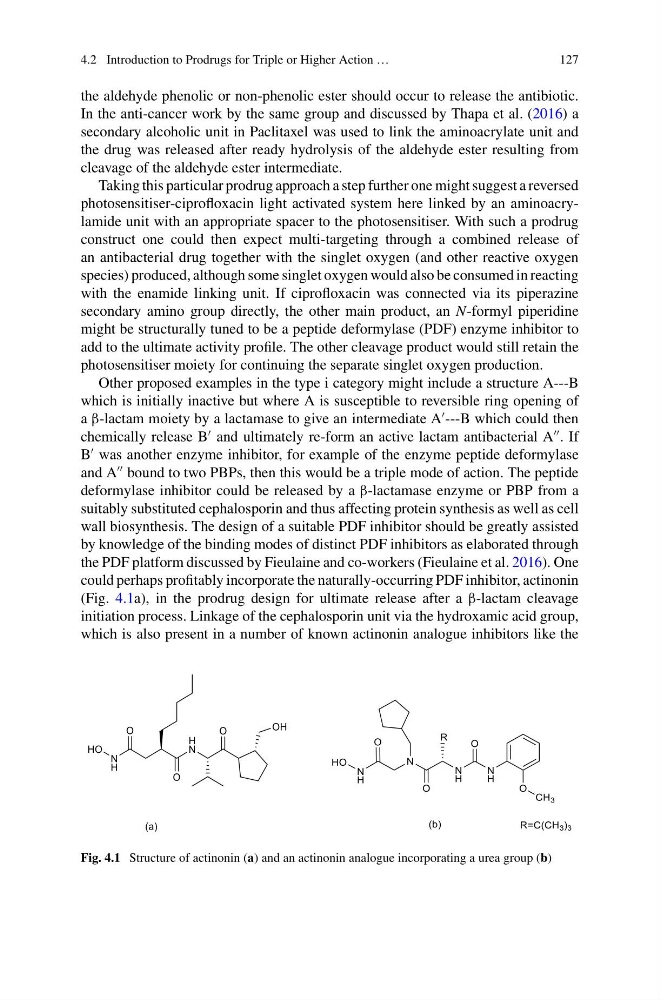
could perhaps profitably incorporate the naturally-occurring PDF inhibitor, actinonin
(Fig. 4.1a), in the prodrug design for ultimate release after a β-lactam cleavage
initiation process. Linkage of the cephalosporin unit via the hydroxamic acid group,
which is also present in a number of known actinonin analogue inhibitors like the
Fig. 4.1 Structure of actinonin (a) and an actinonin analogue incorporating a urea group (b)
127
the aldehyde phenolic or non-phenolic ester should occur to release the antibiotic.
In the anti-cancer work by the same group and discussed by Thapa et al. (2016) a
secondary alcoholic unit in Paclitaxel was used to link the aminoacrylate unit and
the drug was released after ready hydrolysis of the aldehyde ester resulting from
cleavage of the aldehyde ester intermediate.
Taking this particular prodrug approach a step further one might suggest a reversed
photosensitiser-ciprofloxacin light activated system here linked by an aminoacrylamide unit with an appropriate spacer to the photosensitiser. With such a prodrug
construct one could then expect multi-targeting through a combined release of
an antibacterial drug together with the singlet oxygen (and other reactive oxygen
species) produced, although some singlet oxygen would also be consumed in reacting
with the enamide linking unit. If ciprofloxacin was connected via its piperazine
secondary amino group directly, the other main product, an N-formyl piperidine
might be structurally tuned to be a peptide deformylase (PDF) enzyme inhibitor to
add to the ultimate activity profile. The other cleavage product would still retain the
photosensitiser moiety for continuing the separate singlet oxygen production.
Other proposed examples in the type i category might include a structure A---B
which is initially inactive but where A is susceptible to reversible ring opening of
a β-lactam moiety by a lactamase to give an intermediate A
---B which could then
chemically release B
and ultimately re-form an active lactam antibacterial A
. If
B
was another enzyme inhibitor, for example of the enzyme peptide deformylase
and A
bound to two PBPs, then this would be a triple mode of action. The peptide
deformylase inhibitor could be released by a β-lactamase enzyme or PBP from a
suitably substituted cephalosporin and thus affecting protein synthesis as well as cell
wall biosynthesis. The design of a suitable PDF inhibitor should be greatly assisted
by knowledge of the binding modes of distinct PDF inhibitors as elaborated through
the PDF platform discussed by Fieulaine and co-workers (Fieulaine et al. 2016). One
could perhaps profitably incorporate the naturally-occurring PDF inhibitor, actinonin
(Fig. 4.1a), in the prodrug design for ultimate release after a β-lactam cleavage
initiation process. Linkage of the cephalosporin unit via the hydroxamic acid group,
which is also present in a number of known actinonin analogue inhibitors like the
Fig. 4.1 Structure of actinonin (a) and an actinonin analogue incorporating a urea group (b)