

126
4 Design Principles and Development of Prodrugs for Multiply …
4.2.2 Classification and Examples of Cleavable Types
for Triple or Higher Action
With regard to these general type classifications, the letter descriptors A
, B
, or in
some cases C
, are used for changes following prodrug activation and bond cleavage
in order to take into account residual atoms still attached but retaining the required
target recognition features. It should also be noted that for each cleavable type there
could be variations in the sequencing of A, B, and C and the cleavage of the linking
groups.
4.2.3 Cleavable Type I
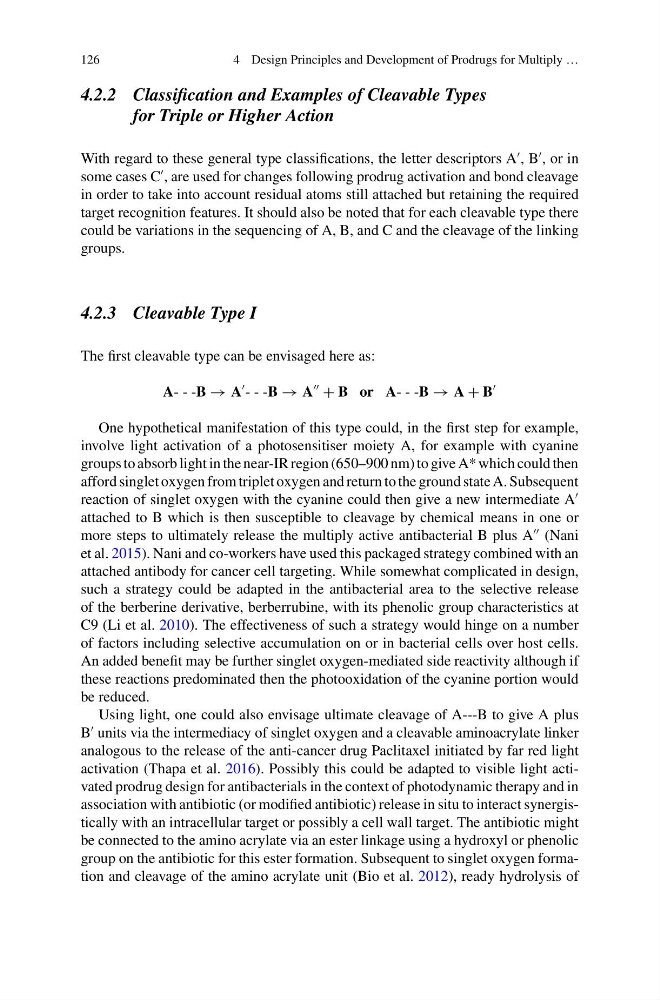
The first cleavable type can be envisaged here as:
A- - -B → A
- - -B → A
+ B or A- - -B → A + B
One hypothetical manifestation of this type could, in the first step for example,
involve light activation of a photosensitiser moiety A, for example with cyanine
groups to absorb light in the near-IR region (650–900 nm) to give A* which could then
afford singlet oxygen from triplet oxygen and return to the ground state A. Subsequent
reaction of singlet oxygen with the cyanine could then give a new intermediate A
attached to B which is then susceptible to cleavage by chemical means in one or
more steps to ultimately release the multiply active antibacterial B plus A
(Nani
et al. 2015). Nani and co-workers have used this packaged strategy combined with an
attached antibody for cancer cell targeting. While somewhat complicated in design,
such a strategy could be adapted in the antibacterial area to the selective release
of the berberine derivative, berberrubine, with its phenolic group characteristics at
C9 (Li et al. 2010). The effectiveness of such a strategy would hinge on a number
of factors including selective accumulation on or in bacterial cells over host cells.
An added benefit may be further singlet oxygen-mediated side reactivity although if
these reactions predominated then the photooxidation of the cyanine portion would
be reduced.
Using light, one could also envisage ultimate cleavage of A---B to give A plus
B
units via the intermediacy of singlet oxygen and a cleavable aminoacrylate linker
analogous to the release of the anti-cancer drug Paclitaxel initiated by far red light
activation (Thapa et al. 2016). Possibly this could be adapted to visible light activated prodrug design for antibacterials in the context of photodynamic therapy and in
association with antibiotic (or modified antibiotic) release in situ to interact synergistically with an intracellular target or possibly a cell wall target. The antibiotic might
be connected to the amino acrylate via an ester linkage using a hydroxyl or phenolic
group on the antibiotic for this ester formation. Subsequent to singlet oxygen formation and cleavage of the amino acrylate unit (Bio et al. 2012), ready hydrolysis of
4 Design Principles and Development of Prodrugs for Multiply …
4.2.2 Classification and Examples of Cleavable Types
for Triple or Higher Action
With regard to these general type classifications, the letter descriptors A
, B
, or in
some cases C
, are used for changes following prodrug activation and bond cleavage
in order to take into account residual atoms still attached but retaining the required
target recognition features. It should also be noted that for each cleavable type there
could be variations in the sequencing of A, B, and C and the cleavage of the linking
groups.
4.2.3 Cleavable Type I
The first cleavable type can be envisaged here as:
A- - -B → A
- - -B → A
+ B or A- - -B → A + B
One hypothetical manifestation of this type could, in the first step for example,
involve light activation of a photosensitiser moiety A, for example with cyanine
groups to absorb light in the near-IR region (650–900 nm) to give A* which could then
afford singlet oxygen from triplet oxygen and return to the ground state A. Subsequent
reaction of singlet oxygen with the cyanine could then give a new intermediate A
attached to B which is then susceptible to cleavage by chemical means in one or
more steps to ultimately release the multiply active antibacterial B plus A
(Nani
et al. 2015). Nani and co-workers have used this packaged strategy combined with an
attached antibody for cancer cell targeting. While somewhat complicated in design,
such a strategy could be adapted in the antibacterial area to the selective release
of the berberine derivative, berberrubine, with its phenolic group characteristics at
C9 (Li et al. 2010). The effectiveness of such a strategy would hinge on a number
of factors including selective accumulation on or in bacterial cells over host cells.
An added benefit may be further singlet oxygen-mediated side reactivity although if
these reactions predominated then the photooxidation of the cyanine portion would
be reduced.
Using light, one could also envisage ultimate cleavage of A---B to give A plus
B
units via the intermediacy of singlet oxygen and a cleavable aminoacrylate linker
analogous to the release of the anti-cancer drug Paclitaxel initiated by far red light
activation (Thapa et al. 2016). Possibly this could be adapted to visible light activated prodrug design for antibacterials in the context of photodynamic therapy and in
association with antibiotic (or modified antibiotic) release in situ to interact synergistically with an intracellular target or possibly a cell wall target. The antibiotic might
be connected to the amino acrylate via an ester linkage using a hydroxyl or phenolic
group on the antibiotic for this ester formation. Subsequent to singlet oxygen formation and cleavage of the amino acrylate unit (Bio et al. 2012), ready hydrolysis of