

3.4 More Than Triple Action Hybrid Agents
109
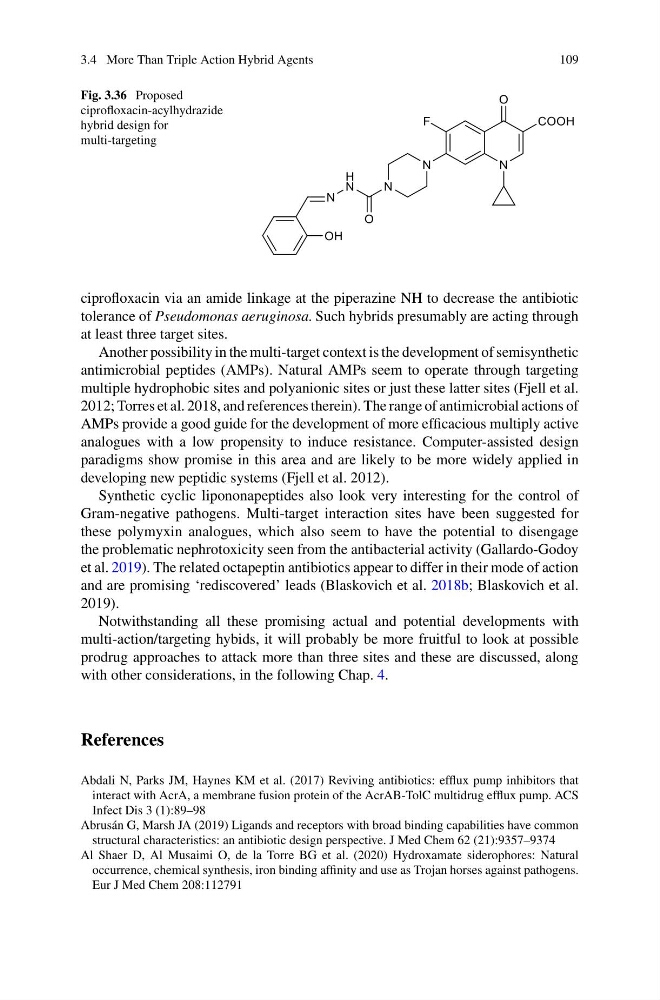
Fig. 3.36 Proposed
ciprofloxacin-acylhydrazide
hybrid design for
multi-targeting
ciprofloxacin via an amide linkage at the piperazine NH to decrease the antibiotic
tolerance of Pseudomonas aeruginosa. Such hybrids presumably are acting through
at least three target sites.
Another possibility in the multi-target context is the development of semisynthetic
antimicrobial peptides (AMPs). Natural AMPs seem to operate through targeting
multiple hydrophobic sites and polyanionic sites or just these latter sites (Fjell et al.
2012; Torres et al. 2018, and references therein). The range of antimicrobial actions of
AMPs provide a good guide for the development of more efficacious multiply active
analogues with a low propensity to induce resistance. Computer-assisted design
paradigms show promise in this area and are likely to be more widely applied in
developing new peptidic systems (Fjell et al. 2012).
Synthetic cyclic lipononapeptides also look very interesting for the control of
Gram-negative pathogens. Multi-target interaction sites have been suggested for
these polymyxin analogues, which also seem to have the potential to disengage
the problematic nephrotoxicity seen from the antibacterial activity (Gallardo-Godoy
et al. 2019). The related octapeptin antibiotics appear to differ in their mode of action
and are promising ‘rediscovered’ leads (Blaskovich et al. 2018b; Blaskovich et al.
2019).
Notwithstanding all these promising actual and potential developments with
multi-action/targeting hybids, it will probably be more fruitful to look at possible
prodrug approaches to attack more than three sites and these are discussed, along
with other considerations, in the following Chap. 4.
References
Abdali N, Parks JM, Haynes KM et al. (2017) Reviving antibiotics: efflux pump inhibitors that
interact with AcrA, a membrane fusion protein of the AcrAB-TolC multidrug efflux pump. ACS
Infect Dis 3 (1):89–98
Abrusán G, Marsh JA (2019) Ligands and receptors with broad binding capabilities have common
structural characteristics: an antibiotic design perspective. J Med Chem 62 (21):9357–9374
Al Shaer D, Al Musaimi O, de la Torre BG et al. (2020) Hydroxamate siderophores: Natural
occurrence, chemical synthesis, iron binding affinity and use as Trojan horses against pathogens.
Eur J Med Chem 208:112791
109
Fig. 3.36 Proposed
ciprofloxacin-acylhydrazide
hybrid design for
multi-targeting
ciprofloxacin via an amide linkage at the piperazine NH to decrease the antibiotic
tolerance of Pseudomonas aeruginosa. Such hybrids presumably are acting through
at least three target sites.
Another possibility in the multi-target context is the development of semisynthetic
antimicrobial peptides (AMPs). Natural AMPs seem to operate through targeting
multiple hydrophobic sites and polyanionic sites or just these latter sites (Fjell et al.
2012; Torres et al. 2018, and references therein). The range of antimicrobial actions of
AMPs provide a good guide for the development of more efficacious multiply active
analogues with a low propensity to induce resistance. Computer-assisted design
paradigms show promise in this area and are likely to be more widely applied in
developing new peptidic systems (Fjell et al. 2012).
Synthetic cyclic lipononapeptides also look very interesting for the control of
Gram-negative pathogens. Multi-target interaction sites have been suggested for
these polymyxin analogues, which also seem to have the potential to disengage
the problematic nephrotoxicity seen from the antibacterial activity (Gallardo-Godoy
et al. 2019). The related octapeptin antibiotics appear to differ in their mode of action
and are promising ‘rediscovered’ leads (Blaskovich et al. 2018b; Blaskovich et al.
2019).
Notwithstanding all these promising actual and potential developments with
multi-action/targeting hybids, it will probably be more fruitful to look at possible
prodrug approaches to attack more than three sites and these are discussed, along
with other considerations, in the following Chap. 4.
References
Abdali N, Parks JM, Haynes KM et al. (2017) Reviving antibiotics: efflux pump inhibitors that
interact with AcrA, a membrane fusion protein of the AcrAB-TolC multidrug efflux pump. ACS
Infect Dis 3 (1):89–98
Abrusán G, Marsh JA (2019) Ligands and receptors with broad binding capabilities have common
structural characteristics: an antibiotic design perspective. J Med Chem 62 (21):9357–9374
Al Shaer D, Al Musaimi O, de la Torre BG et al. (2020) Hydroxamate siderophores: Natural
occurrence, chemical synthesis, iron binding affinity and use as Trojan horses against pathogens.
Eur J Med Chem 208:112791