

108
3 Single Molecule Non-cleavable Multiply Active Antibacterials
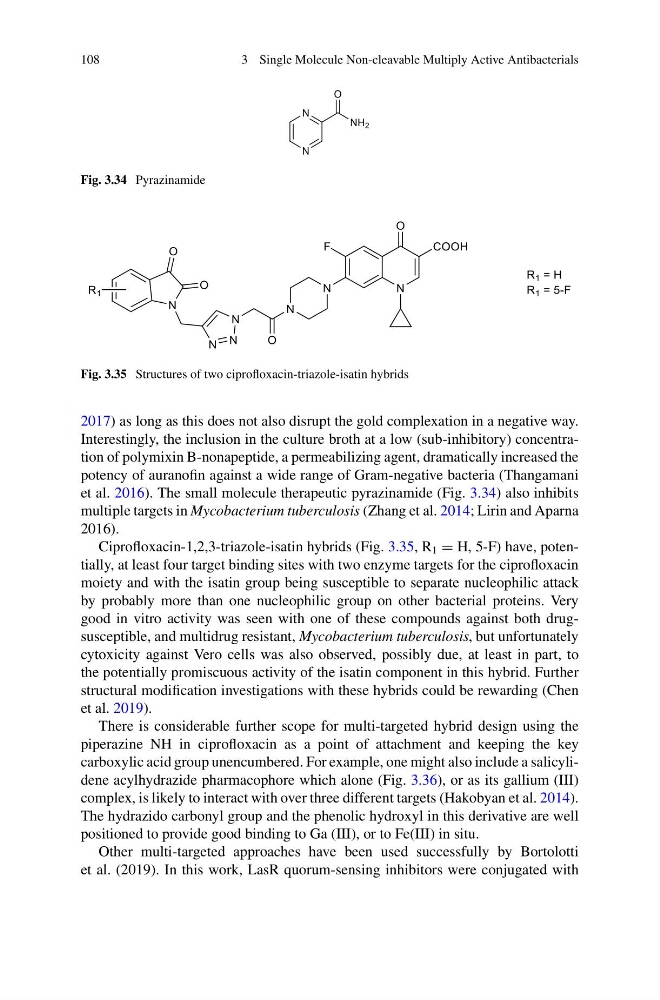
Fig. 3.34 Pyrazinamide
Fig. 3.35 Structures of two ciprofloxacin-triazole-isatin hybrids
2017) as long as this does not also disrupt the gold complexation in a negative way.
Interestingly, the inclusion in the culture broth at a low (sub-inhibitory) concentration of polymixin B-nonapeptide, a permeabilizing agent, dramatically increased the
potency of auranofin against a wide range of Gram-negative bacteria (Thangamani
et al. 2016). The small molecule therapeutic pyrazinamide (Fig. 3.34) also inhibits
multiple targets in Mycobacterium tuberculosis (Zhang et al. 2014; Lirin and Aparna
2016).
Ciprofloxacin-1,2,3-triazole-isatin hybrids (Fig. 3.35, R 1 = H, 5-F) have, potentially, at least four target binding sites with two enzyme targets for the ciprofloxacin
moiety and with the isatin group being susceptible to separate nucleophilic attack
by probably more than one nucleophilic group on other bacterial proteins. Very
good in vitro activity was seen with one of these compounds against both drugsusceptible, and multidrug resistant, Mycobacterium tuberculosis, but unfortunately
cytoxicity against Vero cells was also observed, possibly due, at least in part, to
the potentially promiscuous activity of the isatin component in this hybrid. Further
structural modification investigations with these hybrids could be rewarding (Chen
et al. 2019).
There is considerable further scope for multi-targeted hybrid design using the
piperazine NH in ciprofloxacin as a point of attachment and keeping the key
carboxylic acid group unencumbered. For example, one might also include a salicylidene acylhydrazide pharmacophore which alone (Fig. 3.36), or as its gallium (III)
complex, is likely to interact with over three different targets (Hakobyan et al. 2014).
The hydrazido carbonyl group and the phenolic hydroxyl in this derivative are well
positioned to provide good binding to Ga (III), or to Fe(III) in situ.
Other multi-targeted approaches have been used successfully by Bortolotti
et al. (2019). In this work, LasR quorum-sensing inhibitors were conjugated with
3 Single Molecule Non-cleavable Multiply Active Antibacterials
Fig. 3.34 Pyrazinamide
Fig. 3.35 Structures of two ciprofloxacin-triazole-isatin hybrids
2017) as long as this does not also disrupt the gold complexation in a negative way.
Interestingly, the inclusion in the culture broth at a low (sub-inhibitory) concentration of polymixin B-nonapeptide, a permeabilizing agent, dramatically increased the
potency of auranofin against a wide range of Gram-negative bacteria (Thangamani
et al. 2016). The small molecule therapeutic pyrazinamide (Fig. 3.34) also inhibits
multiple targets in Mycobacterium tuberculosis (Zhang et al. 2014; Lirin and Aparna
2016).
Ciprofloxacin-1,2,3-triazole-isatin hybrids (Fig. 3.35, R 1 = H, 5-F) have, potentially, at least four target binding sites with two enzyme targets for the ciprofloxacin
moiety and with the isatin group being susceptible to separate nucleophilic attack
by probably more than one nucleophilic group on other bacterial proteins. Very
good in vitro activity was seen with one of these compounds against both drugsusceptible, and multidrug resistant, Mycobacterium tuberculosis, but unfortunately
cytoxicity against Vero cells was also observed, possibly due, at least in part, to
the potentially promiscuous activity of the isatin component in this hybrid. Further
structural modification investigations with these hybrids could be rewarding (Chen
et al. 2019).
There is considerable further scope for multi-targeted hybrid design using the
piperazine NH in ciprofloxacin as a point of attachment and keeping the key
carboxylic acid group unencumbered. For example, one might also include a salicylidene acylhydrazide pharmacophore which alone (Fig. 3.36), or as its gallium (III)
complex, is likely to interact with over three different targets (Hakobyan et al. 2014).
The hydrazido carbonyl group and the phenolic hydroxyl in this derivative are well
positioned to provide good binding to Ga (III), or to Fe(III) in situ.
Other multi-targeted approaches have been used successfully by Bortolotti
et al. (2019). In this work, LasR quorum-sensing inhibitors were conjugated with