

3.3 Triple Action Antibacterial Hybrid Agents
105
common bonds including those embedded in ring systems as in fused systems. The
recognition elements could be incorporated in a ring and/or be included in substituent
groups. There does not appear to be any clear precedent in the literature of this general
type of triple action antibacterial agent, but possibilities for the future based on the
berberine template might include for example recognition features A and C being
directly attached to berberine (recognition unit B) perhaps at two different positions
such as at the 8 and 12, 8 and 13, or 12 and 13 berberine positions.
3.3.4.6 Type V. AB/C
In the representation of this type, B/C would indicate an overlap connection between
the two as for BC in type iii. The key differentiating characteristic of this type v is the
absence of extra linking atom groups for A toB/C, but these linking groups would be
replaced by connection via a common atom in a ring (or not), or at least two common
atoms in fused rings, or one bond in a direct connection. B/C represents partial up to
near complete spatial and structural overlaps of the other two recognition elements
B and C. For the near complete overlap case B would then be close to equivalent to
C and action at two biological targets could be envisaged as noted for type iii. Prior
exploration of this type in the berberine context does not seem to have been reported,
but if A was directely attached to B/C in structures like those in Fig. 3.30a and b,
then they would represent such an expression of the type v design concept. Such a
structure based on the former would still have planar ring fusions to give a similar
bent geometry and a positively charged quaternary nitrogen as in berberine.
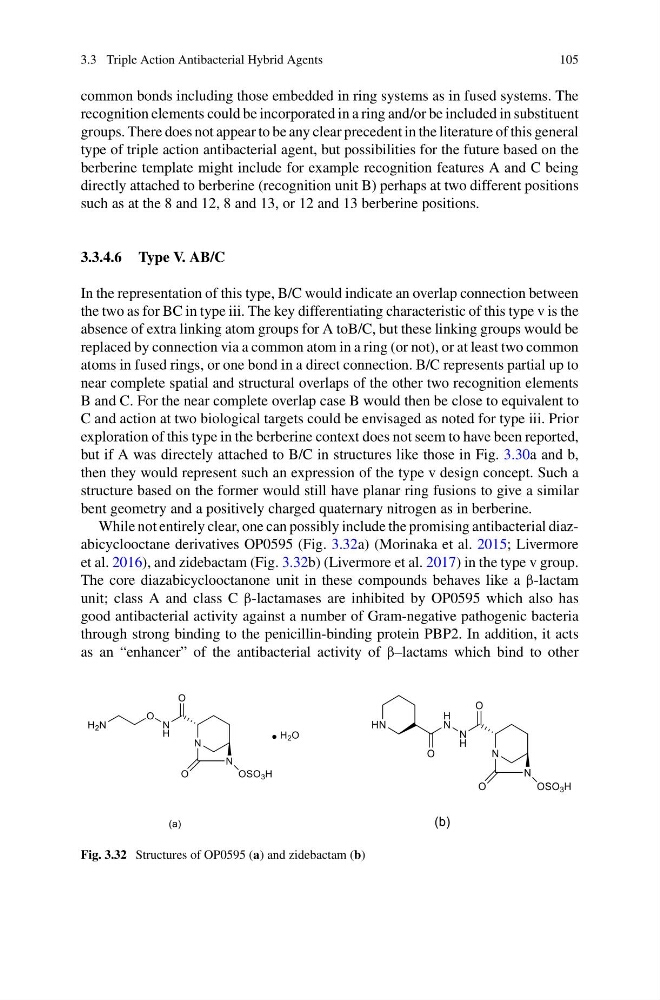
While not entirely clear, one can possibly include the promising antibacterial diazabicyclooctane derivatives OP0595 (Fig. 3.32a) (Morinaka et al. 2015; Livermore
et al. 2016), and zidebactam (Fig. 3.32b) (Livermore et al. 2017) in the type v group.
The core diazabicyclooctanone unit in these compounds behaves like a β-lactam
unit; class A and class C β-lactamases are inhibited by OP0595 which also has
good antibacterial activity against a number of Gram-negative pathogenic bacteria
through strong binding to the penicillin-binding protein PBP2. In addition, it acts
as an “enhancer” of the antibacterial activity of β–lactams which bind to other
Fig. 3.32 Structures of OP0595 (a) and zidebactam (b)
105
common bonds including those embedded in ring systems as in fused systems. The
recognition elements could be incorporated in a ring and/or be included in substituent
groups. There does not appear to be any clear precedent in the literature of this general
type of triple action antibacterial agent, but possibilities for the future based on the
berberine template might include for example recognition features A and C being
directly attached to berberine (recognition unit B) perhaps at two different positions
such as at the 8 and 12, 8 and 13, or 12 and 13 berberine positions.
3.3.4.6 Type V. AB/C
In the representation of this type, B/C would indicate an overlap connection between
the two as for BC in type iii. The key differentiating characteristic of this type v is the
absence of extra linking atom groups for A toB/C, but these linking groups would be
replaced by connection via a common atom in a ring (or not), or at least two common
atoms in fused rings, or one bond in a direct connection. B/C represents partial up to
near complete spatial and structural overlaps of the other two recognition elements
B and C. For the near complete overlap case B would then be close to equivalent to
C and action at two biological targets could be envisaged as noted for type iii. Prior
exploration of this type in the berberine context does not seem to have been reported,
but if A was directely attached to B/C in structures like those in Fig. 3.30a and b,
then they would represent such an expression of the type v design concept. Such a
structure based on the former would still have planar ring fusions to give a similar
bent geometry and a positively charged quaternary nitrogen as in berberine.
While not entirely clear, one can possibly include the promising antibacterial diazabicyclooctane derivatives OP0595 (Fig. 3.32a) (Morinaka et al. 2015; Livermore
et al. 2016), and zidebactam (Fig. 3.32b) (Livermore et al. 2017) in the type v group.
The core diazabicyclooctanone unit in these compounds behaves like a β-lactam
unit; class A and class C β-lactamases are inhibited by OP0595 which also has
good antibacterial activity against a number of Gram-negative pathogenic bacteria
through strong binding to the penicillin-binding protein PBP2. In addition, it acts
as an “enhancer” of the antibacterial activity of β–lactams which bind to other
Fig. 3.32 Structures of OP0595 (a) and zidebactam (b)