

106
3 Single Molecule Non-cleavable Multiply Active Antibacterials
penicillin-binding proteins, independent of the blocking of the β-lactamases (Livermore et al. 2016; Morinaka et al. 2016). Zidebactam has very good activity against
some Gram-negative bacterial strains (Livermore et al. 2017; Sader et al. 2017).
Analogue development to include new N–B(OH) 2 or N–O–B(OH) 2 units relacing
the N–OSO 3 H functionality could also be worth further consideration if resistance
starts to appear with OP0595 and zidebactam. However stability to hydrolysis may
be an issue with these functional groups and this would need to be carefully checked
under physiological conditions.
3.3.4.7 Type VI. A/B/C
Taking the type v design further one would then arrive at the condensed structural
type vi, in which a partial up to complete or near complete spatial overlap of the
recognition elements could be envisaged. With this type it is considered less likely to
be complete overlap of all three units in one molecule interacting with similar binding
strengths at three different biological targets with the same recognition element.
While not apparently reported as yet, one can also envision compounds of type vi
with partial structural overlaps and with a prospective triple action profile. Illustrative
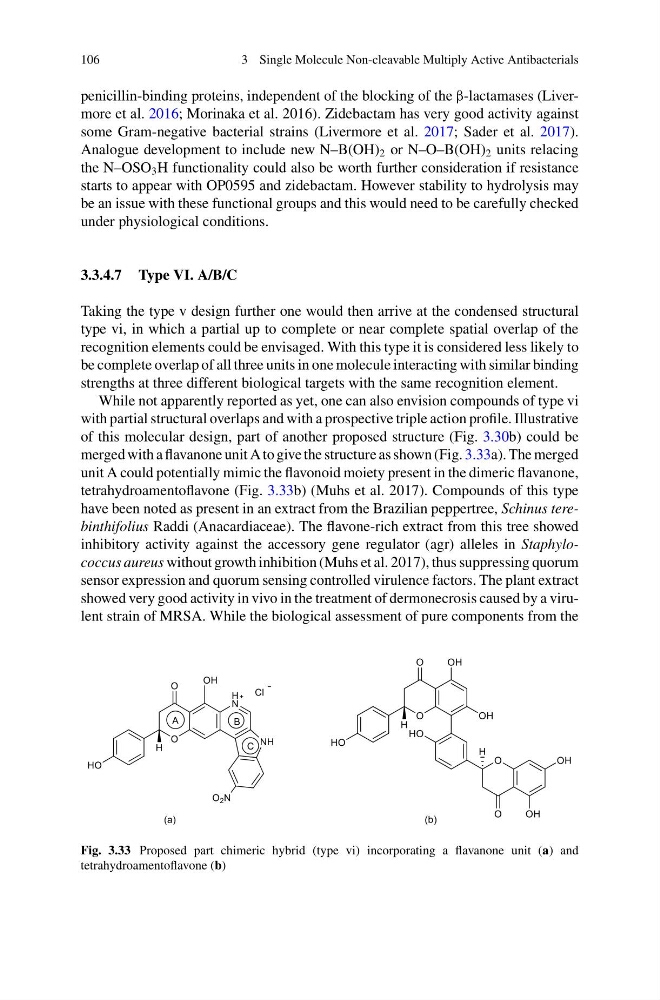
of this molecular design, part of another proposed structure (Fig. 3.30b) could be
merged with a flavanone unit A to give the structure as shown (Fig. 3.33a). The merged
unit A could potentially mimic the flavonoid moiety present in the dimeric flavanone,
tetrahydroamentoflavone (Fig. 3.33b) (Muhs et al. 2017). Compounds of this type
have been noted as present in an extract from the Brazilian peppertree, Schinus terebinthifolius Raddi (Anacardiaceae). The flavone-rich extract from this tree showed
inhibitory activity against the accessory gene regulator (agr) alleles in Staphylococcus aureus without growth inhibition (Muhs et al. 2017), thus suppressing quorum
sensor expression and quorum sensing controlled virulence factors. The plant extract
showed very good activity in vivo in the treatment of dermonecrosis caused by a virulent strain of MRSA. While the biological assessment of pure components from the
Fig. 3.33 Proposed part chimeric hybrid (type vi) incorporating a flavanone unit (a) and
tetrahydroamentoflavone (b)
3 Single Molecule Non-cleavable Multiply Active Antibacterials
penicillin-binding proteins, independent of the blocking of the β-lactamases (Livermore et al. 2016; Morinaka et al. 2016). Zidebactam has very good activity against
some Gram-negative bacterial strains (Livermore et al. 2017; Sader et al. 2017).
Analogue development to include new N–B(OH) 2 or N–O–B(OH) 2 units relacing
the N–OSO 3 H functionality could also be worth further consideration if resistance
starts to appear with OP0595 and zidebactam. However stability to hydrolysis may
be an issue with these functional groups and this would need to be carefully checked
under physiological conditions.
3.3.4.7 Type VI. A/B/C
Taking the type v design further one would then arrive at the condensed structural
type vi, in which a partial up to complete or near complete spatial overlap of the
recognition elements could be envisaged. With this type it is considered less likely to
be complete overlap of all three units in one molecule interacting with similar binding
strengths at three different biological targets with the same recognition element.
While not apparently reported as yet, one can also envision compounds of type vi
with partial structural overlaps and with a prospective triple action profile. Illustrative
of this molecular design, part of another proposed structure (Fig. 3.30b) could be
merged with a flavanone unit A to give the structure as shown (Fig. 3.33a). The merged
unit A could potentially mimic the flavonoid moiety present in the dimeric flavanone,
tetrahydroamentoflavone (Fig. 3.33b) (Muhs et al. 2017). Compounds of this type
have been noted as present in an extract from the Brazilian peppertree, Schinus terebinthifolius Raddi (Anacardiaceae). The flavone-rich extract from this tree showed
inhibitory activity against the accessory gene regulator (agr) alleles in Staphylococcus aureus without growth inhibition (Muhs et al. 2017), thus suppressing quorum
sensor expression and quorum sensing controlled virulence factors. The plant extract
showed very good activity in vivo in the treatment of dermonecrosis caused by a virulent strain of MRSA. While the biological assessment of pure components from the
Fig. 3.33 Proposed part chimeric hybrid (type vi) incorporating a flavanone unit (a) and
tetrahydroamentoflavone (b)