

3.3 Triple Action Antibacterial Hybrid Agents
103
The structurally different bacterial topoisomerase inhibitor REDX 06213
(Fig. 3.29b) can also be considered under this general structural type iii (Charrier
et al. 2017). This compound, along with others in this group, features an isoxazoloquinolone group at one end which interacts with DNA (A), a piperidine-based
linking group, and then a pyrido-oxazinone structural motif (B/C) at the other end
which binds to bacterial gyrase and to topoisomerase IV enzymes. REDX 06213
showed good antibacterial activity with MICs in the low micromolar range against
multi-drug resistant strains of the Gram-negatives Escherichia coli and Acinetobacter
baumannii and with a low likelihood for the development of resistance.
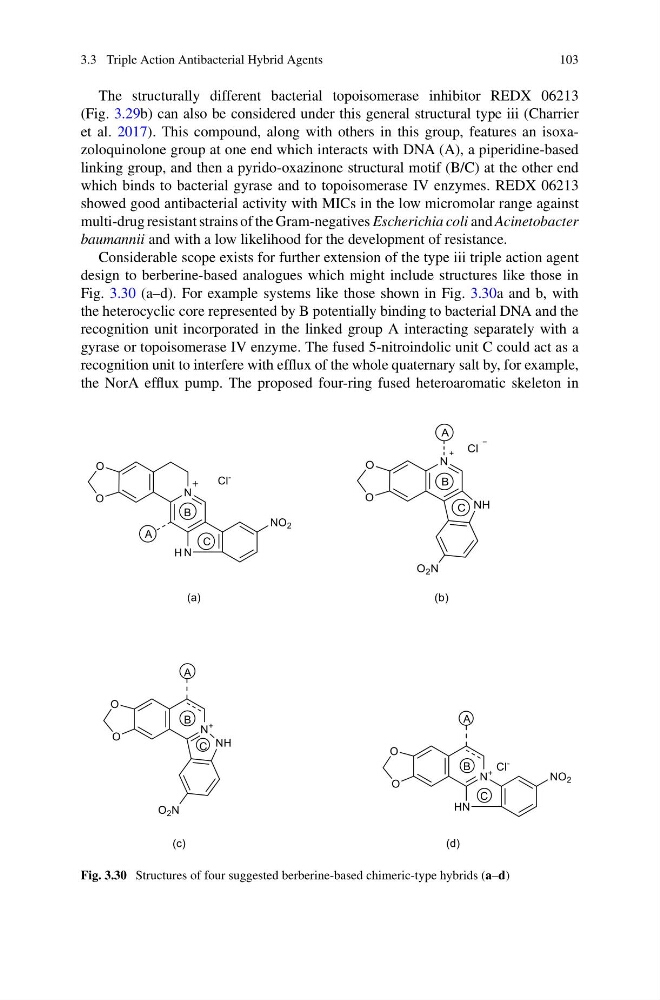
Considerable scope exists for further extension of the type iii triple action agent
design to berberine-based analogues which might include structures like those in
Fig. 3.30 (a–d). For example systems like those shown in Fig. 3.30a and b, with
the heterocyclic core represented by B potentially binding to bacterial DNA and the
recognition unit incorporated in the linked group A interacting separately with a
gyrase or topoisomerase IV enzyme. The fused 5-nitroindolic unit C could act as a
recognition unit to interfere with efflux of the whole quaternary salt by, for example,
the NorA efflux pump. The proposed four-ring fused heteroaromatic skeleton in
Fig. 3.30 Structures of four suggested berberine-based chimeric-type hybrids (a–d)
103
The structurally different bacterial topoisomerase inhibitor REDX 06213
(Fig. 3.29b) can also be considered under this general structural type iii (Charrier
et al. 2017). This compound, along with others in this group, features an isoxazoloquinolone group at one end which interacts with DNA (A), a piperidine-based
linking group, and then a pyrido-oxazinone structural motif (B/C) at the other end
which binds to bacterial gyrase and to topoisomerase IV enzymes. REDX 06213
showed good antibacterial activity with MICs in the low micromolar range against
multi-drug resistant strains of the Gram-negatives Escherichia coli and Acinetobacter
baumannii and with a low likelihood for the development of resistance.
Considerable scope exists for further extension of the type iii triple action agent
design to berberine-based analogues which might include structures like those in
Fig. 3.30 (a–d). For example systems like those shown in Fig. 3.30a and b, with
the heterocyclic core represented by B potentially binding to bacterial DNA and the
recognition unit incorporated in the linked group A interacting separately with a
gyrase or topoisomerase IV enzyme. The fused 5-nitroindolic unit C could act as a
recognition unit to interfere with efflux of the whole quaternary salt by, for example,
the NorA efflux pump. The proposed four-ring fused heteroaromatic skeleton in
Fig. 3.30 Structures of four suggested berberine-based chimeric-type hybrids (a–d)