

102
3 Single Molecule Non-cleavable Multiply Active Antibacterials
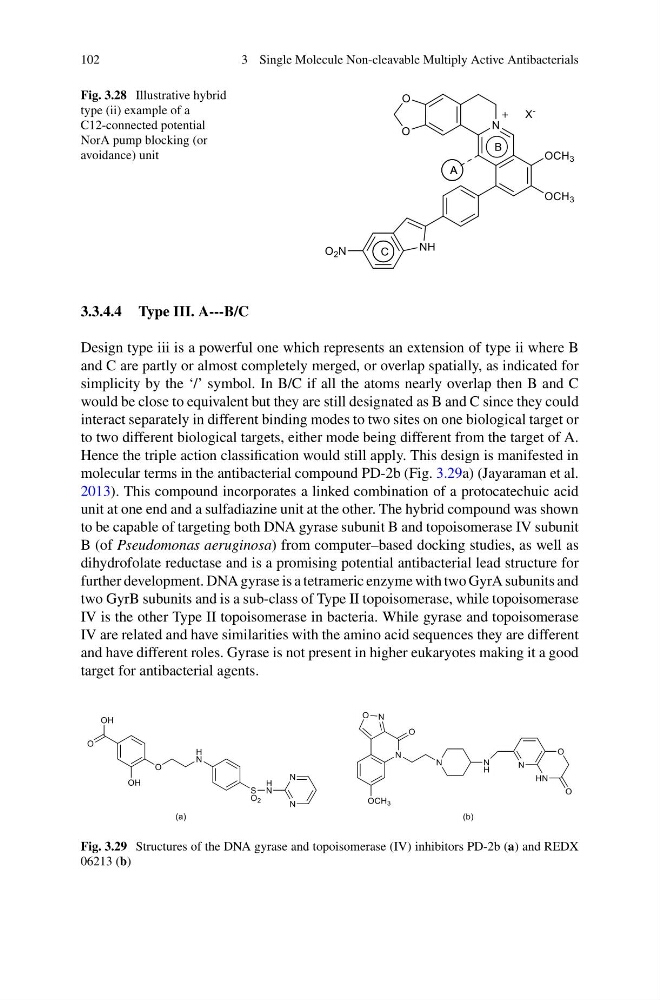
Fig. 3.28 Illustrative hybrid
type (ii) example of a
C12-connected potential
NorA pump blocking (or
avoidance) unit
3.3.4.4 Type III. A---B/C
Design type iii is a powerful one which represents an extension of type ii where B
and C are partly or almost completely merged, or overlap spatially, as indicated for
simplicity by the ‘/’ symbol. In B/C if all the atoms nearly overlap then B and C
would be close to equivalent but they are still designated as B and C since they could
interact separately in different binding modes to two sites on one biological target or
to two different biological targets, either mode being different from the target of A.
Hence the triple action classification would still apply. This design is manifested in
molecular terms in the antibacterial compound PD-2b (Fig. 3.29a) (Jayaraman et al.
2013). This compound incorporates a linked combination of a protocatechuic acid
unit at one end and a sulfadiazine unit at the other. The hybrid compound was shown
to be capable of targeting both DNA gyrase subunit B and topoisomerase IV subunit
B (of Pseudomonas aeruginosa) from computer–based docking studies, as well as
dihydrofolate reductase and is a promising potential antibacterial lead structure for
further development. DNA gyrase is a tetrameric enzyme with two GyrA subunits and
two GyrB subunits and is a sub-class of Type II topoisomerase, while topoisomerase
IV is the other Type II topoisomerase in bacteria. While gyrase and topoisomerase
IV are related and have similarities with the amino acid sequences they are different
and have different roles. Gyrase is not present in higher eukaryotes making it a good
target for antibacterial agents.
Fig. 3.29 Structures of the DNA gyrase and topoisomerase (IV) inhibitors PD-2b (a) and REDX
06213 (b)
3 Single Molecule Non-cleavable Multiply Active Antibacterials
Fig. 3.28 Illustrative hybrid
type (ii) example of a
C12-connected potential
NorA pump blocking (or
avoidance) unit
3.3.4.4 Type III. A---B/C
Design type iii is a powerful one which represents an extension of type ii where B
and C are partly or almost completely merged, or overlap spatially, as indicated for
simplicity by the ‘/’ symbol. In B/C if all the atoms nearly overlap then B and C
would be close to equivalent but they are still designated as B and C since they could
interact separately in different binding modes to two sites on one biological target or
to two different biological targets, either mode being different from the target of A.
Hence the triple action classification would still apply. This design is manifested in
molecular terms in the antibacterial compound PD-2b (Fig. 3.29a) (Jayaraman et al.
2013). This compound incorporates a linked combination of a protocatechuic acid
unit at one end and a sulfadiazine unit at the other. The hybrid compound was shown
to be capable of targeting both DNA gyrase subunit B and topoisomerase IV subunit
B (of Pseudomonas aeruginosa) from computer–based docking studies, as well as
dihydrofolate reductase and is a promising potential antibacterial lead structure for
further development. DNA gyrase is a tetrameric enzyme with two GyrA subunits and
two GyrB subunits and is a sub-class of Type II topoisomerase, while topoisomerase
IV is the other Type II topoisomerase in bacteria. While gyrase and topoisomerase
IV are related and have similarities with the amino acid sequences they are different
and have different roles. Gyrase is not present in higher eukaryotes making it a good
target for antibacterial agents.
Fig. 3.29 Structures of the DNA gyrase and topoisomerase (IV) inhibitors PD-2b (a) and REDX
06213 (b)