

3.3 Triple Action Antibacterial Hybrid Agents
101
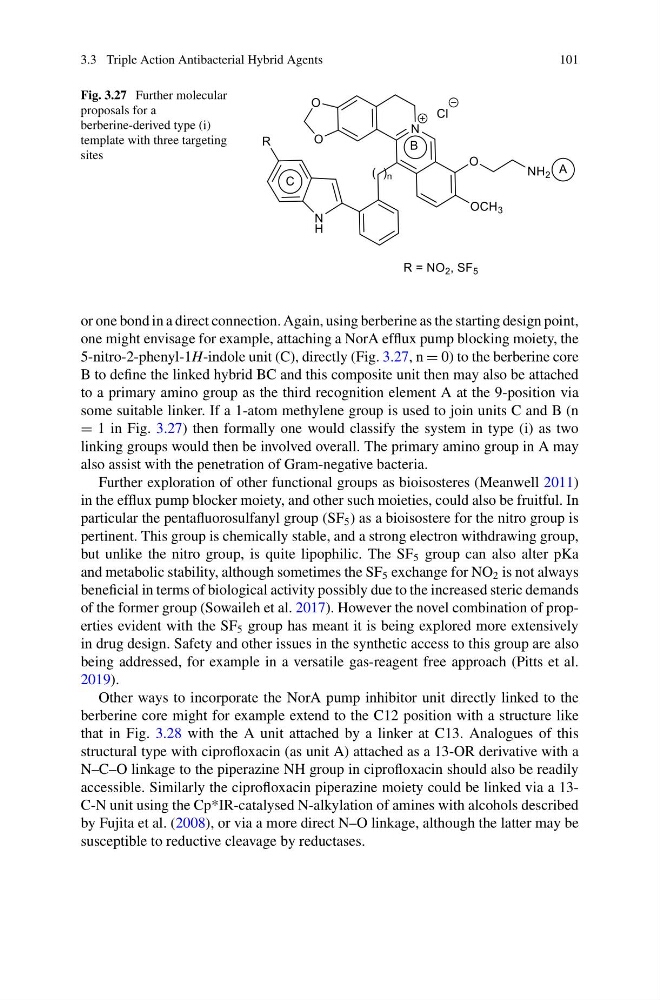
Fig. 3.27 Further molecular
proposals for a
berberine-derived type (i)
template with three targeting
sites
or one bond in a direct connection. Again, using berberine as the starting design point,
one might envisage for example, attaching a NorA efflux pump blocking moiety, the
5-nitro-2-phenyl-1H-indole unit (C), directly (Fig. 3.27, n = 0) to the berberine core
B to define the linked hybrid BC and this composite unit then may also be attached
to a primary amino group as the third recognition element A at the 9-position via
some suitable linker. If a 1-atom methylene group is used to join units C and B (n
= 1 in Fig. 3.27) then formally one would classify the system in type (i) as two
linking groups would then be involved overall. The primary amino group in A may
also assist with the penetration of Gram-negative bacteria.
Further exploration of other functional groups as bioisosteres (Meanwell 2011)
in the efflux pump blocker moiety, and other such moieties, could also be fruitful. In
particular the pentafluorosulfanyl group (SF 5 ) as a bioisostere for the nitro group is
pertinent. This group is chemically stable, and a strong electron withdrawing group,
but unlike the nitro group, is quite lipophilic. The SF 5 group can also alter pKa
and metabolic stability, although sometimes the SF 5 exchange for NO 2 is not always
beneficial in terms of biological activity possibly due to the increased steric demands
of the former group (Sowaileh et al. 2017). However the novel combination of properties evident with the SF 5 group has meant it is being explored more extensively
in drug design. Safety and other issues in the synthetic access to this group are also
being addressed, for example in a versatile gas-reagent free approach (Pitts et al.
2019).
Other ways to incorporate the NorA pump inhibitor unit directly linked to the
berberine core might for example extend to the C12 position with a structure like
that in Fig. 3.28 with the A unit attached by a linker at C13. Analogues of this
structural type with ciprofloxacin (as unit A) attached as a 13-OR derivative with a
N–C–O linkage to the piperazine NH group in ciprofloxacin should also be readily
accessible. Similarly the ciprofloxacin piperazine moiety could be linked via a 13C-N unit using the Cp*IR-catalysed N-alkylation of amines with alcohols described
by Fujita et al. (2008), or via a more direct N–O linkage, although the latter may be
susceptible to reductive cleavage by reductases.
101
Fig. 3.27 Further molecular
proposals for a
berberine-derived type (i)
template with three targeting
sites
or one bond in a direct connection. Again, using berberine as the starting design point,
one might envisage for example, attaching a NorA efflux pump blocking moiety, the
5-nitro-2-phenyl-1H-indole unit (C), directly (Fig. 3.27, n = 0) to the berberine core
B to define the linked hybrid BC and this composite unit then may also be attached
to a primary amino group as the third recognition element A at the 9-position via
some suitable linker. If a 1-atom methylene group is used to join units C and B (n
= 1 in Fig. 3.27) then formally one would classify the system in type (i) as two
linking groups would then be involved overall. The primary amino group in A may
also assist with the penetration of Gram-negative bacteria.
Further exploration of other functional groups as bioisosteres (Meanwell 2011)
in the efflux pump blocker moiety, and other such moieties, could also be fruitful. In
particular the pentafluorosulfanyl group (SF 5 ) as a bioisostere for the nitro group is
pertinent. This group is chemically stable, and a strong electron withdrawing group,
but unlike the nitro group, is quite lipophilic. The SF 5 group can also alter pKa
and metabolic stability, although sometimes the SF 5 exchange for NO 2 is not always
beneficial in terms of biological activity possibly due to the increased steric demands
of the former group (Sowaileh et al. 2017). However the novel combination of properties evident with the SF 5 group has meant it is being explored more extensively
in drug design. Safety and other issues in the synthetic access to this group are also
being addressed, for example in a versatile gas-reagent free approach (Pitts et al.
2019).
Other ways to incorporate the NorA pump inhibitor unit directly linked to the
berberine core might for example extend to the C12 position with a structure like
that in Fig. 3.28 with the A unit attached by a linker at C13. Analogues of this
structural type with ciprofloxacin (as unit A) attached as a 13-OR derivative with a
N–C–O linkage to the piperazine NH group in ciprofloxacin should also be readily
accessible. Similarly the ciprofloxacin piperazine moiety could be linked via a 13C-N unit using the Cp*IR-catalysed N-alkylation of amines with alcohols described
by Fujita et al. (2008), or via a more direct N–O linkage, although the latter may be
susceptible to reductive cleavage by reductases.