

3.3 Triple Action Antibacterial Hybrid Agents
99
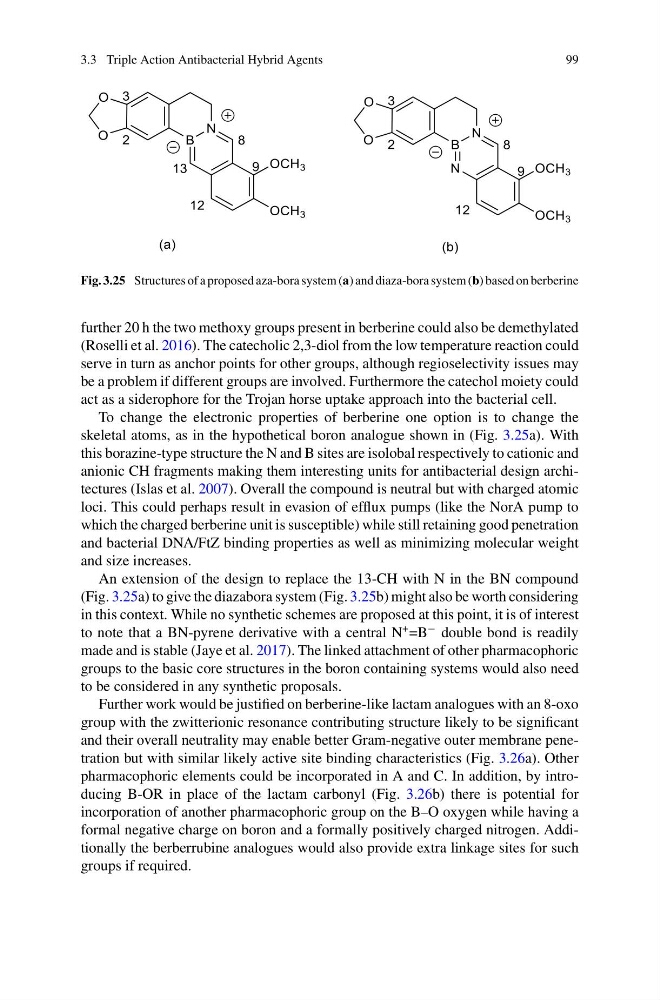
Fig. 3.25 Structures of a proposed aza-bora system (a) and diaza-bora system (b) based on berberine
further 20 h the two methoxy groups present in berberine could also be demethylated
(Roselli et al. 2016). The catecholic 2,3-diol from the low temperature reaction could
serve in turn as anchor points for other groups, although regioselectivity issues may
be a problem if different groups are involved. Furthermore the catechol moiety could
act as a siderophore for the Trojan horse uptake approach into the bacterial cell.
To change the electronic properties of berberine one option is to change the
skeletal atoms, as in the hypothetical boron analogue shown in (Fig. 3.25a). With
this borazine-type structure the N and B sites are isolobal respectively to cationic and
anionic CH fragments making them interesting units for antibacterial design architectures (Islas et al. 2007). Overall the compound is neutral but with charged atomic
loci. This could perhaps result in evasion of efflux pumps (like the NorA pump to
which the charged berberine unit is susceptible) while still retaining good penetration
and bacterial DNA/FtZ binding properties as well as minimizing molecular weight
and size increases.
An extension of the design to replace the 13-CH with N in the BN compound
(Fig. 3.25a) to give the diazabora system (Fig. 3.25b) might also be worth considering
in this context. While no synthetic schemes are proposed at this point, it is of interest
to note that a BN-pyrene derivative with a central N
+ =B
− double bond is readily
made and is stable (Jaye et al. 2017). The linked attachment of other pharmacophoric
groups to the basic core structures in the boron containing systems would also need
to be considered in any synthetic proposals.
Further work would be justified on berberine-like lactam analogues with an 8-oxo
group with the zwitterionic resonance contributing structure likely to be significant
and their overall neutrality may enable better Gram-negative outer membrane penetration but with similar likely active site binding characteristics (Fig. 3.26a). Other
pharmacophoric elements could be incorporated in A and C. In addition, by introducing B-OR in place of the lactam carbonyl (Fig. 3.26b) there is potential for
incorporation of another pharmacophoric group on the B–O oxygen while having a
formal negative charge on boron and a formally positively charged nitrogen. Additionally the berberrubine analogues would also provide extra linkage sites for such
groups if required.
99
Fig. 3.25 Structures of a proposed aza-bora system (a) and diaza-bora system (b) based on berberine
further 20 h the two methoxy groups present in berberine could also be demethylated
(Roselli et al. 2016). The catecholic 2,3-diol from the low temperature reaction could
serve in turn as anchor points for other groups, although regioselectivity issues may
be a problem if different groups are involved. Furthermore the catechol moiety could
act as a siderophore for the Trojan horse uptake approach into the bacterial cell.
To change the electronic properties of berberine one option is to change the
skeletal atoms, as in the hypothetical boron analogue shown in (Fig. 3.25a). With
this borazine-type structure the N and B sites are isolobal respectively to cationic and
anionic CH fragments making them interesting units for antibacterial design architectures (Islas et al. 2007). Overall the compound is neutral but with charged atomic
loci. This could perhaps result in evasion of efflux pumps (like the NorA pump to
which the charged berberine unit is susceptible) while still retaining good penetration
and bacterial DNA/FtZ binding properties as well as minimizing molecular weight
and size increases.
An extension of the design to replace the 13-CH with N in the BN compound
(Fig. 3.25a) to give the diazabora system (Fig. 3.25b) might also be worth considering
in this context. While no synthetic schemes are proposed at this point, it is of interest
to note that a BN-pyrene derivative with a central N
+ =B
− double bond is readily
made and is stable (Jaye et al. 2017). The linked attachment of other pharmacophoric
groups to the basic core structures in the boron containing systems would also need
to be considered in any synthetic proposals.
Further work would be justified on berberine-like lactam analogues with an 8-oxo
group with the zwitterionic resonance contributing structure likely to be significant
and their overall neutrality may enable better Gram-negative outer membrane penetration but with similar likely active site binding characteristics (Fig. 3.26a). Other
pharmacophoric elements could be incorporated in A and C. In addition, by introducing B-OR in place of the lactam carbonyl (Fig. 3.26b) there is potential for
incorporation of another pharmacophoric group on the B–O oxygen while having a
formal negative charge on boron and a formally positively charged nitrogen. Additionally the berberrubine analogues would also provide extra linkage sites for such
groups if required.