

2.3.1 Advanced and Model-Based Control Strategies
Advanced and model-based control strategies (AMBC) like NMPC are of great
interest in the case of processes with fast dynamics because these controllers reduce
the response time [34]. They do not operate just based on the current state of the
system, instead, the control action is based on the calculated evolution of the system.
AMBCs utilise integrated mathematical process models for the prediction of future
process behaviour. At the end of each sampling period, the future course of the
control trajectory is optimised using a process model [34]. The control trajectory that
fulfils the chosen optimisation criterion best is then applied to the real process [34].
The use of AMBC has already been investigated for different bioprocesses in
several research works. For fermentations of S. cerevisiae NMPC was used to
maximise the ethanol (EtOH) yield by controlling the glucose solution feed rate
[42]. For the fed-batch cultivation of Chinese hamster ovary (CHO) mammalian
cells, a glucose concentration fixed setpoint control was implemented and tuned to
enhance product quality and reduce costs [43]. To enhance the sugar concentration
in a cellulose hydrolysation process in a stirred tank reactor, NMPC was applied to
control the feed rates of substrate and cellulase enzymes solutions [50]. Furthermore,
temperature and humidity gradients of solid-state fermentation were controlled by
NMPC [51].
In all listed research works the use of AMBC resulted in higher product concentrations at lower resource demands as compared to processes with conventional
control strategies.
2.3.2 Open-Loop-Feedback-Optimal (OLFO) Control Strategy
A special form of AMBC is the open-loop-feedback-optimal (OLFO) strategy
[52, 53]. The OLFO controller belongs to the class of adaptive NMPCs. It consists
of a process model, a model parameter identification part, and an optimisation part
(see Fig. 1). Model parameters are estimated frequently based on available online
and/or offline data. The updated model parameters are passed on to the optimisation
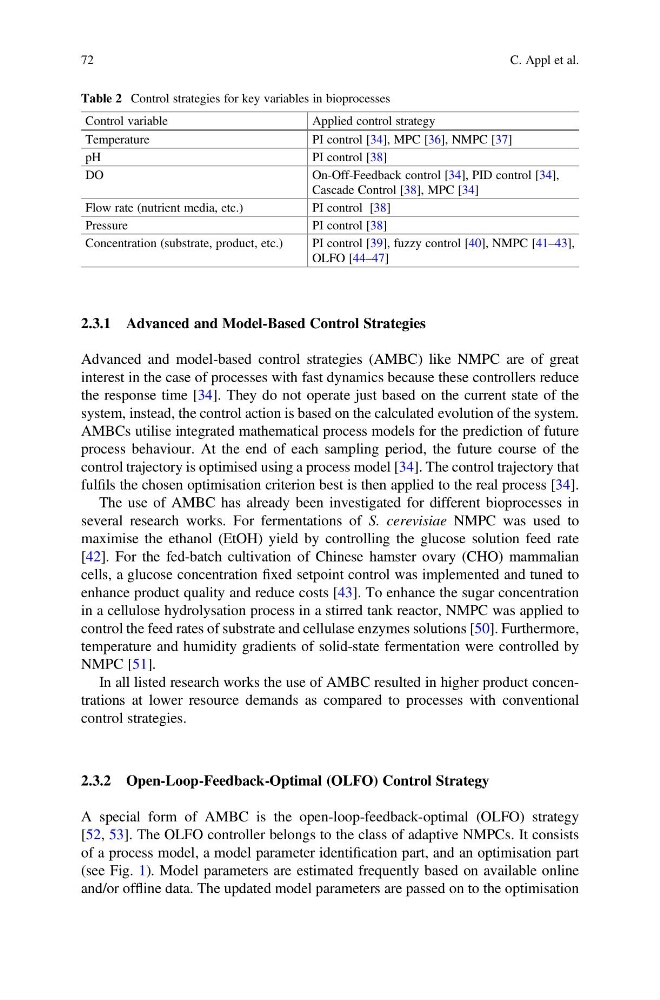
Table 2 Control strategies for key variables in bioprocesses
Control variable
Applied control strategy
Temperature
PI control [34], MPC [36], NMPC [37]
pH
PI control [38]
DO
On-Off-Feedback control [34], PID control [34],
Cascade Control [38], MPC [34]
Flow rate (nutrient media, etc.)
PI control [38]
Pressure
PI control [38]
Concentration (substrate, product, etc.)
PI control [39], fuzzy control [40], NMPC [41–43],
OLFO [44–47]
72
C. Appl et al.
Advanced and model-based control strategies (AMBC) like NMPC are of great
interest in the case of processes with fast dynamics because these controllers reduce
the response time [34]. They do not operate just based on the current state of the
system, instead, the control action is based on the calculated evolution of the system.
AMBCs utilise integrated mathematical process models for the prediction of future
process behaviour. At the end of each sampling period, the future course of the
control trajectory is optimised using a process model [34]. The control trajectory that
fulfils the chosen optimisation criterion best is then applied to the real process [34].
The use of AMBC has already been investigated for different bioprocesses in
several research works. For fermentations of S. cerevisiae NMPC was used to
maximise the ethanol (EtOH) yield by controlling the glucose solution feed rate
[42]. For the fed-batch cultivation of Chinese hamster ovary (CHO) mammalian
cells, a glucose concentration fixed setpoint control was implemented and tuned to
enhance product quality and reduce costs [43]. To enhance the sugar concentration
in a cellulose hydrolysation process in a stirred tank reactor, NMPC was applied to
control the feed rates of substrate and cellulase enzymes solutions [50]. Furthermore,
temperature and humidity gradients of solid-state fermentation were controlled by
NMPC [51].
In all listed research works the use of AMBC resulted in higher product concentrations at lower resource demands as compared to processes with conventional
control strategies.
2.3.2 Open-Loop-Feedback-Optimal (OLFO) Control Strategy
A special form of AMBC is the open-loop-feedback-optimal (OLFO) strategy
[52, 53]. The OLFO controller belongs to the class of adaptive NMPCs. It consists
of a process model, a model parameter identification part, and an optimisation part
(see Fig. 1). Model parameters are estimated frequently based on available online
and/or offline data. The updated model parameters are passed on to the optimisation
Table 2 Control strategies for key variables in bioprocesses
Control variable
Applied control strategy
Temperature
PI control [34], MPC [36], NMPC [37]
pH
PI control [38]
DO
On-Off-Feedback control [34], PID control [34],
Cascade Control [38], MPC [34]
Flow rate (nutrient media, etc.)
PI control [38]
Pressure
PI control [38]
Concentration (substrate, product, etc.)
PI control [39], fuzzy control [40], NMPC [41–43],
OLFO [44–47]
72
C. Appl et al.