

disturbances. More complex processes, such as the enzymatic hydrolysis of lignocellulosic biomass, can be significantly improved by using advanced temperature
control. In this process, endoglucanase and exoglucanase are used, which show a
different temperature optimum. If model-based temperature control is applied in this
case, enzyme-specific temperature gradients can be operated, reducing the consumption of enzymes and significantly increasing the yield of the desired product [36].
Table 2 lists common control variables (e.g. temperature, pH value or dissolved
oxygen (DO)) of bioprocesses with their most used control strategies.
Simple control tasks can be treated using conventional controllers. For more
demanding control tasks, such as concentration control, the use of advanced and
model-based control strategies such as MPC or NMPC has been suggested [34, 35,
48, 49]. The choice of suitable control strategies is not only dependent on the
controlled variable. If, for example, DO control is considered, on-off feedback,
PID control or more complex model-based control like MPC is used depending on
the requirements. In the subsequent sections, some advanced control strategies will
be described that may be developed and tuned utilising Digital Twins.
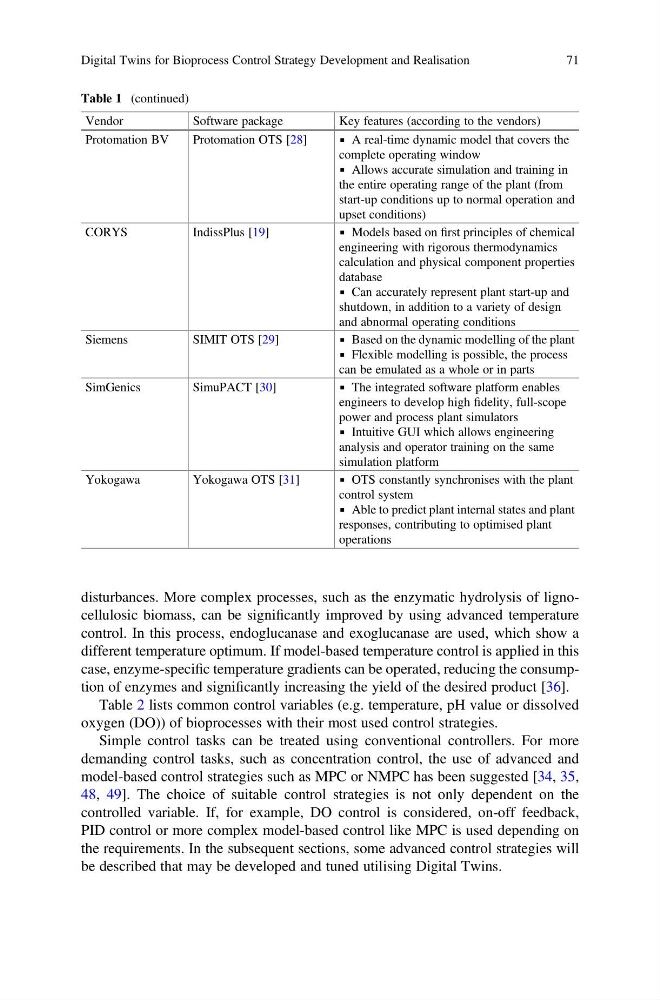
Table 1 (continued)
Vendor
Software package
Key features (according to the vendors)
Protomation BV
Protomation OTS [28]
▪ A real-time dynamic model that covers the
complete operating window
▪ Allows accurate simulation and training in
the entire operating range of the plant (from
start-up conditions up to normal operation and
upset conditions)
CORYS
IndissPlus [19]
▪ Models based on first principles of chemical
engineering with rigorous thermodynamics
calculation and physical component properties
database
▪ Can accurately represent plant start-up and
shutdown, in addition to a variety of design
and abnormal operating conditions
Siemens
SIMIT OTS [29]
▪ Based on the dynamic modelling of the plant
▪ Flexible modelling is possible, the process
can be emulated as a whole or in parts
SimGenics
SimuPACT [30]
▪ The integrated software platform enables
engineers to develop high fidelity, full-scope
power and process plant simulators
▪ Intuitive GUI which allows engineering
analysis and operator training on the same
simulation platform
Yokogawa
Yokogawa OTS [31]
▪ OTS constantly synchronises with the plant
control system
▪ Able to predict plant internal states and plant
responses, contributing to optimised plant
operations
Digital Twins for Bioprocess Control Strategy Development and Realisation
71
control. In this process, endoglucanase and exoglucanase are used, which show a
different temperature optimum. If model-based temperature control is applied in this
case, enzyme-specific temperature gradients can be operated, reducing the consumption of enzymes and significantly increasing the yield of the desired product [36].
Table 2 lists common control variables (e.g. temperature, pH value or dissolved
oxygen (DO)) of bioprocesses with their most used control strategies.
Simple control tasks can be treated using conventional controllers. For more
demanding control tasks, such as concentration control, the use of advanced and
model-based control strategies such as MPC or NMPC has been suggested [34, 35,
48, 49]. The choice of suitable control strategies is not only dependent on the
controlled variable. If, for example, DO control is considered, on-off feedback,
PID control or more complex model-based control like MPC is used depending on
the requirements. In the subsequent sections, some advanced control strategies will
be described that may be developed and tuned utilising Digital Twins.
Table 1 (continued)
Vendor
Software package
Key features (according to the vendors)
Protomation BV
Protomation OTS [28]
▪ A real-time dynamic model that covers the
complete operating window
▪ Allows accurate simulation and training in
the entire operating range of the plant (from
start-up conditions up to normal operation and
upset conditions)
CORYS
IndissPlus [19]
▪ Models based on first principles of chemical
engineering with rigorous thermodynamics
calculation and physical component properties
database
▪ Can accurately represent plant start-up and
shutdown, in addition to a variety of design
and abnormal operating conditions
Siemens
SIMIT OTS [29]
▪ Based on the dynamic modelling of the plant
▪ Flexible modelling is possible, the process
can be emulated as a whole or in parts
SimGenics
SimuPACT [30]
▪ The integrated software platform enables
engineers to develop high fidelity, full-scope
power and process plant simulators
▪ Intuitive GUI which allows engineering
analysis and operator training on the same
simulation platform
Yokogawa
Yokogawa OTS [31]
▪ OTS constantly synchronises with the plant
control system
▪ Able to predict plant internal states and plant
responses, contributing to optimised plant
operations
Digital Twins for Bioprocess Control Strategy Development and Realisation
71