

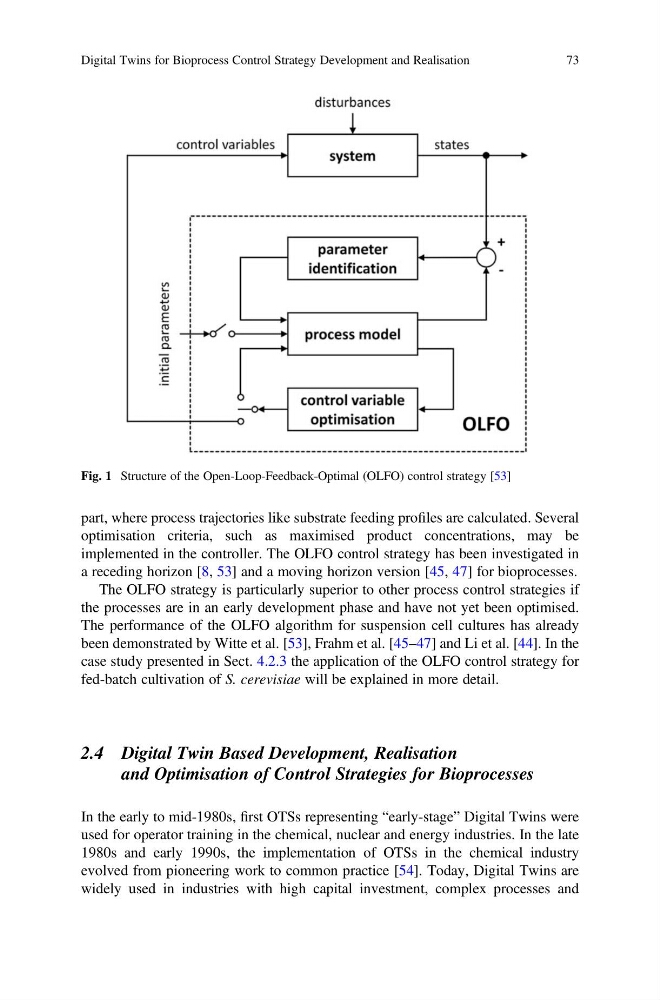
part, where process trajectories like substrate feeding profiles are calculated. Several
optimisation criteria, such as maximised product concentrations, may be
implemented in the controller. The OLFO control strategy has been investigated in
a receding horizon [8, 53] and a moving horizon version [45, 47] for bioprocesses.
The OLFO strategy is particularly superior to other process control strategies if
the processes are in an early development phase and have not yet been optimised.
The performance of the OLFO algorithm for suspension cell cultures has already
been demonstrated by Witte et al. [53], Frahm et al. [45–47] and Li et al. [44]. In the
case study presented in Sect. 4.2.3 the application of the OLFO control strategy for
fed-batch cultivation of S. cerevisiae will be explained in more detail.
2.4 Digital Twin Based Development, Realisation
and Optimisation of Control Strategies for Bioprocesses
In the early to mid-1980s, first OTSs representing “early-stage” Digital Twins were
used for operator training in the chemical, nuclear and energy industries. In the late
1980s and early 1990s, the implementation of OTSs in the chemical industry
evolved from pioneering work to common practice [54]. Today, Digital Twins are
widely used in industries with high capital investment, complex processes and
Fig. 1 Structure of the Open-Loop-Feedback-Optimal (OLFO) control strategy [53]
Digital Twins for Bioprocess Control Strategy Development and Realisation
73
optimisation criteria, such as maximised product concentrations, may be
implemented in the controller. The OLFO control strategy has been investigated in
a receding horizon [8, 53] and a moving horizon version [45, 47] for bioprocesses.
The OLFO strategy is particularly superior to other process control strategies if
the processes are in an early development phase and have not yet been optimised.
The performance of the OLFO algorithm for suspension cell cultures has already
been demonstrated by Witte et al. [53], Frahm et al. [45–47] and Li et al. [44]. In the
case study presented in Sect. 4.2.3 the application of the OLFO control strategy for
fed-batch cultivation of S. cerevisiae will be explained in more detail.
2.4 Digital Twin Based Development, Realisation
and Optimisation of Control Strategies for Bioprocesses
In the early to mid-1980s, first OTSs representing “early-stage” Digital Twins were
used for operator training in the chemical, nuclear and energy industries. In the late
1980s and early 1990s, the implementation of OTSs in the chemical industry
evolved from pioneering work to common practice [54]. Today, Digital Twins are
widely used in industries with high capital investment, complex processes and
Fig. 1 Structure of the Open-Loop-Feedback-Optimal (OLFO) control strategy [53]
Digital Twins for Bioprocess Control Strategy Development and Realisation
73