

3.3 Lagrangian Setup
To introduce the Lagrangian phase, we should indicate the interactions between the
particles (here cells) and the background flow, first. A powerful tool is the Stokes
number (4) which gives indication of how particles follow the stream lines. It
basically indicates how fast a particle can adapt the changes in flow velocities.
Stokes number is the ratio of particle relaxation time (τ p ) to fluid flow timescale
(τ fluid ) decided by agitation rate N in a stirred tank (5). Even by speculating orders of
magnitude for particle diameter (d p ), liquid viscosity (μ) and particle density order of
magnitude for particle relaxation time can be reasonably predicted (6). In case of
microbes in stirred tanks, St << 1 which means that cells can be approximated with
massless particles which follow the streamline. A consequence of weightlessness is
that randomness generated from turbulence will be undermined. Hence, superimposition by the onset of random walk option should be enabled.
St ¼
τ p
τ fluid
ð4Þ
τ fluid ¼ 1 = N
ð5Þ
τ p ¼
ρ p d
2
p
18μ liquid
ð6Þ
So far, those settings could be fixed using the already implemented tunings of the
software. However, fine tuning of the modeling tasks usually requires further inputs
such as specification of microbial kinetics and particle tracking via so-called user• Overflow metabolism
• Substrate limitaƟon
• StarvaƟon
• Full respiration
• Partial respiration
• No respiration
3m
7.7m
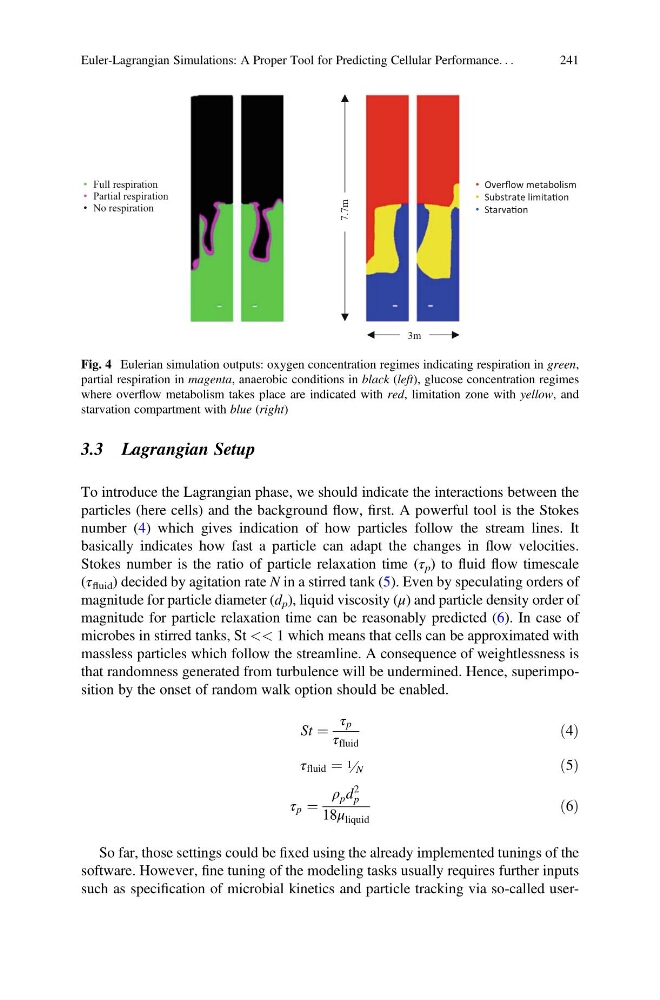
Fig. 4 Eulerian simulation outputs: oxygen concentration regimes indicating respiration in green,
partial respiration in magenta, anaerobic conditions in black (left), glucose concentration regimes
where overflow metabolism takes place are indicated with red, limitation zone with yellow, and
starvation compartment with blue (right)
Euler-Lagrangian Simulations: A Proper Tool for Predicting Cellular Performance. . .
241
To introduce the Lagrangian phase, we should indicate the interactions between the
particles (here cells) and the background flow, first. A powerful tool is the Stokes
number (4) which gives indication of how particles follow the stream lines. It
basically indicates how fast a particle can adapt the changes in flow velocities.
Stokes number is the ratio of particle relaxation time (τ p ) to fluid flow timescale
(τ fluid ) decided by agitation rate N in a stirred tank (5). Even by speculating orders of
magnitude for particle diameter (d p ), liquid viscosity (μ) and particle density order of
magnitude for particle relaxation time can be reasonably predicted (6). In case of
microbes in stirred tanks, St << 1 which means that cells can be approximated with
massless particles which follow the streamline. A consequence of weightlessness is
that randomness generated from turbulence will be undermined. Hence, superimposition by the onset of random walk option should be enabled.
St ¼
τ p
τ fluid
ð4Þ
τ fluid ¼ 1 = N
ð5Þ
τ p ¼
ρ p d
2
p
18μ liquid
ð6Þ
So far, those settings could be fixed using the already implemented tunings of the
software. However, fine tuning of the modeling tasks usually requires further inputs
such as specification of microbial kinetics and particle tracking via so-called user• Overflow metabolism
• Substrate limitaƟon
• StarvaƟon
• Full respiration
• Partial respiration
• No respiration
3m
7.7m
Fig. 4 Eulerian simulation outputs: oxygen concentration regimes indicating respiration in green,
partial respiration in magenta, anaerobic conditions in black (left), glucose concentration regimes
where overflow metabolism takes place are indicated with red, limitation zone with yellow, and
starvation compartment with blue (right)
Euler-Lagrangian Simulations: A Proper Tool for Predicting Cellular Performance. . .
241