

To take drag force into account, the so-called Grace model [52] is employed
which tends to give a mathematically stable solution by offering physically acceptable gas flow regimes.
For grid independence, three different meshed geometries with 500,000,
1,000,000, and 1,500,000 were compared based on the differences in turbulent
parameters k and ε (data not shown here). The procedure includes parameter
evaluation nearby the impeller, a location of outmost importance in stirred bioreactors. If the difference of aforementioned values is less than an acceptable
threshold (in our case 5%), the simulation is considered acceptably grid independent.
Because of the complex and transient flow fields reaching the usual thresholds of
maximum residuals, <10
À6 is not possible without refining computational time steps
for a few orders of magnitude. The latter increases computational times almost
proportionally. Usually, as done here, pseudo-steady states are defined when solutions converge below the given threshold and residuals of continuity fluctuate within
10
À3
–10
À4
. To keep the setup simple, a moving reference frame (MRF) is employed
to set the agitation rate at 150 rpm.
3.2 Eulerian Simulation Outputs
Considering three probes (bottom, middle, top), for example, mixing times are
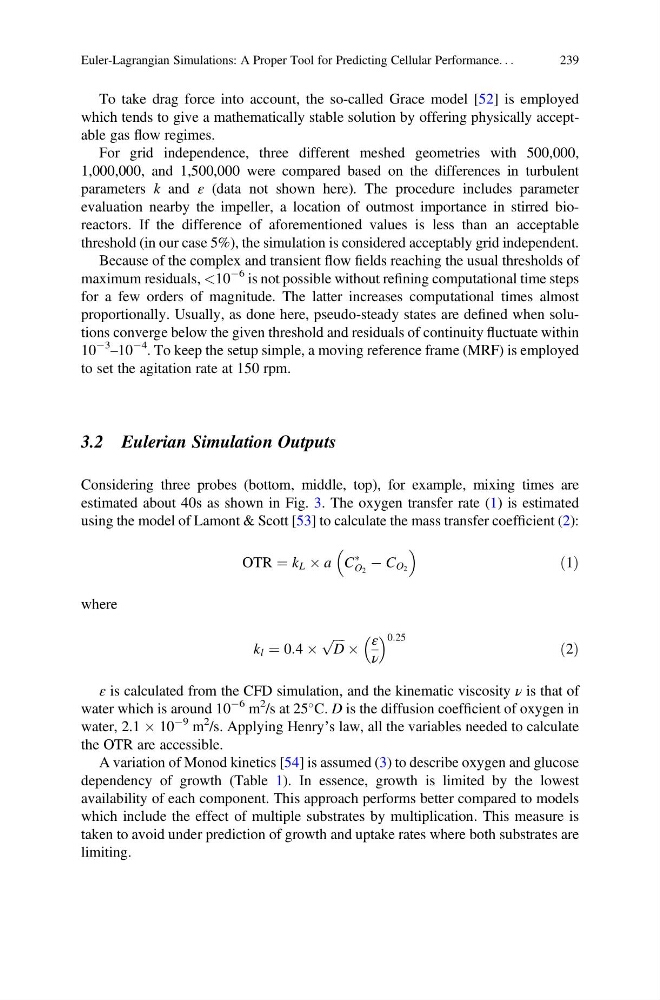
estimated about 40s as shown in Fig. 3. The oxygen transfer rate (1) is estimated
using the model of Lamont & Scott [53] to calculate the mass transfer coefficient (2):
OTR ¼ k L Â a C
Ã
O 2
À C O 2
ð1Þ
where
k l ¼ 0:4 Â
ffiffiffi ffi
D
p Â
ε
ν
0:25
ð2Þ
ε is calculated from the CFD simulation, and the kinematic viscosity ν is that of
water which is around 10
À6 m
2
/s at 25
C. D is the diffusion coefficient of oxygen in
water, 2.1 Â 10
À9 m
2 /s. Applying Henry’s law, all the variables needed to calculate
the OTR are accessible.
A variation of Monod kinetics [54] is assumed (3) to describe oxygen and glucose
dependency of growth (Table 1). In essence, growth is limited by the lowest
availability of each component. This approach performs better compared to models
which include the effect of multiple substrates by multiplication. This measure is
taken to avoid under prediction of growth and uptake rates where both substrates are
limiting.
Euler-Lagrangian Simulations: A Proper Tool for Predicting Cellular Performance. . .
239
which tends to give a mathematically stable solution by offering physically acceptable gas flow regimes.
For grid independence, three different meshed geometries with 500,000,
1,000,000, and 1,500,000 were compared based on the differences in turbulent
parameters k and ε (data not shown here). The procedure includes parameter
evaluation nearby the impeller, a location of outmost importance in stirred bioreactors. If the difference of aforementioned values is less than an acceptable
threshold (in our case 5%), the simulation is considered acceptably grid independent.
Because of the complex and transient flow fields reaching the usual thresholds of
maximum residuals, <10
À6 is not possible without refining computational time steps
for a few orders of magnitude. The latter increases computational times almost
proportionally. Usually, as done here, pseudo-steady states are defined when solutions converge below the given threshold and residuals of continuity fluctuate within
10
À3
–10
À4
. To keep the setup simple, a moving reference frame (MRF) is employed
to set the agitation rate at 150 rpm.
3.2 Eulerian Simulation Outputs
Considering three probes (bottom, middle, top), for example, mixing times are
estimated about 40s as shown in Fig. 3. The oxygen transfer rate (1) is estimated
using the model of Lamont & Scott [53] to calculate the mass transfer coefficient (2):
OTR ¼ k L Â a C
Ã
O 2
À C O 2
ð1Þ
where
k l ¼ 0:4 Â
ffiffiffi ffi
D
p Â
ε
ν
0:25
ð2Þ
ε is calculated from the CFD simulation, and the kinematic viscosity ν is that of
water which is around 10
À6 m
2
/s at 25
C. D is the diffusion coefficient of oxygen in
water, 2.1 Â 10
À9 m
2 /s. Applying Henry’s law, all the variables needed to calculate
the OTR are accessible.
A variation of Monod kinetics [54] is assumed (3) to describe oxygen and glucose
dependency of growth (Table 1). In essence, growth is limited by the lowest
availability of each component. This approach performs better compared to models
which include the effect of multiple substrates by multiplication. This measure is
taken to avoid under prediction of growth and uptake rates where both substrates are
limiting.
Euler-Lagrangian Simulations: A Proper Tool for Predicting Cellular Performance. . .
239