

may yield to describe finest details which not only cause highest computational
effort but also highest likeliness of numerical instabilities and inaccuracies. On the
other hand, less complication equals less computational resources required.
Real applications always have to decide between those extremes finding the
proper compromise for the given problem. Examples of such simulations are abundant in the literature and will not be further discussed here [2, 13, 15, 25, 46, 50, 51].
To realize the importance of this approach, we find it beneficial for the readers to
get familiar with the procedures of the method. Gradients are one of the most
significant aspects of large-scale fermentations. In first part the Eulerian gradients
are resolved and then the fate of the cells within these gradients is investigated.
3.1 Eulerian Simulation Setup
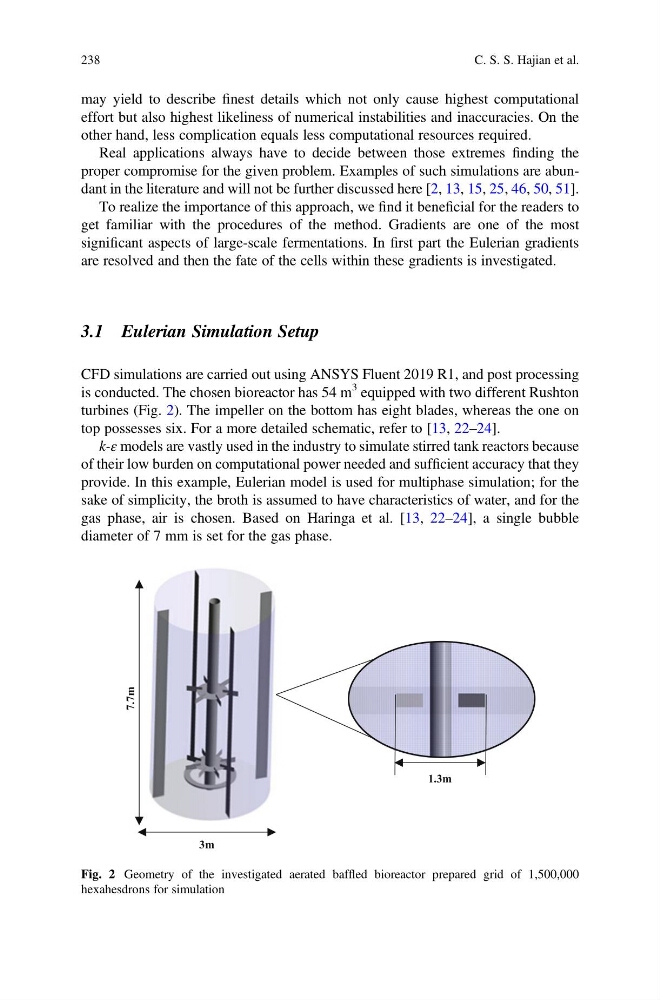
CFD simulations are carried out using ANSYS Fluent 2019 R1, and post processing
is conducted. The chosen bioreactor has 54 m
3 equipped with two different Rushton
turbines (Fig. 2). The impeller on the bottom has eight blades, whereas the one on
top possesses six. For a more detailed schematic, refer to [13, 22–24].
k-ε models are vastly used in the industry to simulate stirred tank reactors because
of their low burden on computational power needed and sufficient accuracy that they
provide. In this example, Eulerian model is used for multiphase simulation; for the
sake of simplicity, the broth is assumed to have characteristics of water, and for the
gas phase, air is chosen. Based on Haringa et al. [13, 22–24], a single bubble
diameter of 7 mm is set for the gas phase.
1.3m
3m
7.7m
Fig. 2 Geometry of the investigated aerated baffled bioreactor prepared grid of 1,500,000
hexahesdrons for simulation
238
C. S. S. Hajian et al.
effort but also highest likeliness of numerical instabilities and inaccuracies. On the
other hand, less complication equals less computational resources required.
Real applications always have to decide between those extremes finding the
proper compromise for the given problem. Examples of such simulations are abundant in the literature and will not be further discussed here [2, 13, 15, 25, 46, 50, 51].
To realize the importance of this approach, we find it beneficial for the readers to
get familiar with the procedures of the method. Gradients are one of the most
significant aspects of large-scale fermentations. In first part the Eulerian gradients
are resolved and then the fate of the cells within these gradients is investigated.
3.1 Eulerian Simulation Setup
CFD simulations are carried out using ANSYS Fluent 2019 R1, and post processing
is conducted. The chosen bioreactor has 54 m
3 equipped with two different Rushton
turbines (Fig. 2). The impeller on the bottom has eight blades, whereas the one on
top possesses six. For a more detailed schematic, refer to [13, 22–24].
k-ε models are vastly used in the industry to simulate stirred tank reactors because
of their low burden on computational power needed and sufficient accuracy that they
provide. In this example, Eulerian model is used for multiphase simulation; for the
sake of simplicity, the broth is assumed to have characteristics of water, and for the
gas phase, air is chosen. Based on Haringa et al. [13, 22–24], a single bubble
diameter of 7 mm is set for the gas phase.
1.3m
3m
7.7m
Fig. 2 Geometry of the investigated aerated baffled bioreactor prepared grid of 1,500,000
hexahesdrons for simulation
238
C. S. S. Hajian et al.