

model, information on individual particles and their circulation and residence times
in different high shear zones cannot be obtained.
Microcarrier Tracking Based on a Euler-Lagrange Approach
Euler-Lagrange simulations allow the spatial distribution of discrete MC particles to
be derived. Based on this information, the circulation time (t cir. ), the residence time
(t res. ), and the hydrodynamic stresses acting on the particles can be calculated. Data
from such an Euler-Lagrange simulation is shown representatively in the following
figure for the SP100. Figure 10a, b shows an example of the fluctuating forces acting
on individual MCs during impeller motion. It is obvious that the acting forces
fluctuated in the order of 100. Thus, each particle has its own history in terms of
hydrodynamic stress, which means that some particles are exposed to a certain
hydrodynamic stress level longer and/or more often than others. Compared to the
Euler-Euler granular approach, which allows volume-weighted data to be derived,
the Euler-Lagrange approach gives a discrete description per MC.
The particle data can further be processed to derive the force distribution for
specific locations or to calculate the circulation and residence times. For this
purpose, the two spinner flask types were vertically divided into four zones (Δh/
H L % 0.25). Figure 11 exemplifies the SP100, showing the force distribution in the
four defined spinner segments. It is obvious that logarithmic normal distributions
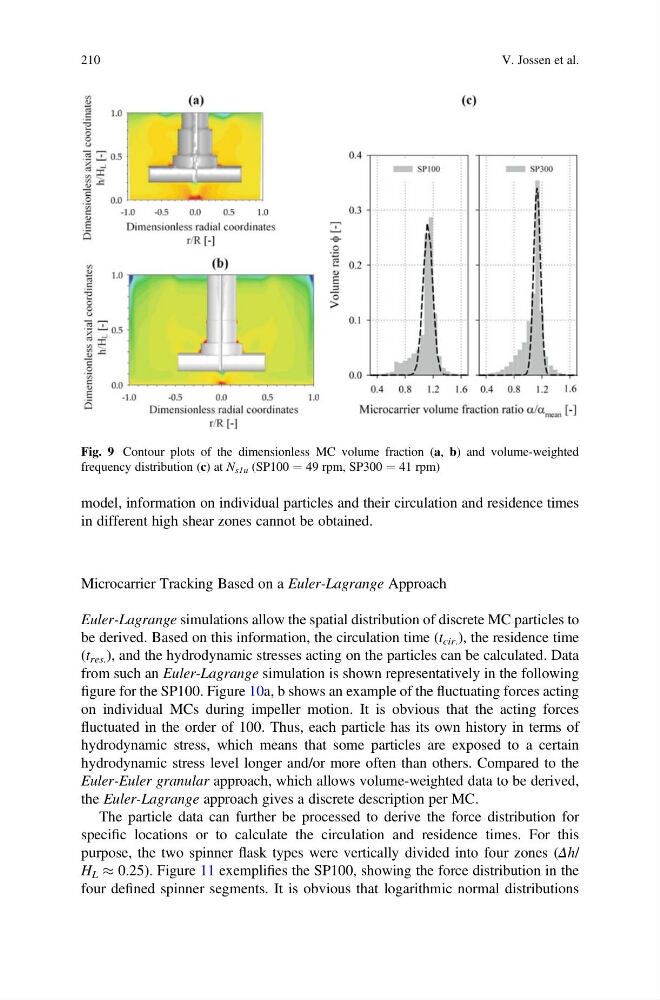
Fig. 9 Contour plots of the dimensionless MC volume fraction (a, b) and volume-weighted
frequency distribution (c) at N s1u (SP100 ¼ 49 rpm, SP300 ¼ 41 rpm)
210
V. Jossen et al.
in different high shear zones cannot be obtained.
Microcarrier Tracking Based on a Euler-Lagrange Approach
Euler-Lagrange simulations allow the spatial distribution of discrete MC particles to
be derived. Based on this information, the circulation time (t cir. ), the residence time
(t res. ), and the hydrodynamic stresses acting on the particles can be calculated. Data
from such an Euler-Lagrange simulation is shown representatively in the following
figure for the SP100. Figure 10a, b shows an example of the fluctuating forces acting
on individual MCs during impeller motion. It is obvious that the acting forces
fluctuated in the order of 100. Thus, each particle has its own history in terms of
hydrodynamic stress, which means that some particles are exposed to a certain
hydrodynamic stress level longer and/or more often than others. Compared to the
Euler-Euler granular approach, which allows volume-weighted data to be derived,
the Euler-Lagrange approach gives a discrete description per MC.
The particle data can further be processed to derive the force distribution for
specific locations or to calculate the circulation and residence times. For this
purpose, the two spinner flask types were vertically divided into four zones (Δh/
H L % 0.25). Figure 11 exemplifies the SP100, showing the force distribution in the
four defined spinner segments. It is obvious that logarithmic normal distributions
Fig. 9 Contour plots of the dimensionless MC volume fraction (a, b) and volume-weighted
frequency distribution (c) at N s1u (SP100 ¼ 49 rpm, SP300 ¼ 41 rpm)
210
V. Jossen et al.