

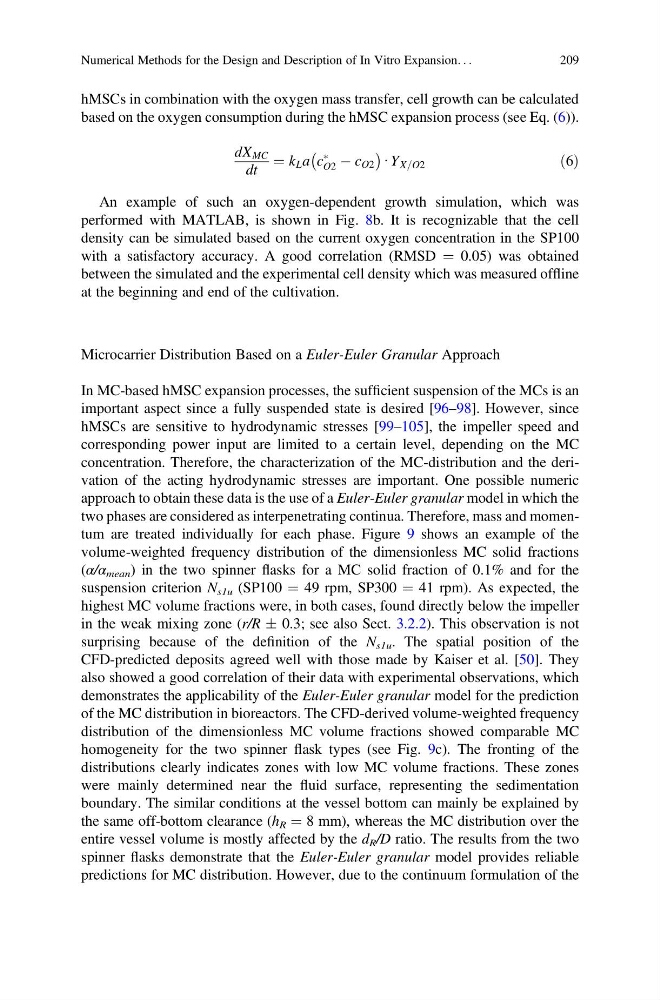
hMSCs in combination with the oxygen mass transfer, cell growth can be calculated
based on the oxygen consumption during the hMSC expansion process (see Eq. (6)).
dX MC
dt
¼ k L a c
Ã
O2 À c O2
À
Á ∙ Y X=O2
ð6Þ
An example of such an oxygen-dependent growth simulation, which was
performed with MATLAB, is shown in Fig. 8b. It is recognizable that the cell
density can be simulated based on the current oxygen concentration in the SP100
with a satisfactory accuracy. A good correlation (RMSD ¼ 0.05) was obtained
between the simulated and the experimental cell density which was measured offline
at the beginning and end of the cultivation.
Microcarrier Distribution Based on a Euler-Euler Granular Approach
In MC-based hMSC expansion processes, the sufficient suspension of the MCs is an
important aspect since a fully suspended state is desired [96–98]. However, since
hMSCs are sensitive to hydrodynamic stresses [99–105], the impeller speed and
corresponding power input are limited to a certain level, depending on the MC
concentration. Therefore, the characterization of the MC-distribution and the derivation of the acting hydrodynamic stresses are important. One possible numeric
approach to obtain these data is the use of a Euler-Euler granular model in which the
two phases are considered as interpenetrating continua. Therefore, mass and momentum are treated individually for each phase. Figure 9 shows an example of the
volume-weighted frequency distribution of the dimensionless MC solid fractions
(α/α mean ) in the two spinner flasks for a MC solid fraction of 0.1% and for the
suspension criterion N s1u (SP100 ¼ 49 rpm, SP300 ¼ 41 rpm). As expected, the
highest MC volume fractions were, in both cases, found directly below the impeller
in the weak mixing zone (r/R Æ 0.3; see also Sect. 3.2.2). This observation is not
surprising because of the definition of the N s1u . The spatial position of the
CFD-predicted deposits agreed well with those made by Kaiser et al. [50]. They
also showed a good correlation of their data with experimental observations, which
demonstrates the applicability of the Euler-Euler granular model for the prediction
of the MC distribution in bioreactors. The CFD-derived volume-weighted frequency
distribution of the dimensionless MC volume fractions showed comparable MC
homogeneity for the two spinner flask types (see Fig. 9c). The fronting of the
distributions clearly indicates zones with low MC volume fractions. These zones
were mainly determined near the fluid surface, representing the sedimentation
boundary. The similar conditions at the vessel bottom can mainly be explained by
the same off-bottom clearance (h R ¼ 8 mm), whereas the MC distribution over the
entire vessel volume is mostly affected by the d R /D ratio. The results from the two
spinner flasks demonstrate that the Euler-Euler granular model provides reliable
predictions for MC distribution. However, due to the continuum formulation of the
Numerical Methods for the Design and Description of In Vitro Expansion. . .
209
based on the oxygen consumption during the hMSC expansion process (see Eq. (6)).
dX MC
dt
¼ k L a c
Ã
O2 À c O2
À
Á ∙ Y X=O2
ð6Þ
An example of such an oxygen-dependent growth simulation, which was
performed with MATLAB, is shown in Fig. 8b. It is recognizable that the cell
density can be simulated based on the current oxygen concentration in the SP100
with a satisfactory accuracy. A good correlation (RMSD ¼ 0.05) was obtained
between the simulated and the experimental cell density which was measured offline
at the beginning and end of the cultivation.
Microcarrier Distribution Based on a Euler-Euler Granular Approach
In MC-based hMSC expansion processes, the sufficient suspension of the MCs is an
important aspect since a fully suspended state is desired [96–98]. However, since
hMSCs are sensitive to hydrodynamic stresses [99–105], the impeller speed and
corresponding power input are limited to a certain level, depending on the MC
concentration. Therefore, the characterization of the MC-distribution and the derivation of the acting hydrodynamic stresses are important. One possible numeric
approach to obtain these data is the use of a Euler-Euler granular model in which the
two phases are considered as interpenetrating continua. Therefore, mass and momentum are treated individually for each phase. Figure 9 shows an example of the
volume-weighted frequency distribution of the dimensionless MC solid fractions
(α/α mean ) in the two spinner flasks for a MC solid fraction of 0.1% and for the
suspension criterion N s1u (SP100 ¼ 49 rpm, SP300 ¼ 41 rpm). As expected, the
highest MC volume fractions were, in both cases, found directly below the impeller
in the weak mixing zone (r/R Æ 0.3; see also Sect. 3.2.2). This observation is not
surprising because of the definition of the N s1u . The spatial position of the
CFD-predicted deposits agreed well with those made by Kaiser et al. [50]. They
also showed a good correlation of their data with experimental observations, which
demonstrates the applicability of the Euler-Euler granular model for the prediction
of the MC distribution in bioreactors. The CFD-derived volume-weighted frequency
distribution of the dimensionless MC volume fractions showed comparable MC
homogeneity for the two spinner flask types (see Fig. 9c). The fronting of the
distributions clearly indicates zones with low MC volume fractions. These zones
were mainly determined near the fluid surface, representing the sedimentation
boundary. The similar conditions at the vessel bottom can mainly be explained by
the same off-bottom clearance (h R ¼ 8 mm), whereas the MC distribution over the
entire vessel volume is mostly affected by the d R /D ratio. The results from the two
spinner flasks demonstrate that the Euler-Euler granular model provides reliable
predictions for MC distribution. However, due to the continuum formulation of the
Numerical Methods for the Design and Description of In Vitro Expansion. . .
209