

– Scope of the DTMS: Is it designed for internal purposes only, or will it also
involve the production processes of other companies in a business-to-business
solution (B2B)?
– What companies, associations, and authorities will take part in it?
– Who is involved in the production process in the company internally (e.g., quality
manager, operators, and logistics manager)?
– Is a business-to-customer (B2C) solution considered?
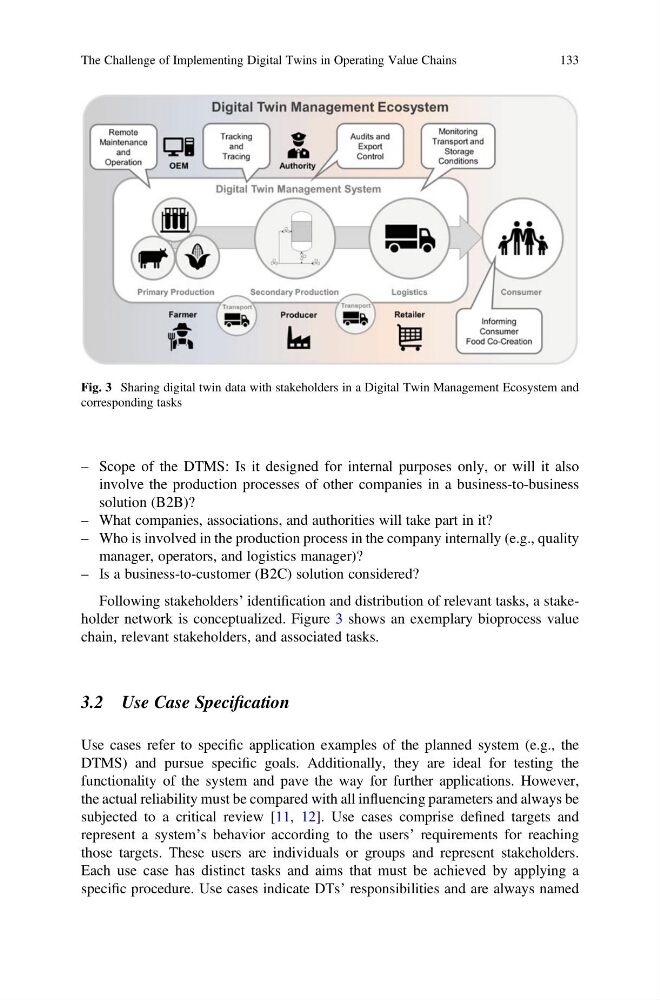
Following stakeholders’ identification and distribution of relevant tasks, a stakeholder network is conceptualized. Figure 3 shows an exemplary bioprocess value
chain, relevant stakeholders, and associated tasks.
3.2 Use Case Specification
Use cases refer to specific application examples of the planned system (e.g., the
DTMS) and pursue specific goals. Additionally, they are ideal for testing the
functionality of the system and pave the way for further applications. However,
the actual reliability must be compared with all influencing parameters and always be
subjected to a critical review [11, 12]. Use cases comprise defined targets and
represent a system’s behavior according to the users’ requirements for reaching
those targets. These users are individuals or groups and represent stakeholders.
Each use case has distinct tasks and aims that must be achieved by applying a
specific procedure. Use cases indicate DTs’ responsibilities and are always named
Fig. 3 Sharing digital twin data with stakeholders in a Digital Twin Management Ecosystem and
corresponding tasks
The Challenge of Implementing Digital Twins in Operating Value Chains
133
involve the production processes of other companies in a business-to-business
solution (B2B)?
– What companies, associations, and authorities will take part in it?
– Who is involved in the production process in the company internally (e.g., quality
manager, operators, and logistics manager)?
– Is a business-to-customer (B2C) solution considered?
Following stakeholders’ identification and distribution of relevant tasks, a stakeholder network is conceptualized. Figure 3 shows an exemplary bioprocess value
chain, relevant stakeholders, and associated tasks.
3.2 Use Case Specification
Use cases refer to specific application examples of the planned system (e.g., the
DTMS) and pursue specific goals. Additionally, they are ideal for testing the
functionality of the system and pave the way for further applications. However,
the actual reliability must be compared with all influencing parameters and always be
subjected to a critical review [11, 12]. Use cases comprise defined targets and
represent a system’s behavior according to the users’ requirements for reaching
those targets. These users are individuals or groups and represent stakeholders.
Each use case has distinct tasks and aims that must be achieved by applying a
specific procedure. Use cases indicate DTs’ responsibilities and are always named
Fig. 3 Sharing digital twin data with stakeholders in a Digital Twin Management Ecosystem and
corresponding tasks
The Challenge of Implementing Digital Twins in Operating Value Chains
133