

identifying the desired data points in the production process, and leading to overall
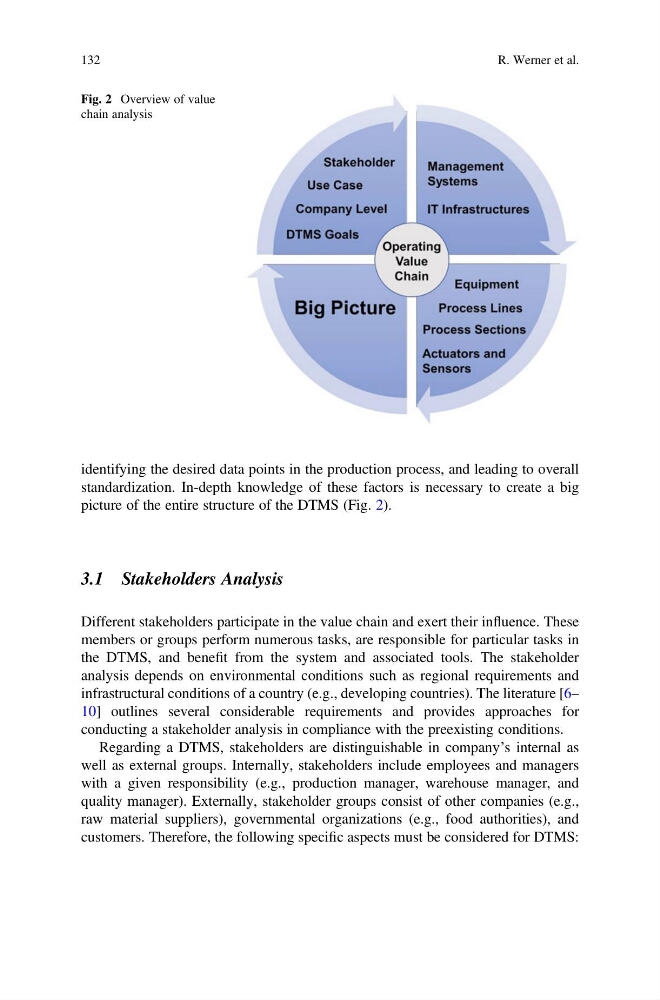
standardization. In-depth knowledge of these factors is necessary to create a big
picture of the entire structure of the DTMS (Fig. 2).
3.1 Stakeholders Analysis
Different stakeholders participate in the value chain and exert their influence. These
members or groups perform numerous tasks, are responsible for particular tasks in
the DTMS, and benefit from the system and associated tools. The stakeholder
analysis depends on environmental conditions such as regional requirements and
infrastructural conditions of a country (e.g., developing countries). The literature [6–
10] outlines several considerable requirements and provides approaches for
conducting a stakeholder analysis in compliance with the preexisting conditions.
Regarding a DTMS, stakeholders are distinguishable in company’s internal as
well as external groups. Internally, stakeholders include employees and managers
with a given responsibility (e.g., production manager, warehouse manager, and
quality manager). Externally, stakeholder groups consist of other companies (e.g.,
raw material suppliers), governmental organizations (e.g., food authorities), and
customers. Therefore, the following specific aspects must be considered for DTMS:
Fig. 2 Overview of value
chain analysis
132
R. Werner et al.
standardization. In-depth knowledge of these factors is necessary to create a big
picture of the entire structure of the DTMS (Fig. 2).
3.1 Stakeholders Analysis
Different stakeholders participate in the value chain and exert their influence. These
members or groups perform numerous tasks, are responsible for particular tasks in
the DTMS, and benefit from the system and associated tools. The stakeholder
analysis depends on environmental conditions such as regional requirements and
infrastructural conditions of a country (e.g., developing countries). The literature [6–
10] outlines several considerable requirements and provides approaches for
conducting a stakeholder analysis in compliance with the preexisting conditions.
Regarding a DTMS, stakeholders are distinguishable in company’s internal as
well as external groups. Internally, stakeholders include employees and managers
with a given responsibility (e.g., production manager, warehouse manager, and
quality manager). Externally, stakeholder groups consist of other companies (e.g.,
raw material suppliers), governmental organizations (e.g., food authorities), and
customers. Therefore, the following specific aspects must be considered for DTMS:
Fig. 2 Overview of value
chain analysis
132
R. Werner et al.