

according to their primary goals. Concerning whole value chains, the product
trackability would be a model use case for implementing DTs. Besides, use cases
illustrate all likely scenarios when a stakeholder acts using the respective system.
Use cases for DT-based application scenarios are described for the current
situation (“As-Is”) or for the future (“To-Be”) and are designed with static (e.g.,
network diagrams) or dynamic (e.g., workflows) representations. They provide the
basis for deriving requirements and the subsequent solution design (software
development).
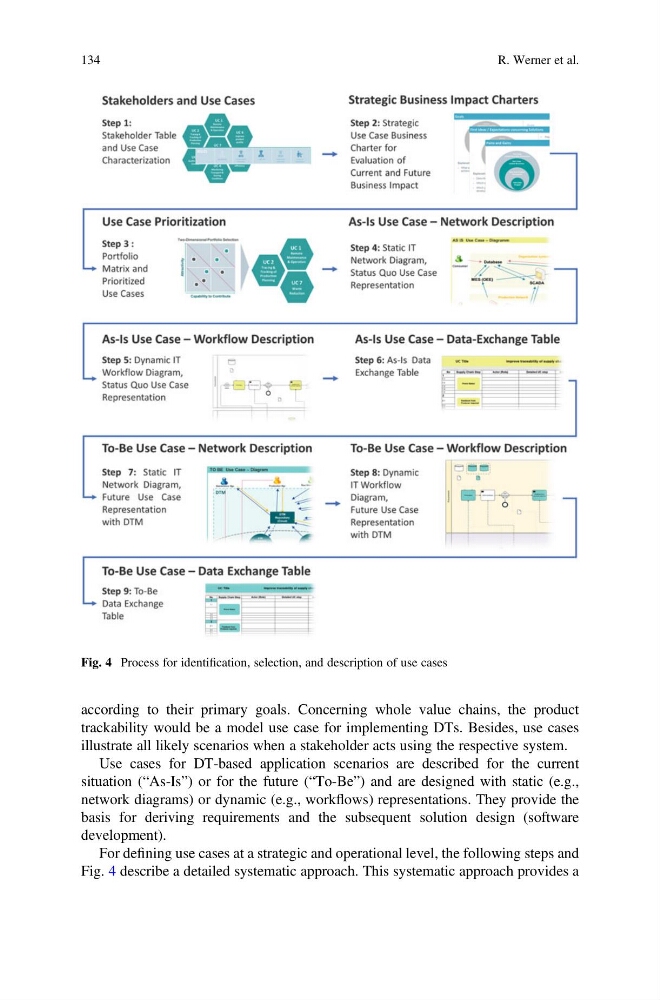
For defining use cases at a strategic and operational level, the following steps and
Fig. 4 describe a detailed systematic approach. This systematic approach provides a
Fig. 4 Process for identification, selection, and description of use cases
134
R. Werner et al.
trackability would be a model use case for implementing DTs. Besides, use cases
illustrate all likely scenarios when a stakeholder acts using the respective system.
Use cases for DT-based application scenarios are described for the current
situation (“As-Is”) or for the future (“To-Be”) and are designed with static (e.g.,
network diagrams) or dynamic (e.g., workflows) representations. They provide the
basis for deriving requirements and the subsequent solution design (software
development).
For defining use cases at a strategic and operational level, the following steps and
Fig. 4 describe a detailed systematic approach. This systematic approach provides a
Fig. 4 Process for identification, selection, and description of use cases
134
R. Werner et al.