

4.2 Bateman Electromagnetic Waves
79
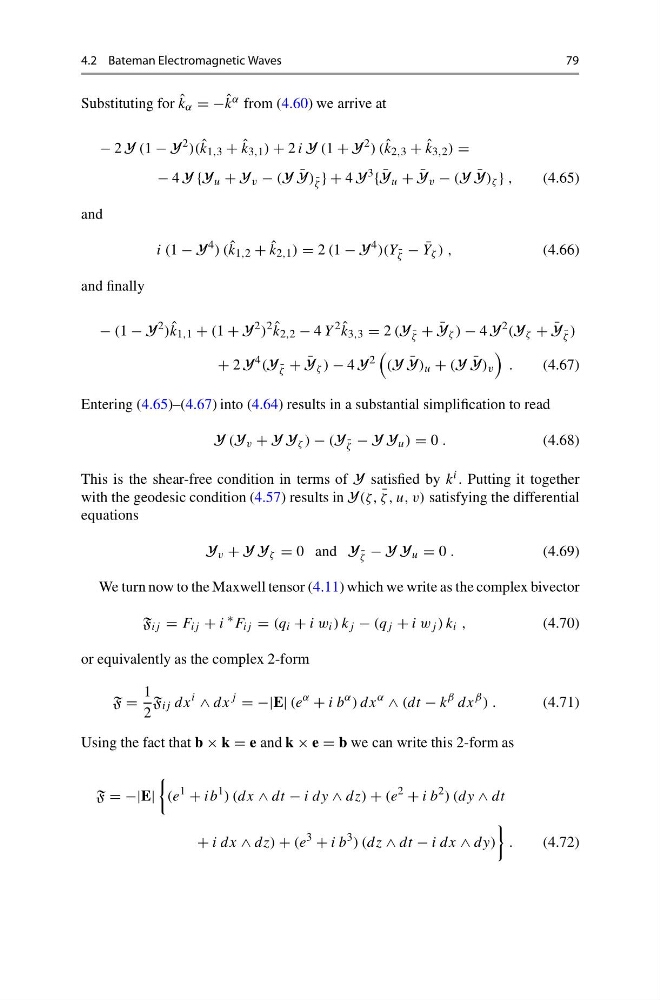
Substituting for ˆ
k α = − ˆ
k α from (4.60) we arrive at
− 2 Y (1 − Y
2 )( ˆ
k 1,3 + ˆ
k 3,1 ) + 2 i Y (1 + Y
2 ) ( ˆ
k 2,3 + ˆ
k 3,2 ) =
− 4 Y {Y u + Y v − (Y ¯
Y) ¯
ζ } + 4 Y
3
{ ¯
Y u + ¯
Y v − (Y ¯
Y) ζ } ,
(4.65)
and
i (1 − Y
4 ) ( ˆ
k 1,2 + ˆ
k 2,1 ) = 2 (1 − Y
4 )(Y ¯
ζ − ¯
Y ζ ) ,
(4.66)
and finally
− (1 − Y
2 ) ˆ
k 1,1 + (1 + Y
2 )
2 ˆ
k 2,2 − 4 Y
2 ˆ
k 3,3 = 2 (Y ¯
ζ + ¯
Y ζ ) − 4 Y
2 (Y ζ + ¯
Y ¯
ζ )
+ 2 Y
4 (Y ¯
ζ + ¯
Y ζ ) − 4 Y
2
(Y ¯
Y) u + (Y ¯
Y) v
.
(4.67)
Entering (4.65)–(4.67) into (4.64) results in a substantial simplification to read
Y (Y v + Y Y ζ ) − (Y ¯
ζ − Y Y u ) = 0 .
(4.68)
This is the shear-free condition in terms of Y satisfied by k i . Putting it together
with the geodesic condition (4.57) results in Y(ζ, ¯
ζ , u, v) satisfying the differential
equations
Y v + Y Y ζ = 0 and Y ¯
ζ − Y Y u = 0 .
(4.69)
We turn now to the Maxwell tensor (4.11) which we write as the complex bivector
F ij = F ij + i
∗ F ij = (q i + i w i ) k j − (q j + i w j ) k i ,
(4.70)
or equivalently as the complex 2-form
F =
1
2
F ij dx
i
∧ dx
j
= −|E| (e
α
+ i b
α ) dx
α
∧ (dt − k
β dx
β ) .
(4.71)
Using the fact that b × k = e and k × e = b we can write this 2-form as
F = −|E|
(e
1
+ ib
1 ) (dx ∧ dt − i dy ∧ dz) + (e
2
+ i b
2 ) (dy ∧ dt
+ i dx ∧ dz) + (e
3
+ i b
3 ) (dz ∧ dt − i dx ∧ dy)
.
(4.72)
79
Substituting for ˆ
k α = − ˆ
k α from (4.60) we arrive at
− 2 Y (1 − Y
2 )( ˆ
k 1,3 + ˆ
k 3,1 ) + 2 i Y (1 + Y
2 ) ( ˆ
k 2,3 + ˆ
k 3,2 ) =
− 4 Y {Y u + Y v − (Y ¯
Y) ¯
ζ } + 4 Y
3
{ ¯
Y u + ¯
Y v − (Y ¯
Y) ζ } ,
(4.65)
and
i (1 − Y
4 ) ( ˆ
k 1,2 + ˆ
k 2,1 ) = 2 (1 − Y
4 )(Y ¯
ζ − ¯
Y ζ ) ,
(4.66)
and finally
− (1 − Y
2 ) ˆ
k 1,1 + (1 + Y
2 )
2 ˆ
k 2,2 − 4 Y
2 ˆ
k 3,3 = 2 (Y ¯
ζ + ¯
Y ζ ) − 4 Y
2 (Y ζ + ¯
Y ¯
ζ )
+ 2 Y
4 (Y ¯
ζ + ¯
Y ζ ) − 4 Y
2
(Y ¯
Y) u + (Y ¯
Y) v
.
(4.67)
Entering (4.65)–(4.67) into (4.64) results in a substantial simplification to read
Y (Y v + Y Y ζ ) − (Y ¯
ζ − Y Y u ) = 0 .
(4.68)
This is the shear-free condition in terms of Y satisfied by k i . Putting it together
with the geodesic condition (4.57) results in Y(ζ, ¯
ζ , u, v) satisfying the differential
equations
Y v + Y Y ζ = 0 and Y ¯
ζ − Y Y u = 0 .
(4.69)
We turn now to the Maxwell tensor (4.11) which we write as the complex bivector
F ij = F ij + i
∗ F ij = (q i + i w i ) k j − (q j + i w j ) k i ,
(4.70)
or equivalently as the complex 2-form
F =
1
2
F ij dx
i
∧ dx
j
= −|E| (e
α
+ i b
α ) dx
α
∧ (dt − k
β dx
β ) .
(4.71)
Using the fact that b × k = e and k × e = b we can write this 2-form as
F = −|E|
(e
1
+ ib
1 ) (dx ∧ dt − i dy ∧ dz) + (e
2
+ i b
2 ) (dy ∧ dt
+ i dx ∧ dz) + (e
3
+ i b
3 ) (dz ∧ dt − i dx ∧ dy)
.
(4.72)