

80
4 Bateman Waves
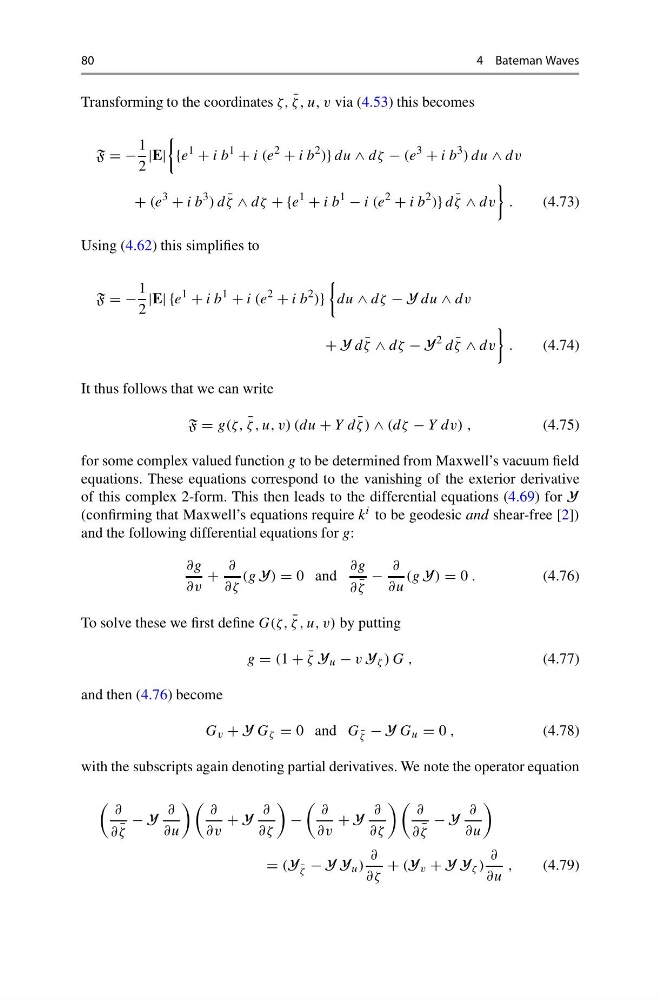
Transforming to the coordinates ζ, ¯
ζ , u, v via (4.53) this becomes
F = −
1
2
|E|
{e
1
+ i b
1
+ i (e
2
+ i b
2 )} du ∧ dζ − (e
3
+ i b
3 ) du ∧ dv
+ (e
3
+ i b
3 ) d ¯
ζ ∧ dζ + {e
1
+ i b
1
− i (e
2
+ i b
2 )} d ¯
ζ ∧ dv
.
(4.73)
Using (4.62) this simplifies to
F = −
1
2
|E| {e
1
+ i b
1
+ i (e
2
+ i b
2 )}
du ∧ dζ − Y du ∧ dv
+ Y d ¯
ζ ∧ dζ − Y
2 d ¯
ζ ∧ dv
.
(4.74)
It thus follows that we can write
F = g(ζ, ¯
ζ , u, v) (du + Y d ¯
ζ ) ∧ (dζ − Y dv) ,
(4.75)
for some complex valued function g to be determined from Maxwell’s vacuum field
equations. These equations correspond to the vanishing of the exterior derivative
of this complex 2-form. This then leads to the differential equations (4.69) for Y
(confirming that Maxwell’s equations require k i to be geodesic and shear-free [2])
and the following differential equations for g:
∂g
∂v
+
∂
∂ζ
(g Y) = 0 and
∂g
∂ ¯
ζ
−
∂
∂u
(g Y) = 0 .
(4.76)
To solve these we first define G(ζ, ¯
ζ , u, v) by putting
g = (1 + ¯
ζ Y u − v Y ζ ) G ,
(4.77)
and then (4.76) become
G v + Y G ζ = 0 and G ¯
ζ − Y G u = 0 ,
(4.78)
with the subscripts again denoting partial derivatives. We note the operator equation
∂
∂ ¯
ζ
− Y
∂
∂u
∂
∂v
+ Y
∂
∂ζ
−
∂
∂v
+ Y
∂
∂ζ
∂
∂ ¯
ζ
− Y
∂
∂u
= (Y ¯
ζ − Y Y u )
∂
∂ζ
+ (Y v + Y Y ζ )
∂
∂u
,
(4.79)
4 Bateman Waves
Transforming to the coordinates ζ, ¯
ζ , u, v via (4.53) this becomes
F = −
1
2
|E|
{e
1
+ i b
1
+ i (e
2
+ i b
2 )} du ∧ dζ − (e
3
+ i b
3 ) du ∧ dv
+ (e
3
+ i b
3 ) d ¯
ζ ∧ dζ + {e
1
+ i b
1
− i (e
2
+ i b
2 )} d ¯
ζ ∧ dv
.
(4.73)
Using (4.62) this simplifies to
F = −
1
2
|E| {e
1
+ i b
1
+ i (e
2
+ i b
2 )}
du ∧ dζ − Y du ∧ dv
+ Y d ¯
ζ ∧ dζ − Y
2 d ¯
ζ ∧ dv
.
(4.74)
It thus follows that we can write
F = g(ζ, ¯
ζ , u, v) (du + Y d ¯
ζ ) ∧ (dζ − Y dv) ,
(4.75)
for some complex valued function g to be determined from Maxwell’s vacuum field
equations. These equations correspond to the vanishing of the exterior derivative
of this complex 2-form. This then leads to the differential equations (4.69) for Y
(confirming that Maxwell’s equations require k i to be geodesic and shear-free [2])
and the following differential equations for g:
∂g
∂v
+
∂
∂ζ
(g Y) = 0 and
∂g
∂ ¯
ζ
−
∂
∂u
(g Y) = 0 .
(4.76)
To solve these we first define G(ζ, ¯
ζ , u, v) by putting
g = (1 + ¯
ζ Y u − v Y ζ ) G ,
(4.77)
and then (4.76) become
G v + Y G ζ = 0 and G ¯
ζ − Y G u = 0 ,
(4.78)
with the subscripts again denoting partial derivatives. We note the operator equation
∂
∂ ¯
ζ
− Y
∂
∂u
∂
∂v
+ Y
∂
∂ζ
−
∂
∂v
+ Y
∂
∂ζ
∂
∂ ¯
ζ
− Y
∂
∂u
= (Y ¯
ζ − Y Y u )
∂
∂ζ
+ (Y v + Y Y ζ )
∂
∂u
,
(4.79)