

78
4 Bateman Waves
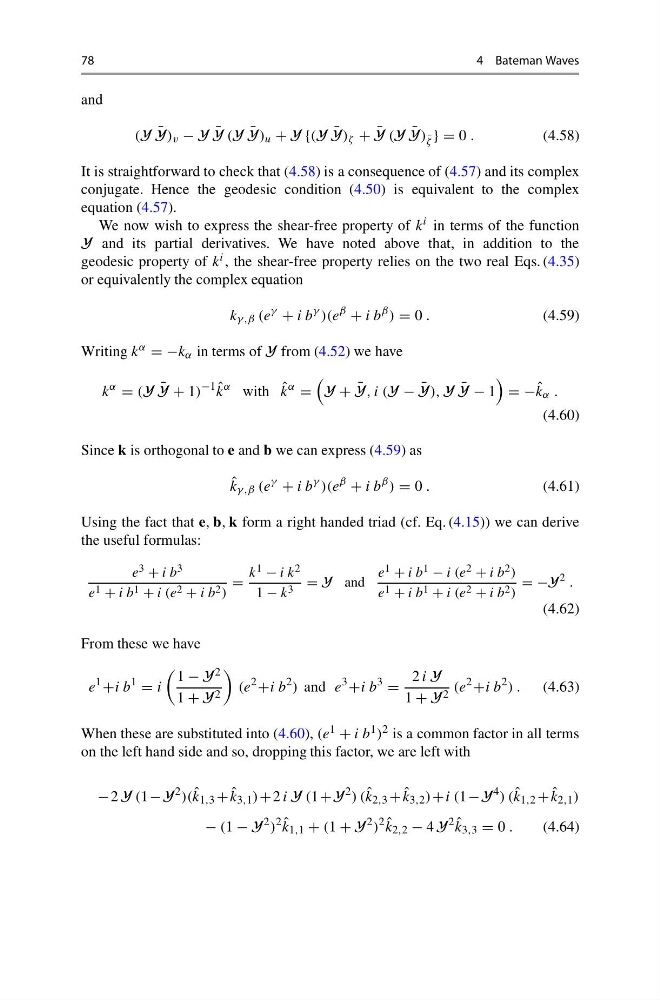
and
(Y ¯
Y) v − Y ¯
Y (Y ¯
Y) u + Y {(Y ¯
Y) ζ + ¯
Y (Y ¯
Y) ¯
ζ } = 0 .
(4.58)
It is straightforward to check that (4.58) is a consequence of (4.57) and its complex
conjugate. Hence the geodesic condition (4.50) is equivalent to the complex
equation (4.57).
We now wish to express the shear-free property of k i in terms of the function
Y and its partial derivatives. We have noted above that, in addition to the
geodesic property of k i , the shear-free property relies on the two real Eqs. (4.35)
or equivalently the complex equation
k γ ,β (e
γ
+ i b
γ )(e
β
+ i b
β ) = 0 .
(4.59)
Writing k α = −k α in terms of Y from (4.52) we have
k
α
= (Y ¯
Y + 1)
−1 ˆ
k
α with ˆ
k
α
=
Y + ¯
Y, i (Y − ¯
Y), Y ¯
Y − 1
= − ˆ
k α .
(4.60)
Since k is orthogonal to e and b we can express (4.59) as
ˆ
k γ ,β (e
γ
+ i b
γ )(e
β
+ i b
β ) = 0 .
(4.61)
Using the fact that e, b, k form a right handed triad (cf. Eq. (4.15)) we can derive
the useful formulas:
e 3 + i b 3
e 1 + i b 1 + i (e 2 + i b 2 )
=
k 1 − i k 2
1 − k 3 = Y and
e 1 + i b 1 − i (e 2 + i b 2 )
e 1 + i b 1 + i (e 2 + i b 2 )
= −Y
2 .
(4.62)
From these we have
e
1
+i b
1
= i
1 − Y 2
1 + Y 2
(e
2
+i b
2 ) and e
3
+i b
3
=
2 i Y
1 + Y 2 (e
2
+i b
2 ) . (4.63)
When these are substituted into (4.60), (e 1 + i b 1 ) 2 is a common factor in all terms
on the left hand side and so, dropping this factor, we are left with
−2 Y (1 −Y
2 )( ˆ
k 1,3 + ˆ
k 3,1 )+2 i Y (1 +Y
2 ) ( ˆ
k 2,3 + ˆ
k 3,2 )+i (1 −Y
4 ) ( ˆ
k 1,2 + ˆ
k 2,1 )
− (1 − Y
2 )
2 ˆ
k 1,1 + (1 + Y
2 )
2 ˆ
k 2,2 − 4 Y
2 ˆ
k 3,3 = 0 .
(4.64)
4 Bateman Waves
and
(Y ¯
Y) v − Y ¯
Y (Y ¯
Y) u + Y {(Y ¯
Y) ζ + ¯
Y (Y ¯
Y) ¯
ζ } = 0 .
(4.58)
It is straightforward to check that (4.58) is a consequence of (4.57) and its complex
conjugate. Hence the geodesic condition (4.50) is equivalent to the complex
equation (4.57).
We now wish to express the shear-free property of k i in terms of the function
Y and its partial derivatives. We have noted above that, in addition to the
geodesic property of k i , the shear-free property relies on the two real Eqs. (4.35)
or equivalently the complex equation
k γ ,β (e
γ
+ i b
γ )(e
β
+ i b
β ) = 0 .
(4.59)
Writing k α = −k α in terms of Y from (4.52) we have
k
α
= (Y ¯
Y + 1)
−1 ˆ
k
α with ˆ
k
α
=
Y + ¯
Y, i (Y − ¯
Y), Y ¯
Y − 1
= − ˆ
k α .
(4.60)
Since k is orthogonal to e and b we can express (4.59) as
ˆ
k γ ,β (e
γ
+ i b
γ )(e
β
+ i b
β ) = 0 .
(4.61)
Using the fact that e, b, k form a right handed triad (cf. Eq. (4.15)) we can derive
the useful formulas:
e 3 + i b 3
e 1 + i b 1 + i (e 2 + i b 2 )
=
k 1 − i k 2
1 − k 3 = Y and
e 1 + i b 1 − i (e 2 + i b 2 )
e 1 + i b 1 + i (e 2 + i b 2 )
= −Y
2 .
(4.62)
From these we have
e
1
+i b
1
= i
1 − Y 2
1 + Y 2
(e
2
+i b
2 ) and e
3
+i b
3
=
2 i Y
1 + Y 2 (e
2
+i b
2 ) . (4.63)
When these are substituted into (4.60), (e 1 + i b 1 ) 2 is a common factor in all terms
on the left hand side and so, dropping this factor, we are left with
−2 Y (1 −Y
2 )( ˆ
k 1,3 + ˆ
k 3,1 )+2 i Y (1 +Y
2 ) ( ˆ
k 2,3 + ˆ
k 3,2 )+i (1 −Y
4 ) ( ˆ
k 1,2 + ˆ
k 2,1 )
− (1 − Y
2 )
2 ˆ
k 1,1 + (1 + Y
2 )
2 ˆ
k 2,2 − 4 Y
2 ˆ
k 3,3 = 0 .
(4.64)