

3.5 Axial Symmetry
63
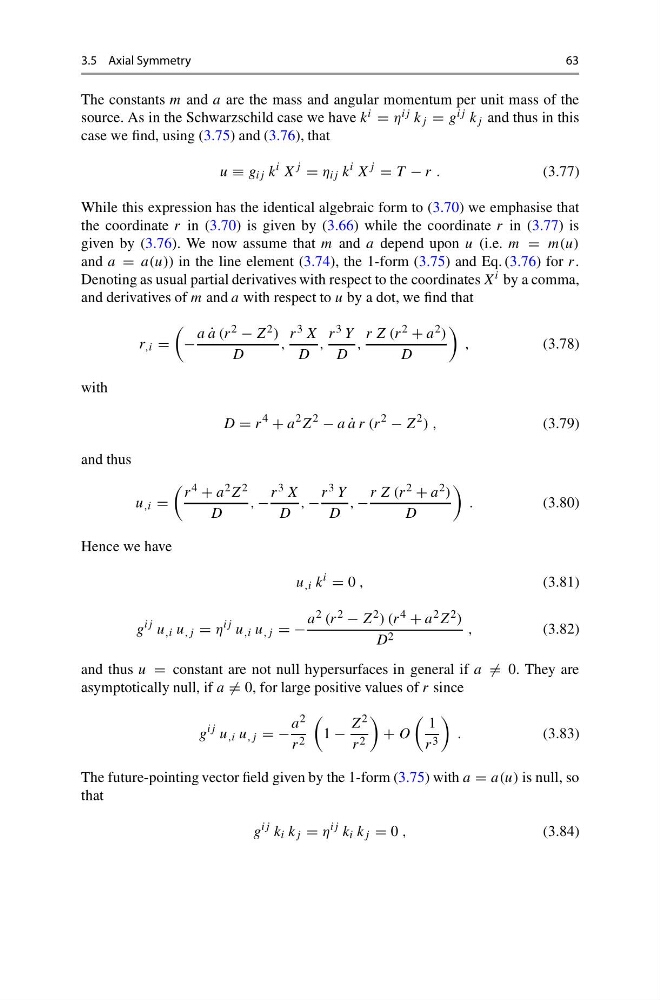
The constants m and a are the mass and angular momentum per unit mass of the
source. As in the Schwarzschild case we have k i = η ij k j = g ij k j and thus in this
case we find, using (3.75) and (3.76), that
u ≡ g ij k
i X
j
= η ij k
i X
j
= T − r .
(3.77)
While this expression has the identical algebraic form to (3.70) we emphasise that
the coordinate r in (3.70) is given by (3.66) while the coordinate r in (3.77) is
given by (3.76). We now assume that m and a depend upon u (i.e. m = m(u)
and a = a(u)) in the line element (3.74), the 1-form (3.75) and Eq. (3.76) for r.
Denoting as usual partial derivatives with respect to the coordinates X i by a comma,
and derivatives of m and a with respect to u by a dot, we find that
r ,i =
−
a ˙
a (r 2 − Z 2 )
D
,
r 3 X
D
,
r 3 Y
D
,
r Z (r 2 + a 2 )
D
,
(3.78)
with
D = r
4
+ a
2 Z
2
− a ˙
a r (r
2
− Z
2 ) ,
(3.79)
and thus
u ,i =
r 4 + a 2 Z 2
D
, −
r 3 X
D
, −
r 3 Y
D
, −
r Z (r 2 + a 2 )
D
.
(3.80)
Hence we have
u ,i k
i
= 0 ,
(3.81)
g
ij u ,i u ,j = η
ij u ,i u ,j = −
a 2 (r 2 − Z 2 ) (r 4 + a 2 Z 2 )
D 2
,
(3.82)
and thus u = constant are not null hypersurfaces in general if a = 0. They are
asymptotically null, if a = 0, for large positive values of r since
g
ij u ,i u ,j = −
a 2
r 2
1 −
Z 2
r 2
+ O
1
r 3
.
(3.83)
The future-pointing vector field given by the 1-form (3.75) with a = a(u) is null, so
that
g
ij k i k j = η
ij k i k j = 0 ,
(3.84)
63
The constants m and a are the mass and angular momentum per unit mass of the
source. As in the Schwarzschild case we have k i = η ij k j = g ij k j and thus in this
case we find, using (3.75) and (3.76), that
u ≡ g ij k
i X
j
= η ij k
i X
j
= T − r .
(3.77)
While this expression has the identical algebraic form to (3.70) we emphasise that
the coordinate r in (3.70) is given by (3.66) while the coordinate r in (3.77) is
given by (3.76). We now assume that m and a depend upon u (i.e. m = m(u)
and a = a(u)) in the line element (3.74), the 1-form (3.75) and Eq. (3.76) for r.
Denoting as usual partial derivatives with respect to the coordinates X i by a comma,
and derivatives of m and a with respect to u by a dot, we find that
r ,i =
−
a ˙
a (r 2 − Z 2 )
D
,
r 3 X
D
,
r 3 Y
D
,
r Z (r 2 + a 2 )
D
,
(3.78)
with
D = r
4
+ a
2 Z
2
− a ˙
a r (r
2
− Z
2 ) ,
(3.79)
and thus
u ,i =
r 4 + a 2 Z 2
D
, −
r 3 X
D
, −
r 3 Y
D
, −
r Z (r 2 + a 2 )
D
.
(3.80)
Hence we have
u ,i k
i
= 0 ,
(3.81)
g
ij u ,i u ,j = η
ij u ,i u ,j = −
a 2 (r 2 − Z 2 ) (r 4 + a 2 Z 2 )
D 2
,
(3.82)
and thus u = constant are not null hypersurfaces in general if a = 0. They are
asymptotically null, if a = 0, for large positive values of r since
g
ij u ,i u ,j = −
a 2
r 2
1 −
Z 2
r 2
+ O
1
r 3
.
(3.83)
The future-pointing vector field given by the 1-form (3.75) with a = a(u) is null, so
that
g
ij k i k j = η
ij k i k j = 0 ,
(3.84)