

26
2 Bivector Formalism
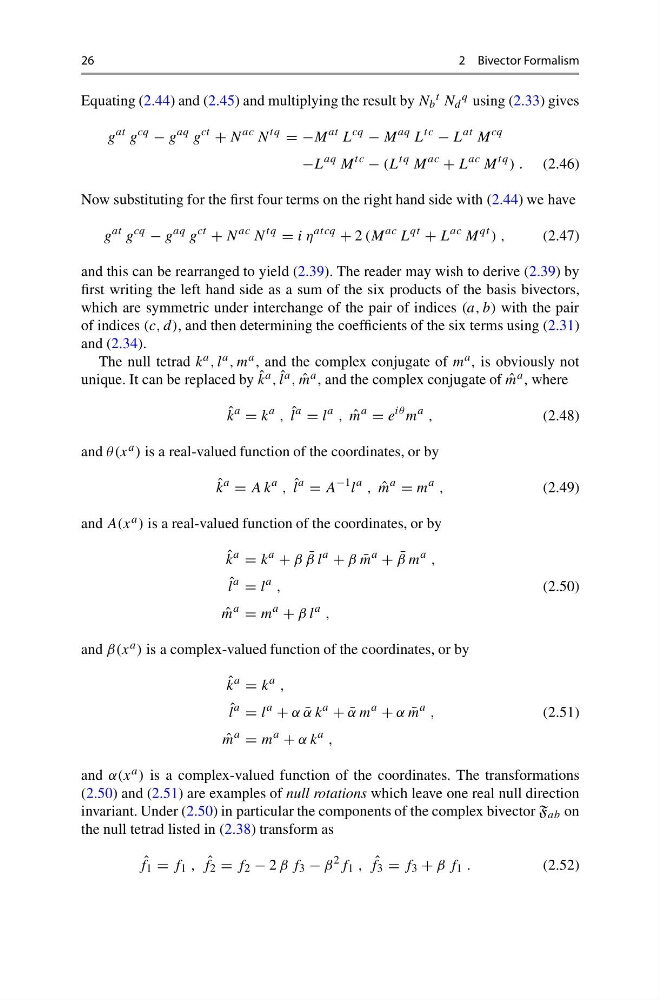
Equating (2.44) and (2.45) and multiplying the result by N b
t N d
q using (2.33) gives
g
at g
cq
− g
aq g
ct
+ N
ac N
tq
= −M
at L
cq
− M
aq L
tc
− L
at M
cq
−L
aq M
tc
− (L
tq M
ac
+ L
ac M
tq ) . (2.46)
Now substituting for the first four terms on the right hand side with (2.44) we have
g
at g
cq
− g
aq g
ct
+ N
ac N
tq
= i η
atcq
+ 2 (M
ac L
qt
+ L
ac M
qt ) ,
(2.47)
and this can be rearranged to yield (2.39). The reader may wish to derive (2.39) by
first writing the left hand side as a sum of the six products of the basis bivectors,
which are symmetric under interchange of the pair of indices (a, b) with the pair
of indices (c, d), and then determining the coefficients of the six terms using (2.31)
and (2.34).
The null tetrad k a , l a , m a , and the complex conjugate of m a , is obviously not
unique. It can be replaced by ˆ
k a , ˆ
l a , ˆ
m a , and the complex conjugate of ˆ
m a , where
ˆ
k
a
= k
a , ˆ
l
a
= l
a , ˆ
m
a
= e
iθ m
a ,
(2.48)
and θ(x a ) is a real-valued function of the coordinates, or by
ˆ
k
a
= A k
a , ˆ
l
a
= A
−1 l
a , ˆ
m
a
= m
a ,
(2.49)
and A(x a ) is a real-valued function of the coordinates, or by
ˆ
k
a
= k
a
+ β ¯
β l
a
+ β ¯
m
a
+ ¯
β m
a ,
ˆ
l
a
= l
a ,
(2.50)
ˆ
m
a
= m
a
+ β l
a ,
and β(x a ) is a complex-valued function of the coordinates, or by
ˆ
k
a
= k
a ,
ˆ
l
a
= l
a
+ α ¯
α k
a
+ ¯
α m
a
+ α ¯
m
a ,
(2.51)
ˆ
m
a
= m
a
+ α k
a ,
and α(x a ) is a complex-valued function of the coordinates. The transformations
(2.50) and (2.51) are examples of null rotations which leave one real null direction
invariant. Under (2.50) in particular the components of the complex bivector F ab on
the null tetrad listed in (2.38) transform as
ˆ
f 1 = f 1 , ˆ
f 2 = f 2 − 2 β f 3 − β
2 f 1 , ˆ
f 3 = f 3 + β f 1 .
(2.52)
2 Bivector Formalism
Equating (2.44) and (2.45) and multiplying the result by N b
t N d
q using (2.33) gives
g
at g
cq
− g
aq g
ct
+ N
ac N
tq
= −M
at L
cq
− M
aq L
tc
− L
at M
cq
−L
aq M
tc
− (L
tq M
ac
+ L
ac M
tq ) . (2.46)
Now substituting for the first four terms on the right hand side with (2.44) we have
g
at g
cq
− g
aq g
ct
+ N
ac N
tq
= i η
atcq
+ 2 (M
ac L
qt
+ L
ac M
qt ) ,
(2.47)
and this can be rearranged to yield (2.39). The reader may wish to derive (2.39) by
first writing the left hand side as a sum of the six products of the basis bivectors,
which are symmetric under interchange of the pair of indices (a, b) with the pair
of indices (c, d), and then determining the coefficients of the six terms using (2.31)
and (2.34).
The null tetrad k a , l a , m a , and the complex conjugate of m a , is obviously not
unique. It can be replaced by ˆ
k a , ˆ
l a , ˆ
m a , and the complex conjugate of ˆ
m a , where
ˆ
k
a
= k
a , ˆ
l
a
= l
a , ˆ
m
a
= e
iθ m
a ,
(2.48)
and θ(x a ) is a real-valued function of the coordinates, or by
ˆ
k
a
= A k
a , ˆ
l
a
= A
−1 l
a , ˆ
m
a
= m
a ,
(2.49)
and A(x a ) is a real-valued function of the coordinates, or by
ˆ
k
a
= k
a
+ β ¯
β l
a
+ β ¯
m
a
+ ¯
β m
a ,
ˆ
l
a
= l
a ,
(2.50)
ˆ
m
a
= m
a
+ β l
a ,
and β(x a ) is a complex-valued function of the coordinates, or by
ˆ
k
a
= k
a ,
ˆ
l
a
= l
a
+ α ¯
α k
a
+ ¯
α m
a
+ α ¯
m
a ,
(2.51)
ˆ
m
a
= m
a
+ α k
a ,
and α(x a ) is a complex-valued function of the coordinates. The transformations
(2.50) and (2.51) are examples of null rotations which leave one real null direction
invariant. Under (2.50) in particular the components of the complex bivector F ab on
the null tetrad listed in (2.38) transform as
ˆ
f 1 = f 1 , ˆ
f 2 = f 2 − 2 β f 3 − β
2 f 1 , ˆ
f 3 = f 3 + β f 1 .
(2.52)