

2.2 Electromagnetic Radiation
27
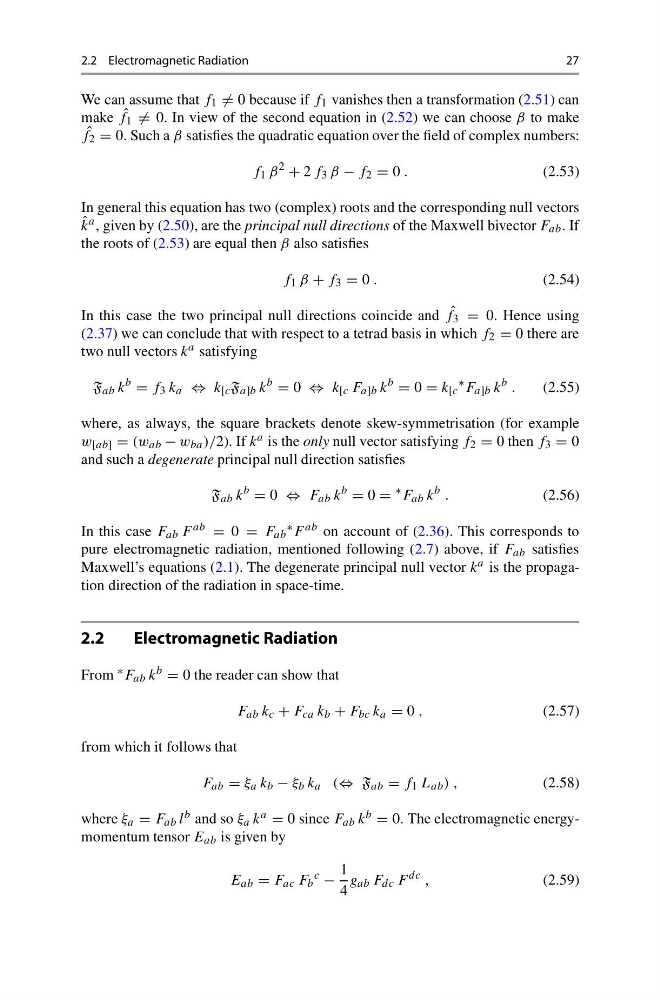
We can assume that f 1 = 0 because if f 1 vanishes then a transformation (2.51) can
make ˆ
f 1 = 0. In view of the second equation in (2.52) we can choose β to make
ˆ
f 2 = 0. Such a β satisfies the quadratic equation over the field of complex numbers:
f 1 β
2
+ 2 f 3 β − f 2 = 0 .
(2.53)
In general this equation has two (complex) roots and the corresponding null vectors
ˆ
k a , given by (2.50), are the principal null directions of the Maxwell bivector F ab . If
the roots of (2.53) are equal then β also satisfies
f 1 β + f 3 = 0 .
(2.54)
In this case the two principal null directions coincide and ˆ
f 3 = 0. Hence using
(2.37) we can conclude that with respect to a tetrad basis in which f 2 = 0 there are
two null vectors k a satisfying
F ab k
b
= f 3 k a ⇔ k [c F a]b k
b
= 0 ⇔ k [c F a]b k
b
= 0 = k [c
∗ F a]b k
b .
(2.55)
where, as always, the square brackets denote skew-symmetrisation (for example
w [ab] = (w ab − w ba )/2). If k a is the only null vector satisfying f 2 = 0 then f 3 = 0
and such a degenerate principal null direction satisfies
F ab k
b
= 0 ⇔ F ab k
b
= 0 =
∗ F ab k
b .
(2.56)
In this case F ab F ab = 0 = F ab
∗ F ab on account of (2.36). This corresponds to
pure electromagnetic radiation, mentioned following (2.7) above, if F ab satisfies
Maxwell’s equations (2.1). The degenerate principal null vector k a is the propagation direction of the radiation in space-time.
2.2
Electromagnetic Radiation
From ∗ F ab k b = 0 the reader can show that
F ab k c + F ca k b + F bc k a = 0 ,
(2.57)
from which it follows that
F ab = ξ a k b − ξ b k a (⇔ F ab = f 1 L ab ) ,
(2.58)
where ξ a = F ab l b and so ξ a k a = 0 since F ab k b = 0. The electromagnetic energymomentum tensor E ab is given by
E ab = F ac F b
c
−
1
4
g ab F dc F
dc ,
(2.59)
27
We can assume that f 1 = 0 because if f 1 vanishes then a transformation (2.51) can
make ˆ
f 1 = 0. In view of the second equation in (2.52) we can choose β to make
ˆ
f 2 = 0. Such a β satisfies the quadratic equation over the field of complex numbers:
f 1 β
2
+ 2 f 3 β − f 2 = 0 .
(2.53)
In general this equation has two (complex) roots and the corresponding null vectors
ˆ
k a , given by (2.50), are the principal null directions of the Maxwell bivector F ab . If
the roots of (2.53) are equal then β also satisfies
f 1 β + f 3 = 0 .
(2.54)
In this case the two principal null directions coincide and ˆ
f 3 = 0. Hence using
(2.37) we can conclude that with respect to a tetrad basis in which f 2 = 0 there are
two null vectors k a satisfying
F ab k
b
= f 3 k a ⇔ k [c F a]b k
b
= 0 ⇔ k [c F a]b k
b
= 0 = k [c
∗ F a]b k
b .
(2.55)
where, as always, the square brackets denote skew-symmetrisation (for example
w [ab] = (w ab − w ba )/2). If k a is the only null vector satisfying f 2 = 0 then f 3 = 0
and such a degenerate principal null direction satisfies
F ab k
b
= 0 ⇔ F ab k
b
= 0 =
∗ F ab k
b .
(2.56)
In this case F ab F ab = 0 = F ab
∗ F ab on account of (2.36). This corresponds to
pure electromagnetic radiation, mentioned following (2.7) above, if F ab satisfies
Maxwell’s equations (2.1). The degenerate principal null vector k a is the propagation direction of the radiation in space-time.
2.2
Electromagnetic Radiation
From ∗ F ab k b = 0 the reader can show that
F ab k c + F ca k b + F bc k a = 0 ,
(2.57)
from which it follows that
F ab = ξ a k b − ξ b k a (⇔ F ab = f 1 L ab ) ,
(2.58)
where ξ a = F ab l b and so ξ a k a = 0 since F ab k b = 0. The electromagnetic energymomentum tensor E ab is given by
E ab = F ac F b
c
−
1
4
g ab F dc F
dc ,
(2.59)