

C Gravitational (Clock) Compass
221
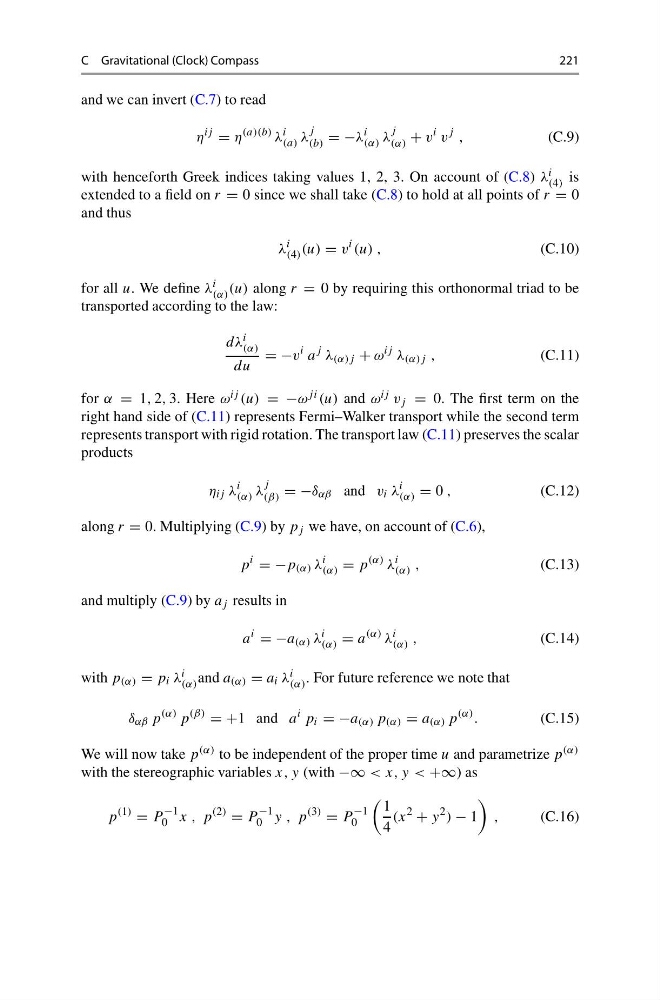
and we can invert (C.7) to read
η
ij
= η
(a)(b) λ
i
(a) λ
j
(b) = −λ
i
(α) λ
j
(α) + v
i v
j ,
(C.9)
with henceforth Greek indices taking values 1, 2, 3. On account of (C.8) λ i
(4) is
extended to a field on r = 0 since we shall take (C.8) to hold at all points of r = 0
and thus
λ
i
(4) (u) = v
i (u) ,
(C.10)
for all u. We define λ
i
(α) (u) along r = 0 by requiring this orthonormal triad to be
transported according to the law:
dλ i
(α)
du
= −v
i a
j λ (α)j + ω
ij λ (α)j ,
(C.11)
for α = 1, 2, 3. Here ω ij (u) = −ω ji (u) and ω ij v j = 0. The first term on the
right hand side of (C.11) represents Fermi–Walker transport while the second term
represents transport with rigid rotation. The transport law (C.11) preserves the scalar
products
η ij λ
i
(α) λ
j
(β) = −δ αβ and v i λ
i
(α) = 0 ,
(C.12)
along r = 0. Multiplying (C.9) by p j we have, on account of (C.6),
p
i
= −p (α) λ
i
(α) = p
(α) λ
i
(α) ,
(C.13)
and multiply (C.9) by a j results in
a
i
= −a (α) λ
i
(α) = a
(α) λ
i
(α) ,
(C.14)
with p (α) = p i λ i
(α) and a (α) = a i λ i
(α) . For future reference we note that
δ αβ p
(α) p
(β)
= +1 and a
i p i = −a (α) p (α) = a (α) p
(α) .
(C.15)
We will now take p (α) to be independent of the proper time u and parametrize p (α)
with the stereographic variables x, y (with −∞ < x, y < +∞) as
p
(1)
= P
−1
0 x , p
(2)
= P
−1
0 y , p
(3)
= P
−1
0
1
4
(x
2
+ y
2 ) − 1
,
(C.16)
221
and we can invert (C.7) to read
η
ij
= η
(a)(b) λ
i
(a) λ
j
(b) = −λ
i
(α) λ
j
(α) + v
i v
j ,
(C.9)
with henceforth Greek indices taking values 1, 2, 3. On account of (C.8) λ i
(4) is
extended to a field on r = 0 since we shall take (C.8) to hold at all points of r = 0
and thus
λ
i
(4) (u) = v
i (u) ,
(C.10)
for all u. We define λ
i
(α) (u) along r = 0 by requiring this orthonormal triad to be
transported according to the law:
dλ i
(α)
du
= −v
i a
j λ (α)j + ω
ij λ (α)j ,
(C.11)
for α = 1, 2, 3. Here ω ij (u) = −ω ji (u) and ω ij v j = 0. The first term on the
right hand side of (C.11) represents Fermi–Walker transport while the second term
represents transport with rigid rotation. The transport law (C.11) preserves the scalar
products
η ij λ
i
(α) λ
j
(β) = −δ αβ and v i λ
i
(α) = 0 ,
(C.12)
along r = 0. Multiplying (C.9) by p j we have, on account of (C.6),
p
i
= −p (α) λ
i
(α) = p
(α) λ
i
(α) ,
(C.13)
and multiply (C.9) by a j results in
a
i
= −a (α) λ
i
(α) = a
(α) λ
i
(α) ,
(C.14)
with p (α) = p i λ i
(α) and a (α) = a i λ i
(α) . For future reference we note that
δ αβ p
(α) p
(β)
= +1 and a
i p i = −a (α) p (α) = a (α) p
(α) .
(C.15)
We will now take p (α) to be independent of the proper time u and parametrize p (α)
with the stereographic variables x, y (with −∞ < x, y < +∞) as
p
(1)
= P
−1
0 x , p
(2)
= P
−1
0 y , p
(3)
= P
−1
0
1
4
(x
2
+ y
2 ) − 1
,
(C.16)