

220
C Gravitational (Clock) Compass
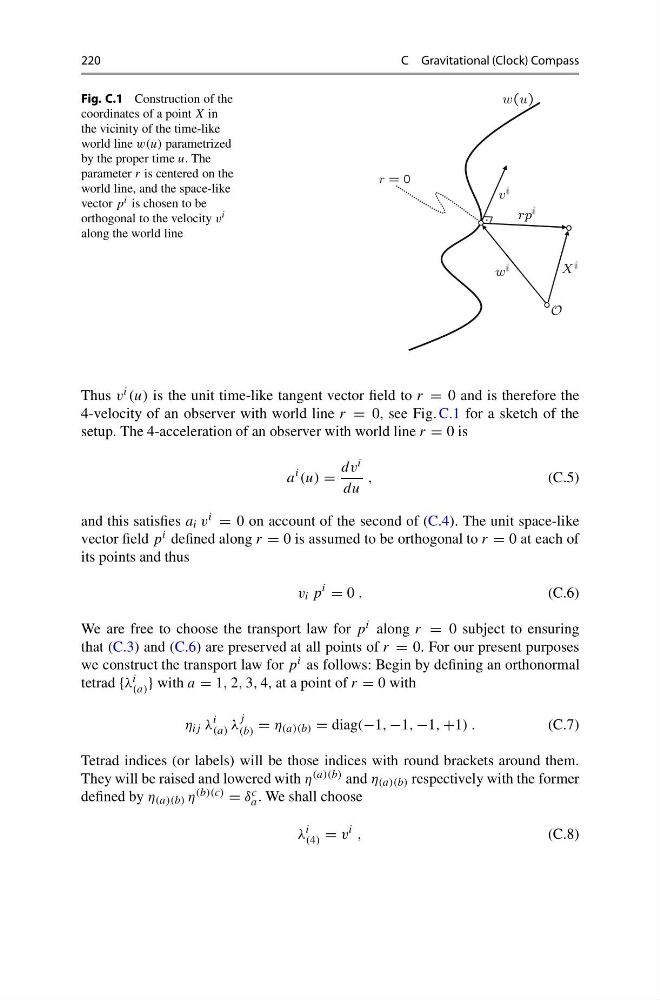
Fig. C.1 Construction of the
coordinates of a point X in
the vicinity of the time-like
world line w(u) parametrized
by the proper time u. The
parameter r is centered on the
world line, and the space-like
vector p i is chosen to be
orthogonal to the velocity v i
along the world line
Thus v i (u) is the unit time-like tangent vector field to r = 0 and is therefore the
4-velocity of an observer with world line r = 0, see Fig. C.1 for a sketch of the
setup. The 4-acceleration of an observer with world line r = 0 is
a
i (u) =
dv i
du
,
(C.5)
and this satisfies a i v i = 0 on account of the second of (C.4). The unit space-like
vector field p i defined along r = 0 is assumed to be orthogonal to r = 0 at each of
its points and thus
v i p
i
= 0 .
(C.6)
We are free to choose the transport law for p i along r = 0 subject to ensuring
that (C.3) and (C.6) are preserved at all points of r = 0. For our present purposes
we construct the transport law for p i as follows: Begin by defining an orthonormal
tetrad {λ i
(a) } with a = 1, 2, 3, 4, at a point of r = 0 with
η ij λ
i
(a) λ
j
(b) = η (a)(b) = diag(−1, −1, −1, +1) .
(C.7)
Tetrad indices (or labels) will be those indices with round brackets around them.
They will be raised and lowered with η (a)(b) and η (a)(b) respectively with the former
defined by η (a)(b) η (b)(c) = δ c
a . We shall choose
λ
i
(4) = v
i ,
(C.8)
C Gravitational (Clock) Compass
Fig. C.1 Construction of the
coordinates of a point X in
the vicinity of the time-like
world line w(u) parametrized
by the proper time u. The
parameter r is centered on the
world line, and the space-like
vector p i is chosen to be
orthogonal to the velocity v i
along the world line
Thus v i (u) is the unit time-like tangent vector field to r = 0 and is therefore the
4-velocity of an observer with world line r = 0, see Fig. C.1 for a sketch of the
setup. The 4-acceleration of an observer with world line r = 0 is
a
i (u) =
dv i
du
,
(C.5)
and this satisfies a i v i = 0 on account of the second of (C.4). The unit space-like
vector field p i defined along r = 0 is assumed to be orthogonal to r = 0 at each of
its points and thus
v i p
i
= 0 .
(C.6)
We are free to choose the transport law for p i along r = 0 subject to ensuring
that (C.3) and (C.6) are preserved at all points of r = 0. For our present purposes
we construct the transport law for p i as follows: Begin by defining an orthonormal
tetrad {λ i
(a) } with a = 1, 2, 3, 4, at a point of r = 0 with
η ij λ
i
(a) λ
j
(b) = η (a)(b) = diag(−1, −1, −1, +1) .
(C.7)
Tetrad indices (or labels) will be those indices with round brackets around them.
They will be raised and lowered with η (a)(b) and η (a)(b) respectively with the former
defined by η (a)(b) η (b)(c) = δ c
a . We shall choose
λ
i
(4) = v
i ,
(C.8)