

222
C Gravitational (Clock) Compass
with
P 0 = 1 +
1
4
(x
2
+ y
2 ) .
(C.17)
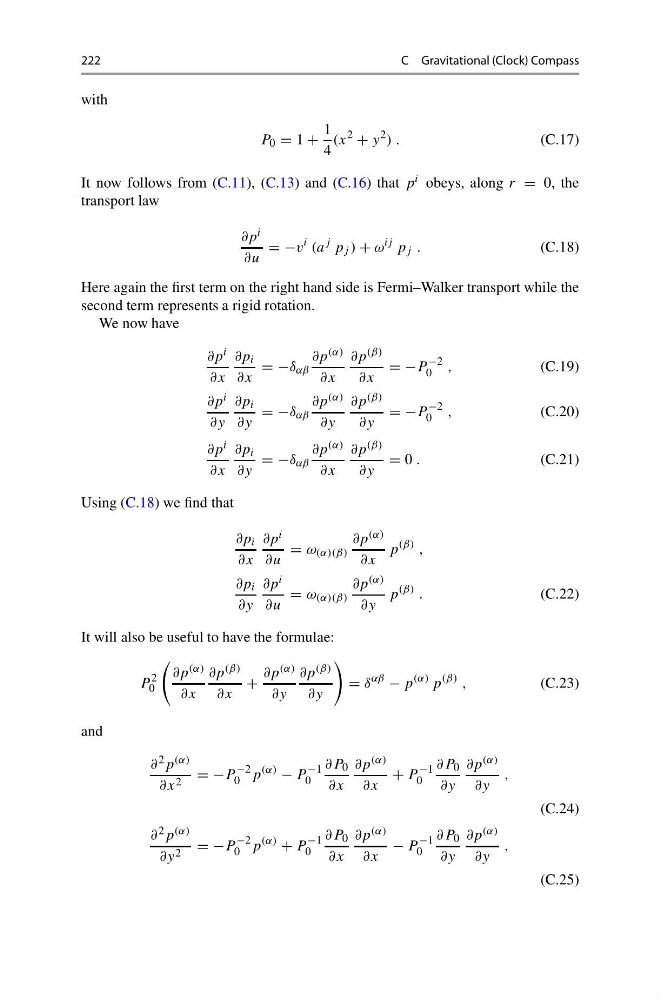
It now follows from (C.11), (C.13) and (C.16) that p i obeys, along r = 0, the
transport law
∂p i
∂u
= −v
i (a
j p j ) + ω
ij p j .
(C.18)
Here again the first term on the right hand side is Fermi–Walker transport while the
second term represents a rigid rotation.
We now have
∂p i
∂x
∂p i
∂x
= −δ αβ
∂p (α)
∂x
∂p (β)
∂x
= −P
−2
0 ,
(C.19)
∂p i
∂y
∂p i
∂y
= −δ αβ
∂p (α)
∂y
∂p (β)
∂y
= −P
−2
0 ,
(C.20)
∂p i
∂x
∂p i
∂y
= −δ αβ
∂p (α)
∂x
∂p (β)
∂y
= 0 .
(C.21)
Using (C.18) we find that
∂p i
∂x
∂p i
∂u
= ω (α)(β)
∂p (α)
∂x
p
(β) ,
∂p i
∂y
∂p i
∂u
= ω (α)(β)
∂p (α)
∂y
p
(β) .
(C.22)
It will also be useful to have the formulae:
P
2
0
∂p (α)
∂x
∂p (β)
∂x
+
∂p (α)
∂y
∂p (β)
∂y
= δ
αβ
− p
(α) p
(β) ,
(C.23)
and
∂ 2 p (α)
∂x 2 = −P
−2
0 p
(α)
− P
−1
0
∂P 0
∂x
∂p (α)
∂x
+ P
−1
0
∂P 0
∂y
∂p (α)
∂y
,
(C.24)
∂ 2 p (α)
∂y 2 = −P
−2
0 p
(α)
+ P
−1
0
∂P 0
∂x
∂p (α)
∂x
− P
−1
0
∂P 0
∂y
∂p (α)
∂y
,
(C.25)
C Gravitational (Clock) Compass
with
P 0 = 1 +
1
4
(x
2
+ y
2 ) .
(C.17)
It now follows from (C.11), (C.13) and (C.16) that p i obeys, along r = 0, the
transport law
∂p i
∂u
= −v
i (a
j p j ) + ω
ij p j .
(C.18)
Here again the first term on the right hand side is Fermi–Walker transport while the
second term represents a rigid rotation.
We now have
∂p i
∂x
∂p i
∂x
= −δ αβ
∂p (α)
∂x
∂p (β)
∂x
= −P
−2
0 ,
(C.19)
∂p i
∂y
∂p i
∂y
= −δ αβ
∂p (α)
∂y
∂p (β)
∂y
= −P
−2
0 ,
(C.20)
∂p i
∂x
∂p i
∂y
= −δ αβ
∂p (α)
∂x
∂p (β)
∂y
= 0 .
(C.21)
Using (C.18) we find that
∂p i
∂x
∂p i
∂u
= ω (α)(β)
∂p (α)
∂x
p
(β) ,
∂p i
∂y
∂p i
∂u
= ω (α)(β)
∂p (α)
∂y
p
(β) .
(C.22)
It will also be useful to have the formulae:
P
2
0
∂p (α)
∂x
∂p (β)
∂x
+
∂p (α)
∂y
∂p (β)
∂y
= δ
αβ
− p
(α) p
(β) ,
(C.23)
and
∂ 2 p (α)
∂x 2 = −P
−2
0 p
(α)
− P
−1
0
∂P 0
∂x
∂p (α)
∂x
+ P
−1
0
∂P 0
∂y
∂p (α)
∂y
,
(C.24)
∂ 2 p (α)
∂y 2 = −P
−2
0 p
(α)
+ P
−1
0
∂P 0
∂x
∂p (α)
∂x
− P
−1
0
∂P 0
∂y
∂p (α)
∂y
,
(C.25)