

8.5 Energy Radiation Rate and Run-Away Motion
203
we can ensure that no l = 0 term appears in Q 2 since, as pointed out following
(8.80), such a term along with an l = 1 spherical harmonic appearing in Q 2
correspond to trivial perturbations of the wave fronts. Therefore the non-trivial, well
behaved solution of (8.104) is
Q 2 = −
19
24
e
4 U 1 +
16
15
e
4 S 2 −
1
3
e
4 V 3 +
2
21
e
4 (a i a
i ) V 1 +
2
3
e
4 V 4 .
(8.110)
8.5
Energy Radiation Rate and Run-Away Motion
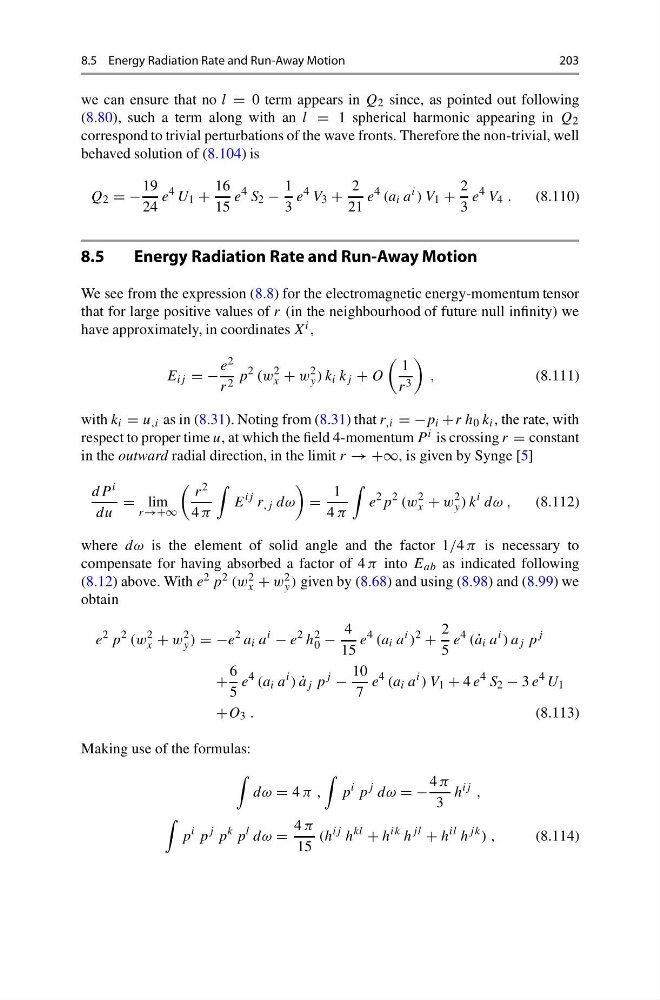
We see from the expression (8.8) for the electromagnetic energy-momentum tensor
that for large positive values of r (in the neighbourhood of future null infinity) we
have approximately, in coordinates X i ,
E ij = −
e 2
r 2 p
2 (w
2
x + w
2
y ) k i k j + O
1
r 3
,
(8.111)
with k i = u ,i as in (8.31). Noting from (8.31) that r ,i = −p i + r h 0 k i , the rate, with
respect to proper time u, at which the field 4-momentum P i is crossing r = constant
in the outward radial direction, in the limit r → +∞, is given by Synge [5]
dP i
du
= lim
r→+∞
r 2
4 π
E
ij r ,j dω
=
1
4 π
e
2 p
2 (w
2
x + w
2
y ) k
i dω ,
(8.112)
where dω is the element of solid angle and the factor 1/4 π is necessary to
compensate for having absorbed a factor of 4 π into E ab as indicated following
(8.12) above. With e 2 p 2 (w 2
x + w 2
y ) given by (8.68) and using (8.98) and (8.99) we
obtain
e
2 p
2 (w
2
x + w
2
y ) = −e
2 a i a
i
− e
2 h
2
0 −
4
15
e
4 (a i a
i )
2
+
2
5
e
4 ( ˙
a i a
i ) a j p
j
+
6
5
e
4 (a i a
i ) ˙
a j p
j
−
10
7
e
4 (a i a
i ) V 1 + 4 e
4 S 2 − 3 e
4 U 1
+O 3 .
(8.113)
Making use of the formulas:
dω = 4 π ,
p
i p
j dω = −
4 π
3
h
ij ,
p
i p
j p
k p
l dω =
4 π
15
(h
ij h
kl
+ h
ik h
jl
+ h
il h
jk ) ,
(8.114)
203
we can ensure that no l = 0 term appears in Q 2 since, as pointed out following
(8.80), such a term along with an l = 1 spherical harmonic appearing in Q 2
correspond to trivial perturbations of the wave fronts. Therefore the non-trivial, well
behaved solution of (8.104) is
Q 2 = −
19
24
e
4 U 1 +
16
15
e
4 S 2 −
1
3
e
4 V 3 +
2
21
e
4 (a i a
i ) V 1 +
2
3
e
4 V 4 .
(8.110)
8.5
Energy Radiation Rate and Run-Away Motion
We see from the expression (8.8) for the electromagnetic energy-momentum tensor
that for large positive values of r (in the neighbourhood of future null infinity) we
have approximately, in coordinates X i ,
E ij = −
e 2
r 2 p
2 (w
2
x + w
2
y ) k i k j + O
1
r 3
,
(8.111)
with k i = u ,i as in (8.31). Noting from (8.31) that r ,i = −p i + r h 0 k i , the rate, with
respect to proper time u, at which the field 4-momentum P i is crossing r = constant
in the outward radial direction, in the limit r → +∞, is given by Synge [5]
dP i
du
= lim
r→+∞
r 2
4 π
E
ij r ,j dω
=
1
4 π
e
2 p
2 (w
2
x + w
2
y ) k
i dω ,
(8.112)
where dω is the element of solid angle and the factor 1/4 π is necessary to
compensate for having absorbed a factor of 4 π into E ab as indicated following
(8.12) above. With e 2 p 2 (w 2
x + w 2
y ) given by (8.68) and using (8.98) and (8.99) we
obtain
e
2 p
2 (w
2
x + w
2
y ) = −e
2 a i a
i
− e
2 h
2
0 −
4
15
e
4 (a i a
i )
2
+
2
5
e
4 ( ˙
a i a
i ) a j p
j
+
6
5
e
4 (a i a
i ) ˙
a j p
j
−
10
7
e
4 (a i a
i ) V 1 + 4 e
4 S 2 − 3 e
4 U 1
+O 3 .
(8.113)
Making use of the formulas:
dω = 4 π ,
p
i p
j dω = −
4 π
3
h
ij ,
p
i p
j p
k p
l dω =
4 π
15
(h
ij h
kl
+ h
ik h
jl
+ h
il h
jk ) ,
(8.114)