

202
8 Reissner–Nordström Particle
where C
2
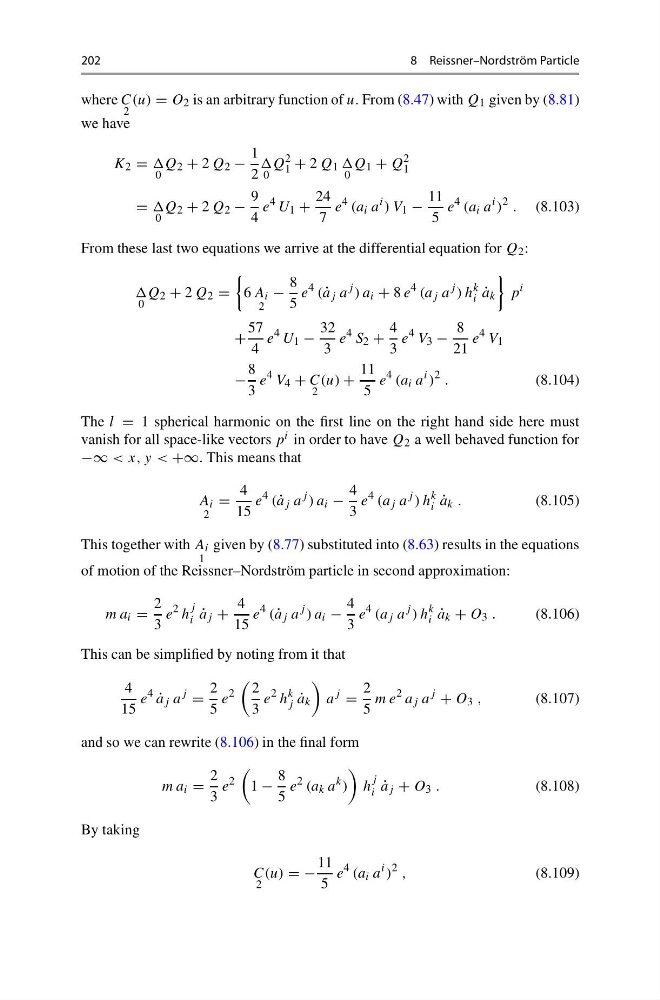
(u) = O 2 is an arbitrary function of u. From (8.47) with Q 1 given by (8.81)
we have
K 2 =
0
Q 2 + 2 Q 2 −
1
2
0
Q
2
1 + 2 Q 1
0
Q 1 + Q
2
1
=
0
Q 2 + 2 Q 2 −
9
4
e
4 U 1 +
24
7
e
4 (a i a
i ) V 1 −
11
5
e
4 (a i a
i )
2 . (8.103)
From these last two equations we arrive at the differential equation for Q 2 :
0
Q 2 + 2 Q 2 =
6 A i
2
−
8
5
e
4 ( ˙
a j a
j ) a i + 8 e
4 (a j a
j ) h
k
i ˙
a k
p
i
+
57
4
e
4 U 1 −
32
3
e
4 S 2 +
4
3
e
4 V 3 −
8
21
e
4 V 1
−
8
3
e
4 V 4 + C
2
(u) +
11
5
e
4 (a i a
i )
2 .
(8.104)
The l = 1 spherical harmonic on the first line on the right hand side here must
vanish for all space-like vectors p i in order to have Q 2 a well behaved function for
−∞ < x, y < +∞. This means that
A i
2
=
4
15
e
4 ( ˙
a j a
j ) a i −
4
3
e
4 (a j a
j ) h
k
i ˙
a k .
(8.105)
This together with A i
1
given by (8.77) substituted into (8.63) results in the equations
of motion of the Reissner–Nordström particle in second approximation:
m a i =
2
3
e
2 h
j
i ˙
a j +
4
15
e
4 ( ˙
a j a
j ) a i −
4
3
e
4 (a j a
j ) h
k
i ˙
a k + O 3 .
(8.106)
This can be simplified by noting from it that
4
15
e
4
˙
a j a
j
=
2
5
e
2
2
3
e
2 h
k
j ˙
a k
a
j
=
2
5
m e
2 a j a
j
+ O 3 ,
(8.107)
and so we can rewrite (8.106) in the final form
m a i =
2
3
e
2
1 −
8
5
e
2 (a k a
k )
h
j
i ˙
a j + O 3 .
(8.108)
By taking
C
2
(u) = −
11
5
e
4 (a i a
i )
2 ,
(8.109)
8 Reissner–Nordström Particle
where C
2
(u) = O 2 is an arbitrary function of u. From (8.47) with Q 1 given by (8.81)
we have
K 2 =
0
Q 2 + 2 Q 2 −
1
2
0
Q
2
1 + 2 Q 1
0
Q 1 + Q
2
1
=
0
Q 2 + 2 Q 2 −
9
4
e
4 U 1 +
24
7
e
4 (a i a
i ) V 1 −
11
5
e
4 (a i a
i )
2 . (8.103)
From these last two equations we arrive at the differential equation for Q 2 :
0
Q 2 + 2 Q 2 =
6 A i
2
−
8
5
e
4 ( ˙
a j a
j ) a i + 8 e
4 (a j a
j ) h
k
i ˙
a k
p
i
+
57
4
e
4 U 1 −
32
3
e
4 S 2 +
4
3
e
4 V 3 −
8
21
e
4 V 1
−
8
3
e
4 V 4 + C
2
(u) +
11
5
e
4 (a i a
i )
2 .
(8.104)
The l = 1 spherical harmonic on the first line on the right hand side here must
vanish for all space-like vectors p i in order to have Q 2 a well behaved function for
−∞ < x, y < +∞. This means that
A i
2
=
4
15
e
4 ( ˙
a j a
j ) a i −
4
3
e
4 (a j a
j ) h
k
i ˙
a k .
(8.105)
This together with A i
1
given by (8.77) substituted into (8.63) results in the equations
of motion of the Reissner–Nordström particle in second approximation:
m a i =
2
3
e
2 h
j
i ˙
a j +
4
15
e
4 ( ˙
a j a
j ) a i −
4
3
e
4 (a j a
j ) h
k
i ˙
a k + O 3 .
(8.106)
This can be simplified by noting from it that
4
15
e
4
˙
a j a
j
=
2
5
e
2
2
3
e
2 h
k
j ˙
a k
a
j
=
2
5
m e
2 a j a
j
+ O 3 ,
(8.107)
and so we can rewrite (8.106) in the final form
m a i =
2
3
e
2
1 −
8
5
e
2 (a k a
k )
h
j
i ˙
a j + O 3 .
(8.108)
By taking
C
2
(u) = −
11
5
e
4 (a i a
i )
2 ,
(8.109)