

8.4 EOMs of a Reissner–Nordström Particle
201
− 2 e
2 P
2
0
∂h 0
∂x
∂w 1
∂x
+
∂h 0
∂y
∂w 1
∂y
= −6 e
4 U 1 + 4 e
4 S 2 −
20
7
e
4 (a i a
i ) V 1
+
2
5
e
4 ( ˙
a i a
i ) h 0 +
6
5
e
4 (a j a
j ) ˙
a i p
i
−
8
15
e
4 (a i a
i )
2 ,
(8.98)
− 2 e
2 Q 1 (a i a
i
+ h
2
0 ) = 3 e
4 U 1 +
10
7
e
4 (a i a
i ) V 1 +
4
15
e
4 (a i a
i )
2 , (8.99)
−
1
2
Q 1
0
K 1 = −27 e
4 U 1 +
36
7
e
4 (a i a
i ) V 1 −
12
5
e
4 (a i a
i )
2 .
(8.100)
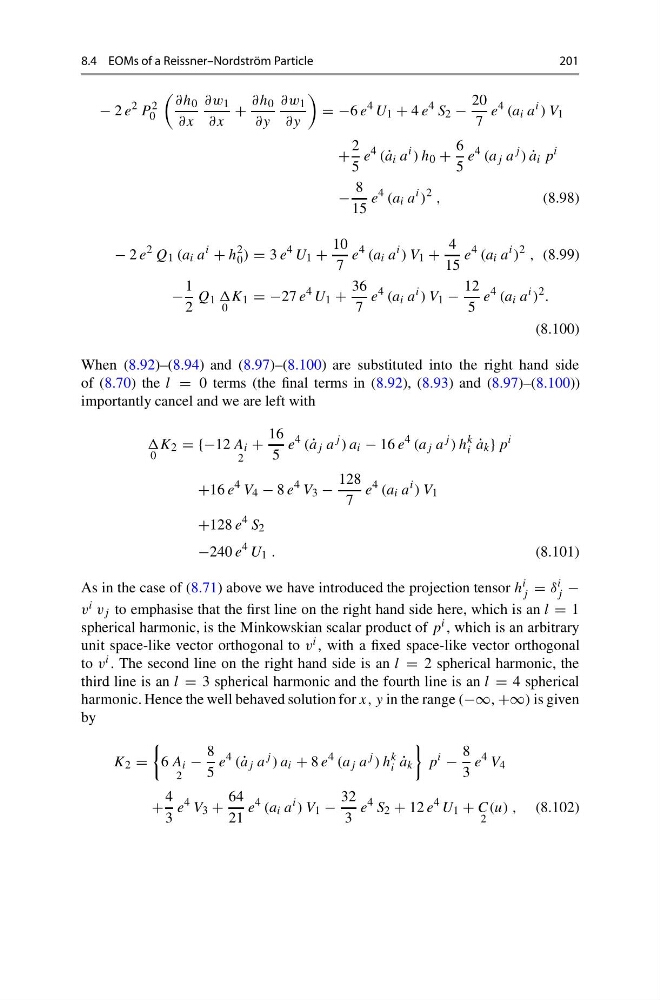
When (8.92)–(8.94) and (8.97)–(8.100) are substituted into the right hand side
of (8.70) the l = 0 terms (the final terms in (8.92), (8.93) and (8.97)–(8.100))
importantly cancel and we are left with
0
K 2 = {−12 A i
2
+
16
5
e
4 ( ˙
a j a
j ) a i − 16 e
4 (a j a
j ) h
k
i ˙
a k } p
i
+16 e
4 V 4 − 8 e
4 V 3 −
128
7
e
4 (a i a
i ) V 1
+128 e
4 S 2
−240 e
4 U 1 .
(8.101)
As in the case of (8.71) above we have introduced the projection tensor h
i
j = δ
i
j −
v i v j to emphasise that the first line on the right hand side here, which is an l = 1
spherical harmonic, is the Minkowskian scalar product of p i , which is an arbitrary
unit space-like vector orthogonal to v i , with a fixed space-like vector orthogonal
to v i . The second line on the right hand side is an l = 2 spherical harmonic, the
third line is an l = 3 spherical harmonic and the fourth line is an l = 4 spherical
harmonic. Hence the well behaved solution for x, y in the range (−∞, +∞) is given
by
K 2 =
6 A i
2
−
8
5
e
4 ( ˙
a j a
j ) a i + 8 e
4 (a j a
j ) h
k
i ˙
a k
p
i
−
8
3
e
4 V 4
+
4
3
e
4 V 3 +
64
21
e
4 (a i a
i ) V 1 −
32
3
e
4 S 2 + 12 e
4 U 1 + C
2
(u) , (8.102)
201
− 2 e
2 P
2
0
∂h 0
∂x
∂w 1
∂x
+
∂h 0
∂y
∂w 1
∂y
= −6 e
4 U 1 + 4 e
4 S 2 −
20
7
e
4 (a i a
i ) V 1
+
2
5
e
4 ( ˙
a i a
i ) h 0 +
6
5
e
4 (a j a
j ) ˙
a i p
i
−
8
15
e
4 (a i a
i )
2 ,
(8.98)
− 2 e
2 Q 1 (a i a
i
+ h
2
0 ) = 3 e
4 U 1 +
10
7
e
4 (a i a
i ) V 1 +
4
15
e
4 (a i a
i )
2 , (8.99)
−
1
2
Q 1
0
K 1 = −27 e
4 U 1 +
36
7
e
4 (a i a
i ) V 1 −
12
5
e
4 (a i a
i )
2 .
(8.100)
When (8.92)–(8.94) and (8.97)–(8.100) are substituted into the right hand side
of (8.70) the l = 0 terms (the final terms in (8.92), (8.93) and (8.97)–(8.100))
importantly cancel and we are left with
0
K 2 = {−12 A i
2
+
16
5
e
4 ( ˙
a j a
j ) a i − 16 e
4 (a j a
j ) h
k
i ˙
a k } p
i
+16 e
4 V 4 − 8 e
4 V 3 −
128
7
e
4 (a i a
i ) V 1
+128 e
4 S 2
−240 e
4 U 1 .
(8.101)
As in the case of (8.71) above we have introduced the projection tensor h
i
j = δ
i
j −
v i v j to emphasise that the first line on the right hand side here, which is an l = 1
spherical harmonic, is the Minkowskian scalar product of p i , which is an arbitrary
unit space-like vector orthogonal to v i , with a fixed space-like vector orthogonal
to v i . The second line on the right hand side is an l = 2 spherical harmonic, the
third line is an l = 3 spherical harmonic and the fourth line is an l = 4 spherical
harmonic. Hence the well behaved solution for x, y in the range (−∞, +∞) is given
by
K 2 =
6 A i
2
−
8
5
e
4 ( ˙
a j a
j ) a i + 8 e
4 (a j a
j ) h
k
i ˙
a k
p
i
−
8
3
e
4 V 4
+
4
3
e
4 V 3 +
64
21
e
4 (a i a
i ) V 1 −
32
3
e
4 S 2 + 12 e
4 U 1 + C
2
(u) , (8.102)