

200
8 Reissner–Nordström Particle
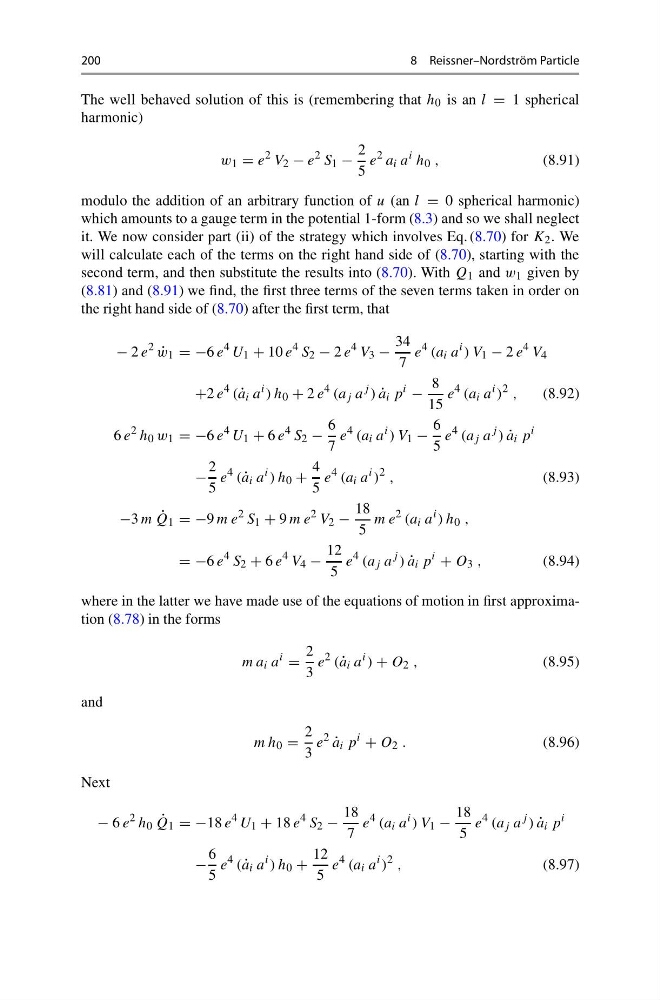
The well behaved solution of this is (remembering that h 0 is an l = 1 spherical
harmonic)
w 1 = e
2 V 2 − e
2 S 1 −
2
5
e
2 a i a
i h 0 ,
(8.91)
modulo the addition of an arbitrary function of u (an l = 0 spherical harmonic)
which amounts to a gauge term in the potential 1-form (8.3) and so we shall neglect
it. We now consider part (ii) of the strategy which involves Eq. (8.70) for K 2 . We
will calculate each of the terms on the right hand side of (8.70), starting with the
second term, and then substitute the results into (8.70). With Q 1 and w 1 given by
(8.81) and (8.91) we find, the first three terms of the seven terms taken in order on
the right hand side of (8.70) after the first term, that
− 2 e
2
˙
w 1 = −6 e
4 U 1 + 10 e
4 S 2 − 2 e
4 V 3 −
34
7
e
4 (a i a
i ) V 1 − 2 e
4 V 4
+2 e
4 ( ˙
a i a
i ) h 0 + 2 e
4 (a j a
j ) ˙
a i p
i
−
8
15
e
4 (a i a
i )
2 ,
(8.92)
6 e
2 h 0 w 1 = −6 e
4 U 1 + 6 e
4 S 2 −
6
7
e
4 (a i a
i ) V 1 −
6
5
e
4 (a j a
j ) ˙
a i p
i
−
2
5
e
4 ( ˙
a i a
i ) h 0 +
4
5
e
4 (a i a
i )
2 ,
(8.93)
−3 m ˙
Q 1 = −9 m e
2 S 1 + 9 m e
2 V 2 −
18
5
m e
2 (a i a
i ) h 0 ,
= −6 e
4 S 2 + 6 e
4 V 4 −
12
5
e
4 (a j a
j ) ˙
a i p
i
+ O 3 ,
(8.94)
where in the latter we have made use of the equations of motion in first approximation (8.78) in the forms
m a i a
i
=
2
3
e
2 ( ˙
a i a
i ) + O 2 ,
(8.95)
and
m h 0 =
2
3
e
2
˙
a i p
i
+ O 2 .
(8.96)
Next
− 6 e
2 h 0 ˙
Q 1 = −18 e
4 U 1 + 18 e
4 S 2 −
18
7
e
4 (a i a
i ) V 1 −
18
5
e
4 (a j a
j ) ˙
a i p
i
−
6
5
e
4 ( ˙
a i a
i ) h 0 +
12
5
e
4 (a i a
i )
2 ,
(8.97)
8 Reissner–Nordström Particle
The well behaved solution of this is (remembering that h 0 is an l = 1 spherical
harmonic)
w 1 = e
2 V 2 − e
2 S 1 −
2
5
e
2 a i a
i h 0 ,
(8.91)
modulo the addition of an arbitrary function of u (an l = 0 spherical harmonic)
which amounts to a gauge term in the potential 1-form (8.3) and so we shall neglect
it. We now consider part (ii) of the strategy which involves Eq. (8.70) for K 2 . We
will calculate each of the terms on the right hand side of (8.70), starting with the
second term, and then substitute the results into (8.70). With Q 1 and w 1 given by
(8.81) and (8.91) we find, the first three terms of the seven terms taken in order on
the right hand side of (8.70) after the first term, that
− 2 e
2
˙
w 1 = −6 e
4 U 1 + 10 e
4 S 2 − 2 e
4 V 3 −
34
7
e
4 (a i a
i ) V 1 − 2 e
4 V 4
+2 e
4 ( ˙
a i a
i ) h 0 + 2 e
4 (a j a
j ) ˙
a i p
i
−
8
15
e
4 (a i a
i )
2 ,
(8.92)
6 e
2 h 0 w 1 = −6 e
4 U 1 + 6 e
4 S 2 −
6
7
e
4 (a i a
i ) V 1 −
6
5
e
4 (a j a
j ) ˙
a i p
i
−
2
5
e
4 ( ˙
a i a
i ) h 0 +
4
5
e
4 (a i a
i )
2 ,
(8.93)
−3 m ˙
Q 1 = −9 m e
2 S 1 + 9 m e
2 V 2 −
18
5
m e
2 (a i a
i ) h 0 ,
= −6 e
4 S 2 + 6 e
4 V 4 −
12
5
e
4 (a j a
j ) ˙
a i p
i
+ O 3 ,
(8.94)
where in the latter we have made use of the equations of motion in first approximation (8.78) in the forms
m a i a
i
=
2
3
e
2 ( ˙
a i a
i ) + O 2 ,
(8.95)
and
m h 0 =
2
3
e
2
˙
a i p
i
+ O 2 .
(8.96)
Next
− 6 e
2 h 0 ˙
Q 1 = −18 e
4 U 1 + 18 e
4 S 2 −
18
7
e
4 (a i a
i ) V 1 −
18
5
e
4 (a j a
j ) ˙
a i p
i
−
6
5
e
4 ( ˙
a i a
i ) h 0 +
12
5
e
4 (a i a
i )
2 ,
(8.97)