

204
8 Reissner–Nordström Particle
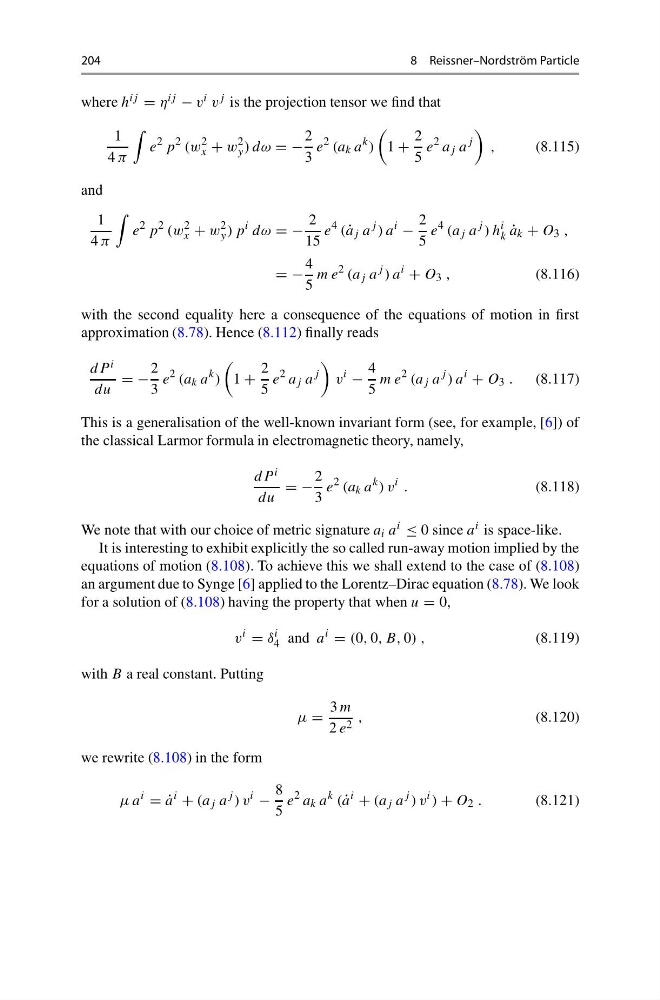
where h ij = η ij − v i v j is the projection tensor we find that
1
4 π
e
2 p
2 (w
2
x + w
2
y ) dω = −
2
3
e
2 (a k a
k )
1 +
2
5
e
2 a j a
j
,
(8.115)
and
1
4 π
e
2 p
2 (w
2
x + w
2
y ) p
i dω = −
2
15
e
4 ( ˙
a j a
j ) a
i
−
2
5
e
4 (a j a
j ) h
i
k ˙
a k + O 3 ,
= −
4
5
m e
2 (a j a
j ) a
i
+ O 3 ,
(8.116)
with the second equality here a consequence of the equations of motion in first
approximation (8.78). Hence (8.112) finally reads
dP i
du
= −
2
3
e
2 (a k a
k )
1 +
2
5
e
2 a j a
j
v
i
−
4
5
m e
2 (a j a
j ) a
i
+ O 3 .
(8.117)
This is a generalisation of the well-known invariant form (see, for example, [6]) of
the classical Larmor formula in electromagnetic theory, namely,
dP i
du
= −
2
3
e
2 (a k a
k ) v
i .
(8.118)
We note that with our choice of metric signature a i a i ≤ 0 since a i is space-like.
It is interesting to exhibit explicitly the so called run-away motion implied by the
equations of motion (8.108). To achieve this we shall extend to the case of (8.108)
an argument due to Synge [6] applied to the Lorentz–Dirac equation (8.78). We look
for a solution of (8.108) having the property that when u = 0,
v
i
= δ
i
4 and a
i
= (0, 0, B, 0) ,
(8.119)
with B a real constant. Putting
μ =
3 m
2 e 2 ,
(8.120)
we rewrite (8.108) in the form
μ a
i
= ˙
a
i
+ (a j a
j ) v
i
−
8
5
e
2 a k a
k ( ˙
a
i
+ (a j a
j ) v
i ) + O 2 .
(8.121)
8 Reissner–Nordström Particle
where h ij = η ij − v i v j is the projection tensor we find that
1
4 π
e
2 p
2 (w
2
x + w
2
y ) dω = −
2
3
e
2 (a k a
k )
1 +
2
5
e
2 a j a
j
,
(8.115)
and
1
4 π
e
2 p
2 (w
2
x + w
2
y ) p
i dω = −
2
15
e
4 ( ˙
a j a
j ) a
i
−
2
5
e
4 (a j a
j ) h
i
k ˙
a k + O 3 ,
= −
4
5
m e
2 (a j a
j ) a
i
+ O 3 ,
(8.116)
with the second equality here a consequence of the equations of motion in first
approximation (8.78). Hence (8.112) finally reads
dP i
du
= −
2
3
e
2 (a k a
k )
1 +
2
5
e
2 a j a
j
v
i
−
4
5
m e
2 (a j a
j ) a
i
+ O 3 .
(8.117)
This is a generalisation of the well-known invariant form (see, for example, [6]) of
the classical Larmor formula in electromagnetic theory, namely,
dP i
du
= −
2
3
e
2 (a k a
k ) v
i .
(8.118)
We note that with our choice of metric signature a i a i ≤ 0 since a i is space-like.
It is interesting to exhibit explicitly the so called run-away motion implied by the
equations of motion (8.108). To achieve this we shall extend to the case of (8.108)
an argument due to Synge [6] applied to the Lorentz–Dirac equation (8.78). We look
for a solution of (8.108) having the property that when u = 0,
v
i
= δ
i
4 and a
i
= (0, 0, B, 0) ,
(8.119)
with B a real constant. Putting
μ =
3 m
2 e 2 ,
(8.120)
we rewrite (8.108) in the form
μ a
i
= ˙
a
i
+ (a j a
j ) v
i
−
8
5
e
2 a k a
k ( ˙
a
i
+ (a j a
j ) v
i ) + O 2 .
(8.121)