

192
8 Reissner–Nordström Particle
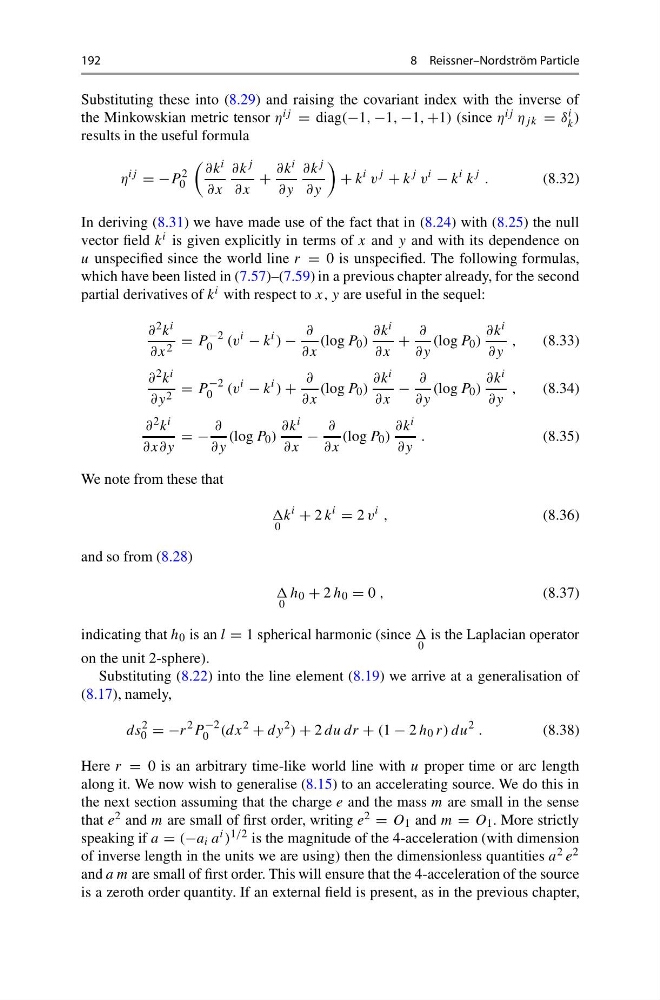
Substituting these into (8.29) and raising the covariant index with the inverse of
the Minkowskian metric tensor η ij = diag(−1, −1, −1, +1) (since η ij η jk = δ i
k )
results in the useful formula
η
ij
= −P
2
0
∂k i
∂x
∂k j
∂x
+
∂k i
∂y
∂k j
∂y
+ k
i v
j
+ k
j v
i
− k
i k
j .
(8.32)
In deriving (8.31) we have made use of the fact that in (8.24) with (8.25) the null
vector field k i is given explicitly in terms of x and y and with its dependence on
u unspecified since the world line r = 0 is unspecified. The following formulas,
which have been listed in (7.57)–(7.59) in a previous chapter already, for the second
partial derivatives of k i with respect to x, y are useful in the sequel:
∂ 2 k i
∂x 2 = P
−2
0 (v
i
− k
i ) −
∂
∂x
(log P 0 )
∂k i
∂x
+
∂
∂y
(log P 0 )
∂k i
∂y
,
(8.33)
∂ 2 k i
∂y 2 = P
−2
0 (v
i
− k
i ) +
∂
∂x
(log P 0 )
∂k i
∂x
−
∂
∂y
(log P 0 )
∂k i
∂y
,
(8.34)
∂ 2 k i
∂x∂y
= −
∂
∂y
(log P 0 )
∂k i
∂x
−
∂
∂x
(log P 0 )
∂k i
∂y
.
(8.35)
We note from these that
0
k
i
+ 2 k
i
= 2 v
i ,
(8.36)
and so from (8.28)
0
h 0 + 2 h 0 = 0 ,
(8.37)
indicating that h 0 is an l = 1 spherical harmonic (since
0
is the Laplacian operator
on the unit 2-sphere).
Substituting (8.22) into the line element (8.19) we arrive at a generalisation of
(8.17), namely,
ds
2
0 = −r
2 P
−2
0 (dx
2
+ dy
2 ) + 2 du dr + (1 − 2 h 0 r) du
2 .
(8.38)
Here r = 0 is an arbitrary time-like world line with u proper time or arc length
along it. We now wish to generalise (8.15) to an accelerating source. We do this in
the next section assuming that the charge e and the mass m are small in the sense
that e 2 and m are small of first order, writing e 2 = O 1 and m = O 1 . More strictly
speaking if a = (−a i a i ) 1/2 is the magnitude of the 4-acceleration (with dimension
of inverse length in the units we are using) then the dimensionless quantities a 2 e 2
and a m are small of first order. This will ensure that the 4-acceleration of the source
is a zeroth order quantity. If an external field is present, as in the previous chapter,
8 Reissner–Nordström Particle
Substituting these into (8.29) and raising the covariant index with the inverse of
the Minkowskian metric tensor η ij = diag(−1, −1, −1, +1) (since η ij η jk = δ i
k )
results in the useful formula
η
ij
= −P
2
0
∂k i
∂x
∂k j
∂x
+
∂k i
∂y
∂k j
∂y
+ k
i v
j
+ k
j v
i
− k
i k
j .
(8.32)
In deriving (8.31) we have made use of the fact that in (8.24) with (8.25) the null
vector field k i is given explicitly in terms of x and y and with its dependence on
u unspecified since the world line r = 0 is unspecified. The following formulas,
which have been listed in (7.57)–(7.59) in a previous chapter already, for the second
partial derivatives of k i with respect to x, y are useful in the sequel:
∂ 2 k i
∂x 2 = P
−2
0 (v
i
− k
i ) −
∂
∂x
(log P 0 )
∂k i
∂x
+
∂
∂y
(log P 0 )
∂k i
∂y
,
(8.33)
∂ 2 k i
∂y 2 = P
−2
0 (v
i
− k
i ) +
∂
∂x
(log P 0 )
∂k i
∂x
−
∂
∂y
(log P 0 )
∂k i
∂y
,
(8.34)
∂ 2 k i
∂x∂y
= −
∂
∂y
(log P 0 )
∂k i
∂x
−
∂
∂x
(log P 0 )
∂k i
∂y
.
(8.35)
We note from these that
0
k
i
+ 2 k
i
= 2 v
i ,
(8.36)
and so from (8.28)
0
h 0 + 2 h 0 = 0 ,
(8.37)
indicating that h 0 is an l = 1 spherical harmonic (since
0
is the Laplacian operator
on the unit 2-sphere).
Substituting (8.22) into the line element (8.19) we arrive at a generalisation of
(8.17), namely,
ds
2
0 = −r
2 P
−2
0 (dx
2
+ dy
2 ) + 2 du dr + (1 − 2 h 0 r) du
2 .
(8.38)
Here r = 0 is an arbitrary time-like world line with u proper time or arc length
along it. We now wish to generalise (8.15) to an accelerating source. We do this in
the next section assuming that the charge e and the mass m are small in the sense
that e 2 and m are small of first order, writing e 2 = O 1 and m = O 1 . More strictly
speaking if a = (−a i a i ) 1/2 is the magnitude of the 4-acceleration (with dimension
of inverse length in the units we are using) then the dimensionless quantities a 2 e 2
and a m are small of first order. This will ensure that the 4-acceleration of the source
is a zeroth order quantity. If an external field is present, as in the previous chapter,