

8.2 Accelerating Reissner–Nordström Particle
191
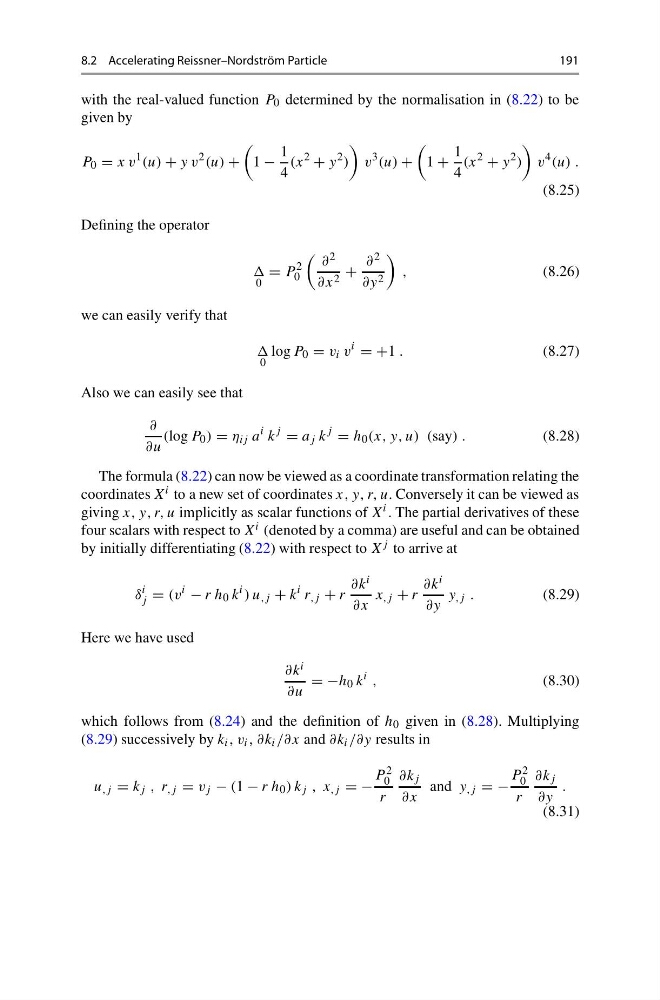
with the real-valued function P 0 determined by the normalisation in (8.22) to be
given by
P 0 = x v
1 (u) + y v
2 (u) +
1 −
1
4
(x
2
+ y
2 )
v
3 (u) +
1 +
1
4
(x
2
+ y
2 )
v
4 (u) .
(8.25)
Defining the operator
0
= P
2
0
∂ 2
∂x 2 +
∂ 2
∂y 2
,
(8.26)
we can easily verify that
0
log P 0 = v i v
i
= +1 .
(8.27)
Also we can easily see that
∂
∂u
(log P 0 ) = η ij a
i k
j
= a j k
j
= h 0 (x, y, u) (say) .
(8.28)
The formula (8.22) can now be viewed as a coordinate transformation relating the
coordinates X i to a new set of coordinates x, y, r, u. Conversely it can be viewed as
giving x, y, r, u implicitly as scalar functions of X i . The partial derivatives of these
four scalars with respect to X i (denoted by a comma) are useful and can be obtained
by initially differentiating (8.22) with respect to X j to arrive at
δ
i
j = (v
i
− r h 0 k
i ) u ,j + k
i r ,j + r
∂k i
∂x
x ,j + r
∂k i
∂y
y ,j .
(8.29)
Here we have used
∂k i
∂u
= −h 0 k
i ,
(8.30)
which follows from (8.24) and the definition of h 0 given in (8.28). Multiplying
(8.29) successively by k i , v i , ∂k i /∂x and ∂k i /∂y results in
u ,j = k j , r ,j = v j − (1 − r h 0 ) k j , x ,j = −
P 2
0
r
∂k j
∂x
and y ,j = −
P 2
0
r
∂k j
∂y
.
(8.31)
191
with the real-valued function P 0 determined by the normalisation in (8.22) to be
given by
P 0 = x v
1 (u) + y v
2 (u) +
1 −
1
4
(x
2
+ y
2 )
v
3 (u) +
1 +
1
4
(x
2
+ y
2 )
v
4 (u) .
(8.25)
Defining the operator
0
= P
2
0
∂ 2
∂x 2 +
∂ 2
∂y 2
,
(8.26)
we can easily verify that
0
log P 0 = v i v
i
= +1 .
(8.27)
Also we can easily see that
∂
∂u
(log P 0 ) = η ij a
i k
j
= a j k
j
= h 0 (x, y, u) (say) .
(8.28)
The formula (8.22) can now be viewed as a coordinate transformation relating the
coordinates X i to a new set of coordinates x, y, r, u. Conversely it can be viewed as
giving x, y, r, u implicitly as scalar functions of X i . The partial derivatives of these
four scalars with respect to X i (denoted by a comma) are useful and can be obtained
by initially differentiating (8.22) with respect to X j to arrive at
δ
i
j = (v
i
− r h 0 k
i ) u ,j + k
i r ,j + r
∂k i
∂x
x ,j + r
∂k i
∂y
y ,j .
(8.29)
Here we have used
∂k i
∂u
= −h 0 k
i ,
(8.30)
which follows from (8.24) and the definition of h 0 given in (8.28). Multiplying
(8.29) successively by k i , v i , ∂k i /∂x and ∂k i /∂y results in
u ,j = k j , r ,j = v j − (1 − r h 0 ) k j , x ,j = −
P 2
0
r
∂k j
∂x
and y ,j = −
P 2
0
r
∂k j
∂y
.
(8.31)