

190
8 Reissner–Nordström Particle
may be a small perturbation of Minkowskian space-time which is singular on r = 0
in the “background” Minkowskian space-time.
8.2
Accelerating Reissner–Nordström Particle
We generalise the latter part of the introduction above by first writing the
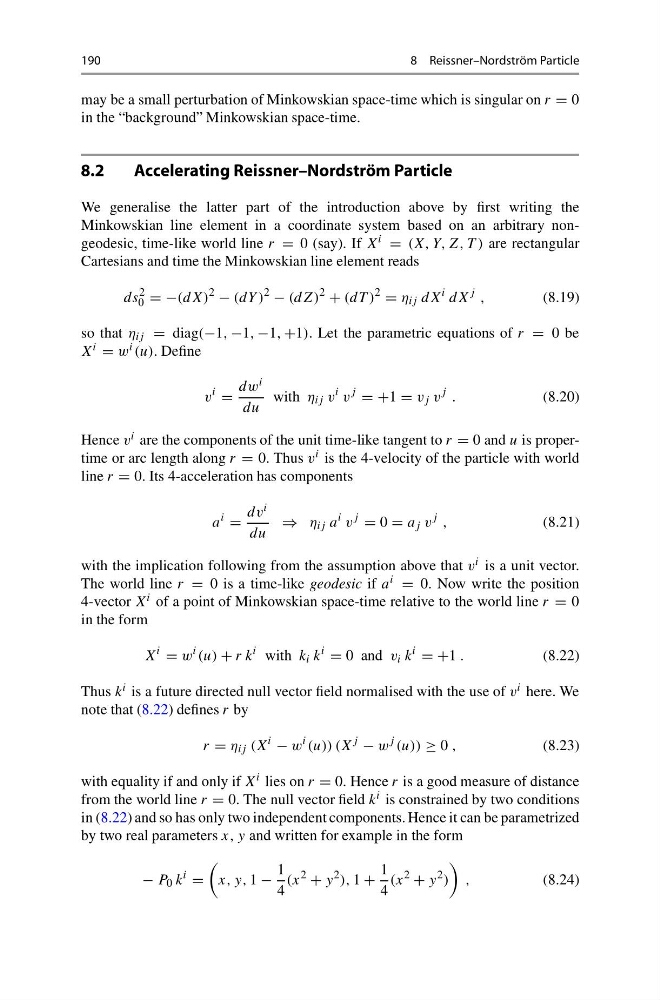
Minkowskian line element in a coordinate system based on an arbitrary nongeodesic, time-like world line r = 0 (say). If X i = (X, Y, Z, T ) are rectangular
Cartesians and time the Minkowskian line element reads
ds
2
0 = −(dX)
2
− (dY )
2
− (dZ)
2
+ (dT )
2
= η ij dX
i dX
j ,
(8.19)
so that η ij = diag(−1, −1, −1, +1). Let the parametric equations of r = 0 be
X i = w i (u). Define
v
i
=
dw i
du
with η ij v
i v
j
= +1 = v j v
j .
(8.20)
Hence v i are the components of the unit time-like tangent to r = 0 and u is propertime or arc length along r = 0. Thus v i is the 4-velocity of the particle with world
line r = 0. Its 4-acceleration has components
a
i
=
dv i
du
⇒ η ij a
i v
j
= 0 = a j v
j ,
(8.21)
with the implication following from the assumption above that v i is a unit vector.
The world line r = 0 is a time-like geodesic if a i = 0. Now write the position
4-vector X i of a point of Minkowskian space-time relative to the world line r = 0
in the form
X
i
= w
i (u) + r k
i with k i k
i
= 0 and v i k
i
= +1 .
(8.22)
Thus k i is a future directed null vector field normalised with the use of v i here. We
note that (8.22) defines r by
r = η ij (X
i
− w
i (u)) (X
j
− w
j (u)) ≥ 0 ,
(8.23)
with equality if and only if X i lies on r = 0. Hence r is a good measure of distance
from the world line r = 0. The null vector field k i is constrained by two conditions
in (8.22) and so has only two independent components. Hence it can be parametrized
by two real parameters x, y and written for example in the form
− P 0 k
i
=
x, y, 1 −
1
4
(x
2
+ y
2 ), 1 +
1
4
(x
2
+ y
2 )
,
(8.24)
8 Reissner–Nordström Particle
may be a small perturbation of Minkowskian space-time which is singular on r = 0
in the “background” Minkowskian space-time.
8.2
Accelerating Reissner–Nordström Particle
We generalise the latter part of the introduction above by first writing the
Minkowskian line element in a coordinate system based on an arbitrary nongeodesic, time-like world line r = 0 (say). If X i = (X, Y, Z, T ) are rectangular
Cartesians and time the Minkowskian line element reads
ds
2
0 = −(dX)
2
− (dY )
2
− (dZ)
2
+ (dT )
2
= η ij dX
i dX
j ,
(8.19)
so that η ij = diag(−1, −1, −1, +1). Let the parametric equations of r = 0 be
X i = w i (u). Define
v
i
=
dw i
du
with η ij v
i v
j
= +1 = v j v
j .
(8.20)
Hence v i are the components of the unit time-like tangent to r = 0 and u is propertime or arc length along r = 0. Thus v i is the 4-velocity of the particle with world
line r = 0. Its 4-acceleration has components
a
i
=
dv i
du
⇒ η ij a
i v
j
= 0 = a j v
j ,
(8.21)
with the implication following from the assumption above that v i is a unit vector.
The world line r = 0 is a time-like geodesic if a i = 0. Now write the position
4-vector X i of a point of Minkowskian space-time relative to the world line r = 0
in the form
X
i
= w
i (u) + r k
i with k i k
i
= 0 and v i k
i
= +1 .
(8.22)
Thus k i is a future directed null vector field normalised with the use of v i here. We
note that (8.22) defines r by
r = η ij (X
i
− w
i (u)) (X
j
− w
j (u)) ≥ 0 ,
(8.23)
with equality if and only if X i lies on r = 0. Hence r is a good measure of distance
from the world line r = 0. The null vector field k i is constrained by two conditions
in (8.22) and so has only two independent components. Hence it can be parametrized
by two real parameters x, y and written for example in the form
− P 0 k
i
=
x, y, 1 −
1
4
(x
2
+ y
2 ), 1 +
1
4
(x
2
+ y
2 )
,
(8.24)