

158
7 Small Magnetic Black Hole
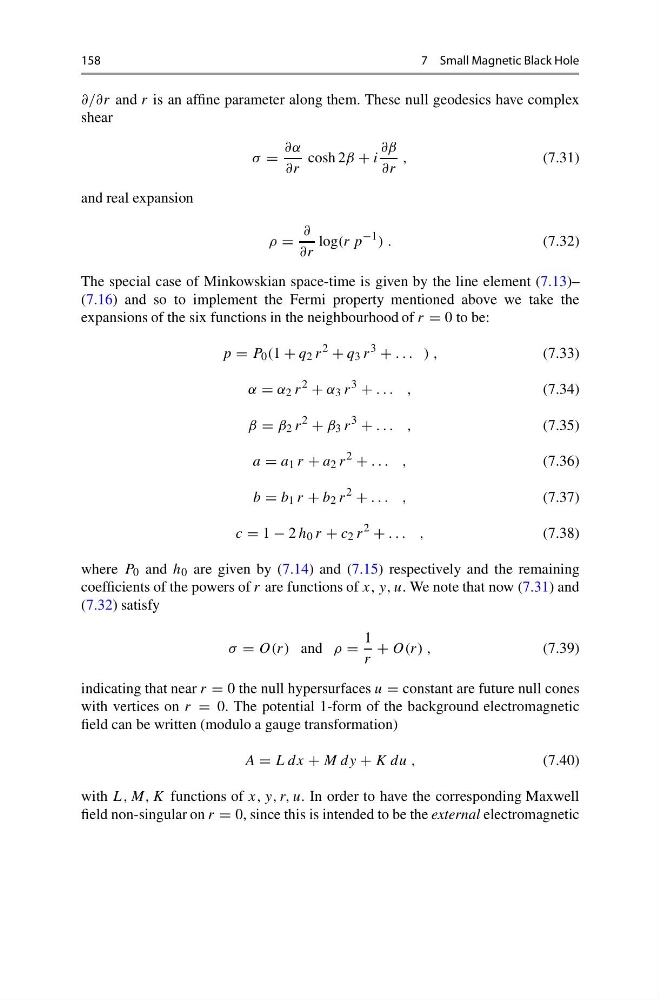
∂/∂r and r is an affine parameter along them. These null geodesics have complex
shear
σ =
∂α
∂r
cosh 2β + i
∂β
∂r
,
(7.31)
and real expansion
ρ =
∂
∂r
log(r p
−1 ) .
(7.32)
The special case of Minkowskian space-time is given by the line element (7.13)–
(7.16) and so to implement the Fermi property mentioned above we take the
expansions of the six functions in the neighbourhood of r = 0 to be:
p = P 0 (1 + q 2 r
2
+ q 3 r
3
+ . . . ) ,
(7.33)
α = α 2 r
2
+ α 3 r
3
+ . . . ,
(7.34)
β = β 2 r
2
+ β 3 r
3
+ . . . ,
(7.35)
a = a 1 r + a 2 r
2
+ . . . ,
(7.36)
b = b 1 r + b 2 r
2
+ . . . ,
(7.37)
c = 1 − 2 h 0 r + c 2 r
2
+ . . . ,
(7.38)
where P 0 and h 0 are given by (7.14) and (7.15) respectively and the remaining
coefficients of the powers of r are functions of x, y, u. We note that now (7.31) and
(7.32) satisfy
σ = O(r) and ρ =
1
r
+ O(r) ,
(7.39)
indicating that near r = 0 the null hypersurfaces u = constant are future null cones
with vertices on r = 0. The potential 1-form of the background electromagnetic
field can be written (modulo a gauge transformation)
A = L dx + M dy + K du ,
(7.40)
with L, M, K functions of x, y, r, u. In order to have the corresponding Maxwell
field non-singular on r = 0, since this is intended to be the external electromagnetic
7 Small Magnetic Black Hole
∂/∂r and r is an affine parameter along them. These null geodesics have complex
shear
σ =
∂α
∂r
cosh 2β + i
∂β
∂r
,
(7.31)
and real expansion
ρ =
∂
∂r
log(r p
−1 ) .
(7.32)
The special case of Minkowskian space-time is given by the line element (7.13)–
(7.16) and so to implement the Fermi property mentioned above we take the
expansions of the six functions in the neighbourhood of r = 0 to be:
p = P 0 (1 + q 2 r
2
+ q 3 r
3
+ . . . ) ,
(7.33)
α = α 2 r
2
+ α 3 r
3
+ . . . ,
(7.34)
β = β 2 r
2
+ β 3 r
3
+ . . . ,
(7.35)
a = a 1 r + a 2 r
2
+ . . . ,
(7.36)
b = b 1 r + b 2 r
2
+ . . . ,
(7.37)
c = 1 − 2 h 0 r + c 2 r
2
+ . . . ,
(7.38)
where P 0 and h 0 are given by (7.14) and (7.15) respectively and the remaining
coefficients of the powers of r are functions of x, y, u. We note that now (7.31) and
(7.32) satisfy
σ = O(r) and ρ =
1
r
+ O(r) ,
(7.39)
indicating that near r = 0 the null hypersurfaces u = constant are future null cones
with vertices on r = 0. The potential 1-form of the background electromagnetic
field can be written (modulo a gauge transformation)
A = L dx + M dy + K du ,
(7.40)
with L, M, K functions of x, y, r, u. In order to have the corresponding Maxwell
field non-singular on r = 0, since this is intended to be the external electromagnetic