

7.2 Background Space-Time/External Fields
157
on account of (7.10), while the gravitational field (the Weyl tensor) has only one
non-vanishing Newman–Penrose component:
2 = −
1
2
R (3)(4)(3)(4) + E (3)(4) = −
m
r 3 +
g 2
r 4 ,
(7.25)
where R (a)(b)(c)(d) are the tetrad components of the Riemann tensor and E (a)(b) are
the tetrad components of the electromagnetic energy-momentum tensor.
7.2
Background Space-Time/External Fields
The external gravitational and electromagnetic fields in which we place the magnetic
black hole are modelled by a potential 1-form and a space-time manifold which
are solutions of the vacuum Einstein–Maxwell field equations. The space-time
manifold contains a time-like world line (r = 0) on which the Maxwell field
and the gravitational field (described by the Weyl conformal curvature tensor of
the space-time) are non-singular. The space-time has the Fermi property of being
Minkowskian in the neighbourhood of the world line r = 0 in the sense that the
metric tensor is the Minkowskian metric tensor if we neglect terms of order r 2 . The
details are motivated and described in [9] and so we will briefly outline the results
now. A convenient form of the line element for our purposes reads (see [10])
ds
2
= −(ϑ
(1) )
2
− (ϑ
(2) )
2
+ 2 ϑ
(3) ϑ
(4)
= g (a)(b) ϑ
(a) ϑ
(b) ,
(7.26)
with
ϑ
(1)
= r p
−1 (e
α cosh β dx + e
−α sinh β dy + a du) ,
(7.27)
ϑ
(2)
= r p
−1 (e
α sinh β dx + e
−α cosh β dy + b du) ,
(7.28)
ϑ
(3)
= dr +
c
2
du ,
(7.29)
ϑ
(4)
= du .
(7.30)
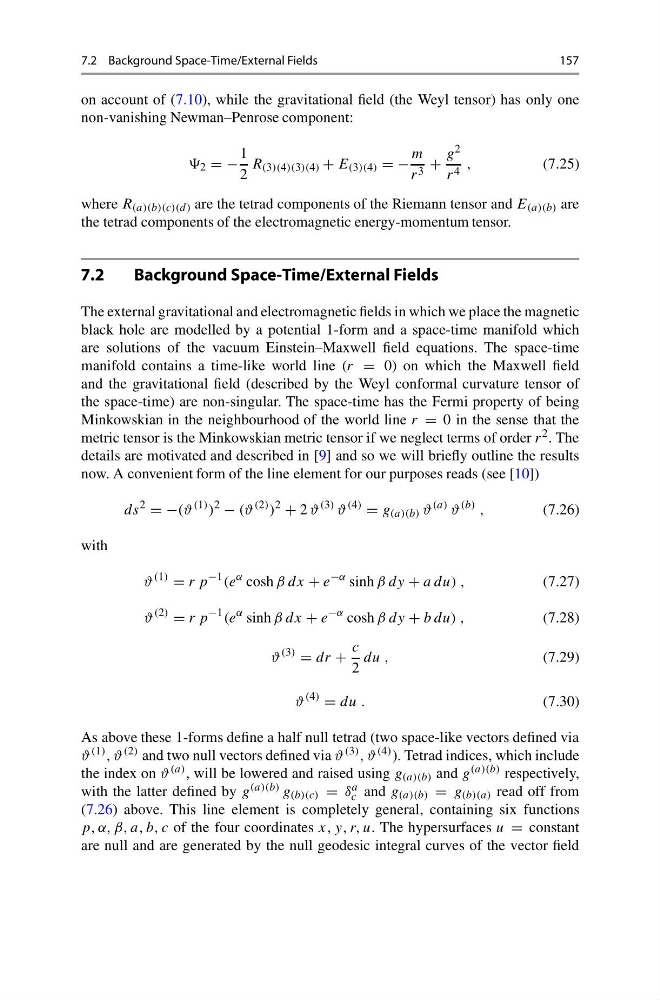
As above these 1-forms define a half null tetrad (two space-like vectors defined via
ϑ (1) , ϑ (2) and two null vectors defined via ϑ (3) , ϑ (4) ). Tetrad indices, which include
the index on ϑ (a) , will be lowered and raised using g (a)(b) and g (a)(b) respectively,
with the latter defined by g (a)(b) g (b)(c) = δ a
c and g (a)(b) = g (b)(a) read off from
(7.26) above. This line element is completely general, containing six functions
p, α, β, a, b, c of the four coordinates x, y, r, u. The hypersurfaces u = constant
are null and are generated by the null geodesic integral curves of the vector field
157
on account of (7.10), while the gravitational field (the Weyl tensor) has only one
non-vanishing Newman–Penrose component:
2 = −
1
2
R (3)(4)(3)(4) + E (3)(4) = −
m
r 3 +
g 2
r 4 ,
(7.25)
where R (a)(b)(c)(d) are the tetrad components of the Riemann tensor and E (a)(b) are
the tetrad components of the electromagnetic energy-momentum tensor.
7.2
Background Space-Time/External Fields
The external gravitational and electromagnetic fields in which we place the magnetic
black hole are modelled by a potential 1-form and a space-time manifold which
are solutions of the vacuum Einstein–Maxwell field equations. The space-time
manifold contains a time-like world line (r = 0) on which the Maxwell field
and the gravitational field (described by the Weyl conformal curvature tensor of
the space-time) are non-singular. The space-time has the Fermi property of being
Minkowskian in the neighbourhood of the world line r = 0 in the sense that the
metric tensor is the Minkowskian metric tensor if we neglect terms of order r 2 . The
details are motivated and described in [9] and so we will briefly outline the results
now. A convenient form of the line element for our purposes reads (see [10])
ds
2
= −(ϑ
(1) )
2
− (ϑ
(2) )
2
+ 2 ϑ
(3) ϑ
(4)
= g (a)(b) ϑ
(a) ϑ
(b) ,
(7.26)
with
ϑ
(1)
= r p
−1 (e
α cosh β dx + e
−α sinh β dy + a du) ,
(7.27)
ϑ
(2)
= r p
−1 (e
α sinh β dx + e
−α cosh β dy + b du) ,
(7.28)
ϑ
(3)
= dr +
c
2
du ,
(7.29)
ϑ
(4)
= du .
(7.30)
As above these 1-forms define a half null tetrad (two space-like vectors defined via
ϑ (1) , ϑ (2) and two null vectors defined via ϑ (3) , ϑ (4) ). Tetrad indices, which include
the index on ϑ (a) , will be lowered and raised using g (a)(b) and g (a)(b) respectively,
with the latter defined by g (a)(b) g (b)(c) = δ a
c and g (a)(b) = g (b)(a) read off from
(7.26) above. This line element is completely general, containing six functions
p, α, β, a, b, c of the four coordinates x, y, r, u. The hypersurfaces u = constant
are null and are generated by the null geodesic integral curves of the vector field