

156
7 Small Magnetic Black Hole
we have
ds
2
= −(ϑ
(1) )
2
− (ϑ
(2) )
2
+ 2 ϑ
(3) ϑ
(4)
= g (a)(b) ϑ
(a) ϑ
(b) ,
(7.20)
and
F = dA =
g
r 2 ϑ
(1)
∧ ϑ
(2)
−
g
r
P 0
∂h 0
∂x
ϑ
(2)
∧ ϑ
(4)
+
g
r
P 0
∂h 0
∂y
ϑ
(1)
∧ ϑ
(4)
=
1
2
F (a)(b) ϑ
(a)
∧ ϑ
(b) .
(7.21)
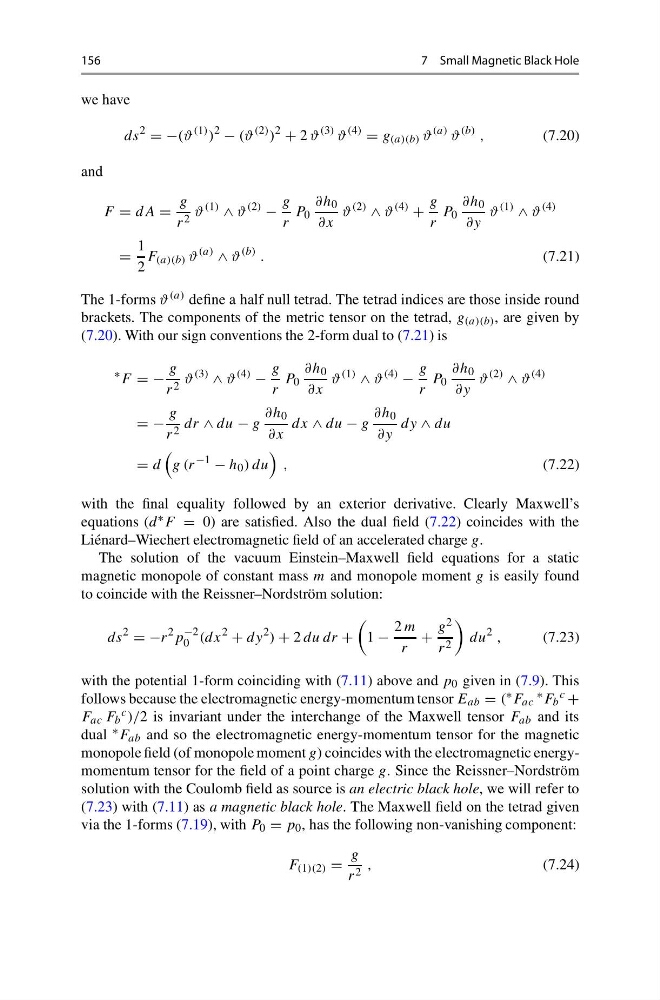
The 1-forms ϑ (a) define a half null tetrad. The tetrad indices are those inside round
brackets. The components of the metric tensor on the tetrad, g (a)(b) , are given by
(7.20). With our sign conventions the 2-form dual to (7.21) is
∗ F = −
g
r 2 ϑ
(3)
∧ ϑ
(4)
−
g
r
P 0
∂h 0
∂x
ϑ
(1)
∧ ϑ
(4)
−
g
r
P 0
∂h 0
∂y
ϑ
(2)
∧ ϑ
(4)
= −
g
r 2 dr ∧ du − g
∂h 0
∂x
dx ∧ du − g
∂h 0
∂y
dy ∧ du
= d
g (r
−1
− h 0 ) du
,
(7.22)
with the final equality followed by an exterior derivative. Clearly Maxwell’s
equations (d ∗ F = 0) are satisfied. Also the dual field (7.22) coincides with the
Liénard–Wiechert electromagnetic field of an accelerated charge g.
The solution of the vacuum Einstein–Maxwell field equations for a static
magnetic monopole of constant mass m and monopole moment g is easily found
to coincide with the Reissner–Nordström solution:
ds
2
= −r
2 p
−2
0 (dx
2
+ dy
2 ) + 2 du dr +
1 −
2 m
r
+
g 2
r 2
du
2 ,
(7.23)
with the potential 1-form coinciding with (7.11) above and p 0 given in (7.9). This
follows because the electromagnetic energy-momentum tensor E ab = ( ∗ F ac
∗ F b
c +
F ac F b
c )/2 is invariant under the interchange of the Maxwell tensor F ab and its
dual ∗ F ab and so the electromagnetic energy-momentum tensor for the magnetic
monopole field (of monopole moment g) coincides with the electromagnetic energymomentum tensor for the field of a point charge g. Since the Reissner–Nordström
solution with the Coulomb field as source is an electric black hole, we will refer to
(7.23) with (7.11) as a magnetic black hole. The Maxwell field on the tetrad given
via the 1-forms (7.19), with P 0 = p 0 , has the following non-vanishing component:
F (1)(2) =
g
r 2 ,
(7.24)
7 Small Magnetic Black Hole
we have
ds
2
= −(ϑ
(1) )
2
− (ϑ
(2) )
2
+ 2 ϑ
(3) ϑ
(4)
= g (a)(b) ϑ
(a) ϑ
(b) ,
(7.20)
and
F = dA =
g
r 2 ϑ
(1)
∧ ϑ
(2)
−
g
r
P 0
∂h 0
∂x
ϑ
(2)
∧ ϑ
(4)
+
g
r
P 0
∂h 0
∂y
ϑ
(1)
∧ ϑ
(4)
=
1
2
F (a)(b) ϑ
(a)
∧ ϑ
(b) .
(7.21)
The 1-forms ϑ (a) define a half null tetrad. The tetrad indices are those inside round
brackets. The components of the metric tensor on the tetrad, g (a)(b) , are given by
(7.20). With our sign conventions the 2-form dual to (7.21) is
∗ F = −
g
r 2 ϑ
(3)
∧ ϑ
(4)
−
g
r
P 0
∂h 0
∂x
ϑ
(1)
∧ ϑ
(4)
−
g
r
P 0
∂h 0
∂y
ϑ
(2)
∧ ϑ
(4)
= −
g
r 2 dr ∧ du − g
∂h 0
∂x
dx ∧ du − g
∂h 0
∂y
dy ∧ du
= d
g (r
−1
− h 0 ) du
,
(7.22)
with the final equality followed by an exterior derivative. Clearly Maxwell’s
equations (d ∗ F = 0) are satisfied. Also the dual field (7.22) coincides with the
Liénard–Wiechert electromagnetic field of an accelerated charge g.
The solution of the vacuum Einstein–Maxwell field equations for a static
magnetic monopole of constant mass m and monopole moment g is easily found
to coincide with the Reissner–Nordström solution:
ds
2
= −r
2 p
−2
0 (dx
2
+ dy
2 ) + 2 du dr +
1 −
2 m
r
+
g 2
r 2
du
2 ,
(7.23)
with the potential 1-form coinciding with (7.11) above and p 0 given in (7.9). This
follows because the electromagnetic energy-momentum tensor E ab = ( ∗ F ac
∗ F b
c +
F ac F b
c )/2 is invariant under the interchange of the Maxwell tensor F ab and its
dual ∗ F ab and so the electromagnetic energy-momentum tensor for the magnetic
monopole field (of monopole moment g) coincides with the electromagnetic energymomentum tensor for the field of a point charge g. Since the Reissner–Nordström
solution with the Coulomb field as source is an electric black hole, we will refer to
(7.23) with (7.11) as a magnetic black hole. The Maxwell field on the tetrad given
via the 1-forms (7.19), with P 0 = p 0 , has the following non-vanishing component:
F (1)(2) =
g
r 2 ,
(7.24)