

7.1 Magnetic Poles
155
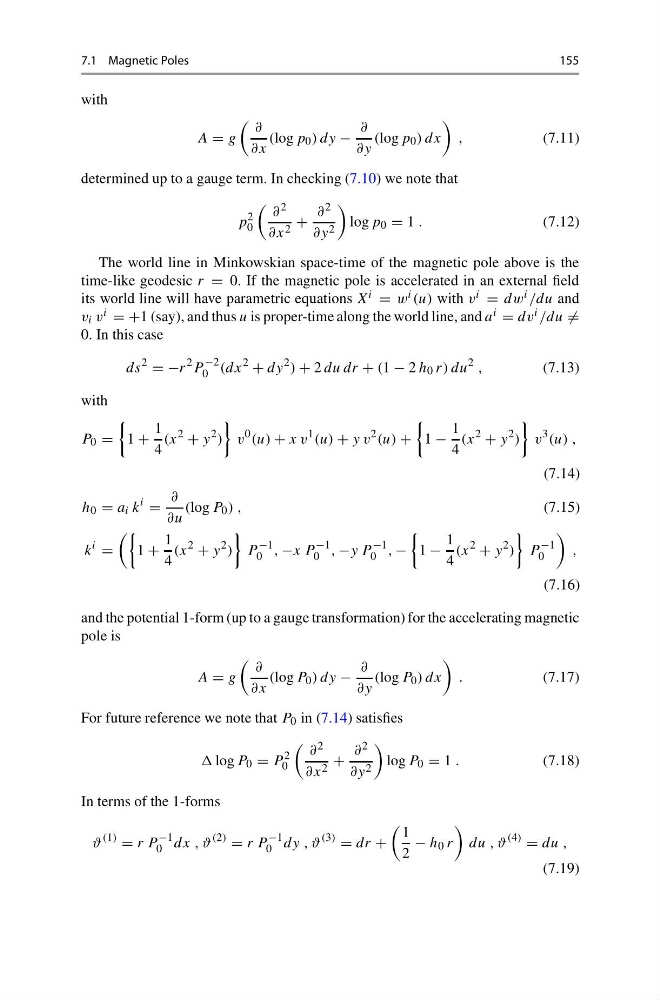
with
A = g
∂
∂x
(log p 0 ) dy −
∂
∂y
(log p 0 ) dx
,
(7.11)
determined up to a gauge term. In checking (7.10) we note that
p
2
0
∂ 2
∂x 2 +
∂ 2
∂y 2
log p 0 = 1 .
(7.12)
The world line in Minkowskian space-time of the magnetic pole above is the
time-like geodesic r = 0. If the magnetic pole is accelerated in an external field
its world line will have parametric equations X i = w i (u) with v i = dw i /du and
v i v i = +1 (say), and thus u is proper-time along the world line, and a i = dv i /du =
0. In this case
ds
2
= −r
2 P
−2
0 (dx
2
+ dy
2 ) + 2 du dr + (1 − 2 h 0 r) du
2 ,
(7.13)
with
P 0 =
1 +
1
4
(x
2
+ y
2 )
v
0 (u) + x v
1 (u) + y v
2 (u) +
1 −
1
4
(x
2
+ y
2 )
v
3 (u) ,
(7.14)
h 0 = a i k
i
=
∂
∂u
(log P 0 ) ,
(7.15)
k
i
=
1 +
1
4
(x
2
+ y
2 )
P
−1
0 , −x P
−1
0 , −y P
−1
0 , −
1 −
1
4
(x
2
+ y
2 )
P
−1
0
,
(7.16)
and the potential 1-form (up to a gauge transformation) for the accelerating magnetic
pole is
A = g
∂
∂x
(log P 0 ) dy −
∂
∂y
(log P 0 ) dx
.
(7.17)
For future reference we note that P 0 in (7.14) satisfies
log P 0 = P
2
0
∂ 2
∂x 2 +
∂ 2
∂y 2
log P 0 = 1 .
(7.18)
In terms of the 1-forms
ϑ
(1)
= r P
−1
0 dx , ϑ
(2)
= r P
−1
0 dy , ϑ
(3)
= dr +
1
2
− h 0 r
du , ϑ
(4)
= du ,
(7.19)
155
with
A = g
∂
∂x
(log p 0 ) dy −
∂
∂y
(log p 0 ) dx
,
(7.11)
determined up to a gauge term. In checking (7.10) we note that
p
2
0
∂ 2
∂x 2 +
∂ 2
∂y 2
log p 0 = 1 .
(7.12)
The world line in Minkowskian space-time of the magnetic pole above is the
time-like geodesic r = 0. If the magnetic pole is accelerated in an external field
its world line will have parametric equations X i = w i (u) with v i = dw i /du and
v i v i = +1 (say), and thus u is proper-time along the world line, and a i = dv i /du =
0. In this case
ds
2
= −r
2 P
−2
0 (dx
2
+ dy
2 ) + 2 du dr + (1 − 2 h 0 r) du
2 ,
(7.13)
with
P 0 =
1 +
1
4
(x
2
+ y
2 )
v
0 (u) + x v
1 (u) + y v
2 (u) +
1 −
1
4
(x
2
+ y
2 )
v
3 (u) ,
(7.14)
h 0 = a i k
i
=
∂
∂u
(log P 0 ) ,
(7.15)
k
i
=
1 +
1
4
(x
2
+ y
2 )
P
−1
0 , −x P
−1
0 , −y P
−1
0 , −
1 −
1
4
(x
2
+ y
2 )
P
−1
0
,
(7.16)
and the potential 1-form (up to a gauge transformation) for the accelerating magnetic
pole is
A = g
∂
∂x
(log P 0 ) dy −
∂
∂y
(log P 0 ) dx
.
(7.17)
For future reference we note that P 0 in (7.14) satisfies
log P 0 = P
2
0
∂ 2
∂x 2 +
∂ 2
∂y 2
log P 0 = 1 .
(7.18)
In terms of the 1-forms
ϑ
(1)
= r P
−1
0 dx , ϑ
(2)
= r P
−1
0 dy , ϑ
(3)
= dr +
1
2
− h 0 r
du , ϑ
(4)
= du ,
(7.19)