

6.5 Collision of Gravitational Waves and = 0
149
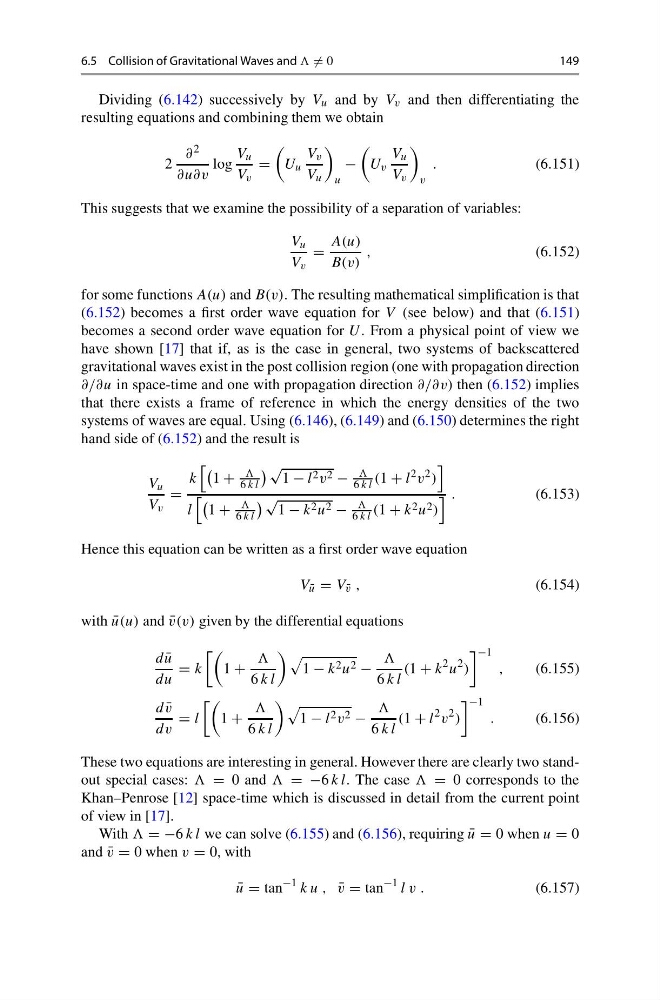
Dividing (6.142) successively by V u and by V v and then differentiating the
resulting equations and combining them we obtain
2
∂ 2
∂u∂v
log
V u
V v
=
U u
V v
V u
u
−
U v
V u
V v
v
.
(6.151)
This suggests that we examine the possibility of a separation of variables:
V u
V v
=
A(u)
B(v)
,
(6.152)
for some functions A(u) and B(v). The resulting mathematical simplification is that
(6.152) becomes a first order wave equation for V (see below) and that (6.151)
becomes a second order wave equation for U . From a physical point of view we
have shown [17] that if, as is the case in general, two systems of backscattered
gravitational waves exist in the post collision region (one with propagation direction
∂/∂u in space-time and one with propagation direction ∂/∂v) then (6.152) implies
that there exists a frame of reference in which the energy densities of the two
systems of waves are equal. Using (6.146), (6.149) and (6.150) determines the right
hand side of (6.152) and the result is
V u
V v
=
k
1 +
6 k l
√
1 − l 2 v 2 −
6 k l (1 + l 2 v 2 )
l
1 +
6 k l
√
1 − k 2 u 2 −
6 k l (1 + k 2 u 2 )
.
(6.153)
Hence this equation can be written as a first order wave equation
V ¯
u = V ¯
v ,
(6.154)
with ¯
u(u) and ¯
v(v) given by the differential equations
d ¯
u
du
= k
1 +
6 k l
1 − k 2 u 2 −
6 k l
(1 + k
2 u
2 )
−1
,
(6.155)
d ¯
v
dv
= l
1 +
6 k l
1 − l 2 v 2 −
6 k l
(1 + l
2 v
2 )
−1
.
(6.156)
These two equations are interesting in general. However there are clearly two standout special cases: = 0 and = −6 k l. The case = 0 corresponds to the
Khan–Penrose [12] space-time which is discussed in detail from the current point
of view in [17].
With = −6 k l we can solve (6.155) and (6.156), requiring ¯
u = 0 when u = 0
and ¯
v = 0 when v = 0, with
¯
u = tan
−1 k u , ¯
v = tan
−1 l v .
(6.157)
149
Dividing (6.142) successively by V u and by V v and then differentiating the
resulting equations and combining them we obtain
2
∂ 2
∂u∂v
log
V u
V v
=
U u
V v
V u
u
−
U v
V u
V v
v
.
(6.151)
This suggests that we examine the possibility of a separation of variables:
V u
V v
=
A(u)
B(v)
,
(6.152)
for some functions A(u) and B(v). The resulting mathematical simplification is that
(6.152) becomes a first order wave equation for V (see below) and that (6.151)
becomes a second order wave equation for U . From a physical point of view we
have shown [17] that if, as is the case in general, two systems of backscattered
gravitational waves exist in the post collision region (one with propagation direction
∂/∂u in space-time and one with propagation direction ∂/∂v) then (6.152) implies
that there exists a frame of reference in which the energy densities of the two
systems of waves are equal. Using (6.146), (6.149) and (6.150) determines the right
hand side of (6.152) and the result is
V u
V v
=
k
1 +
6 k l
√
1 − l 2 v 2 −
6 k l (1 + l 2 v 2 )
l
1 +
6 k l
√
1 − k 2 u 2 −
6 k l (1 + k 2 u 2 )
.
(6.153)
Hence this equation can be written as a first order wave equation
V ¯
u = V ¯
v ,
(6.154)
with ¯
u(u) and ¯
v(v) given by the differential equations
d ¯
u
du
= k
1 +
6 k l
1 − k 2 u 2 −
6 k l
(1 + k
2 u
2 )
−1
,
(6.155)
d ¯
v
dv
= l
1 +
6 k l
1 − l 2 v 2 −
6 k l
(1 + l
2 v
2 )
−1
.
(6.156)
These two equations are interesting in general. However there are clearly two standout special cases: = 0 and = −6 k l. The case = 0 corresponds to the
Khan–Penrose [12] space-time which is discussed in detail from the current point
of view in [17].
With = −6 k l we can solve (6.155) and (6.156), requiring ¯
u = 0 when u = 0
and ¯
v = 0 when v = 0, with
¯
u = tan
−1 k u , ¯
v = tan
−1 l v .
(6.157)