

6.5 Collision of Gravitational Waves and = 0
147
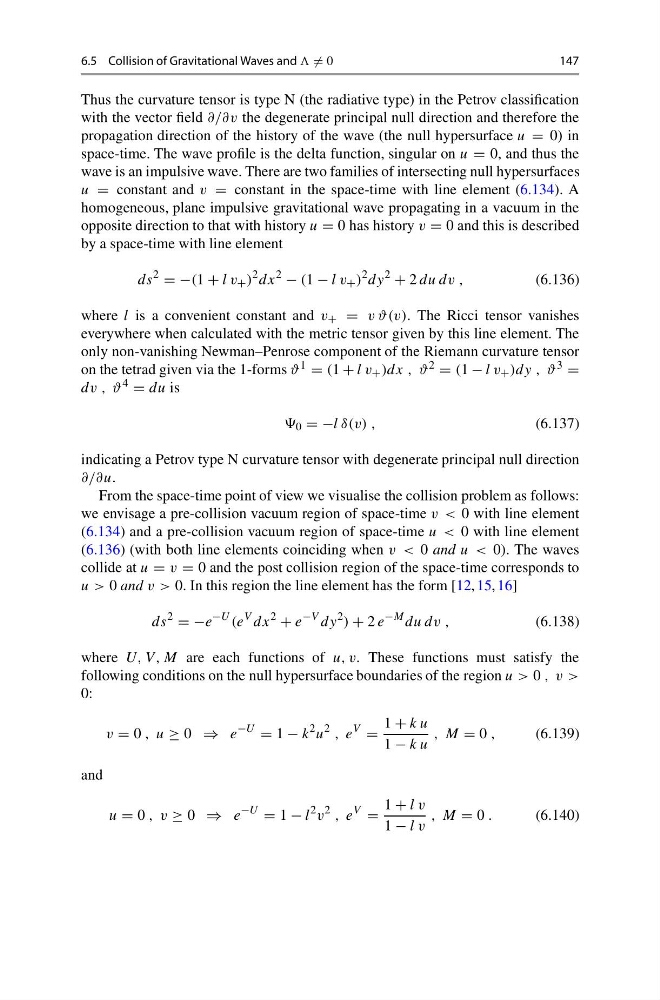
Thus the curvature tensor is type N (the radiative type) in the Petrov classification
with the vector field ∂/∂v the degenerate principal null direction and therefore the
propagation direction of the history of the wave (the null hypersurface u = 0) in
space-time. The wave profile is the delta function, singular on u = 0, and thus the
wave is an impulsive wave. There are two families of intersecting null hypersurfaces
u = constant and v = constant in the space-time with line element (6.134). A
homogeneous, plane impulsive gravitational wave propagating in a vacuum in the
opposite direction to that with history u = 0 has history v = 0 and this is described
by a space-time with line element
ds
2
= −(1 + l v + )
2 dx
2
− (1 − l v + )
2 dy
2
+ 2 du dv ,
(6.136)
where l is a convenient constant and v + = v ϑ(v). The Ricci tensor vanishes
everywhere when calculated with the metric tensor given by this line element. The
only non-vanishing Newman–Penrose component of the Riemann curvature tensor
on the tetrad given via the 1-forms ϑ 1 = (1 + l v + )dx , ϑ 2 = (1 − l v + )dy , ϑ 3 =
dv , ϑ 4 = du is
0 = −l δ(v) ,
(6.137)
indicating a Petrov type N curvature tensor with degenerate principal null direction
∂/∂u.
From the space-time point of view we visualise the collision problem as follows:
we envisage a pre-collision vacuum region of space-time v < 0 with line element
(6.134) and a pre-collision vacuum region of space-time u < 0 with line element
(6.136) (with both line elements coinciding when v < 0 and u < 0). The waves
collide at u = v = 0 and the post collision region of the space-time corresponds to
u > 0 and v > 0. In this region the line element has the form [12, 15, 16]
ds
2
= −e
−U (e
V dx
2
+ e
−V dy
2 ) + 2 e
−M du dv ,
(6.138)
where U, V , M are each functions of u, v. These functions must satisfy the
following conditions on the null hypersurface boundaries of the region u > 0 , v >
0:
v = 0 , u ≥ 0 ⇒ e
−U
= 1 − k
2 u
2 , e
V
=
1 + k u
1 − k u
, M = 0 ,
(6.139)
and
u = 0 , v ≥ 0 ⇒ e
−U
= 1 − l
2 v
2 , e
V
=
1 + l v
1 − l v
, M = 0 .
(6.140)
147
Thus the curvature tensor is type N (the radiative type) in the Petrov classification
with the vector field ∂/∂v the degenerate principal null direction and therefore the
propagation direction of the history of the wave (the null hypersurface u = 0) in
space-time. The wave profile is the delta function, singular on u = 0, and thus the
wave is an impulsive wave. There are two families of intersecting null hypersurfaces
u = constant and v = constant in the space-time with line element (6.134). A
homogeneous, plane impulsive gravitational wave propagating in a vacuum in the
opposite direction to that with history u = 0 has history v = 0 and this is described
by a space-time with line element
ds
2
= −(1 + l v + )
2 dx
2
− (1 − l v + )
2 dy
2
+ 2 du dv ,
(6.136)
where l is a convenient constant and v + = v ϑ(v). The Ricci tensor vanishes
everywhere when calculated with the metric tensor given by this line element. The
only non-vanishing Newman–Penrose component of the Riemann curvature tensor
on the tetrad given via the 1-forms ϑ 1 = (1 + l v + )dx , ϑ 2 = (1 − l v + )dy , ϑ 3 =
dv , ϑ 4 = du is
0 = −l δ(v) ,
(6.137)
indicating a Petrov type N curvature tensor with degenerate principal null direction
∂/∂u.
From the space-time point of view we visualise the collision problem as follows:
we envisage a pre-collision vacuum region of space-time v < 0 with line element
(6.134) and a pre-collision vacuum region of space-time u < 0 with line element
(6.136) (with both line elements coinciding when v < 0 and u < 0). The waves
collide at u = v = 0 and the post collision region of the space-time corresponds to
u > 0 and v > 0. In this region the line element has the form [12, 15, 16]
ds
2
= −e
−U (e
V dx
2
+ e
−V dy
2 ) + 2 e
−M du dv ,
(6.138)
where U, V , M are each functions of u, v. These functions must satisfy the
following conditions on the null hypersurface boundaries of the region u > 0 , v >
0:
v = 0 , u ≥ 0 ⇒ e
−U
= 1 − k
2 u
2 , e
V
=
1 + k u
1 − k u
, M = 0 ,
(6.139)
and
u = 0 , v ≥ 0 ⇒ e
−U
= 1 − l
2 v
2 , e
V
=
1 + l v
1 − l v
, M = 0 .
(6.140)