

146
6 de Sitter Cosmology
with
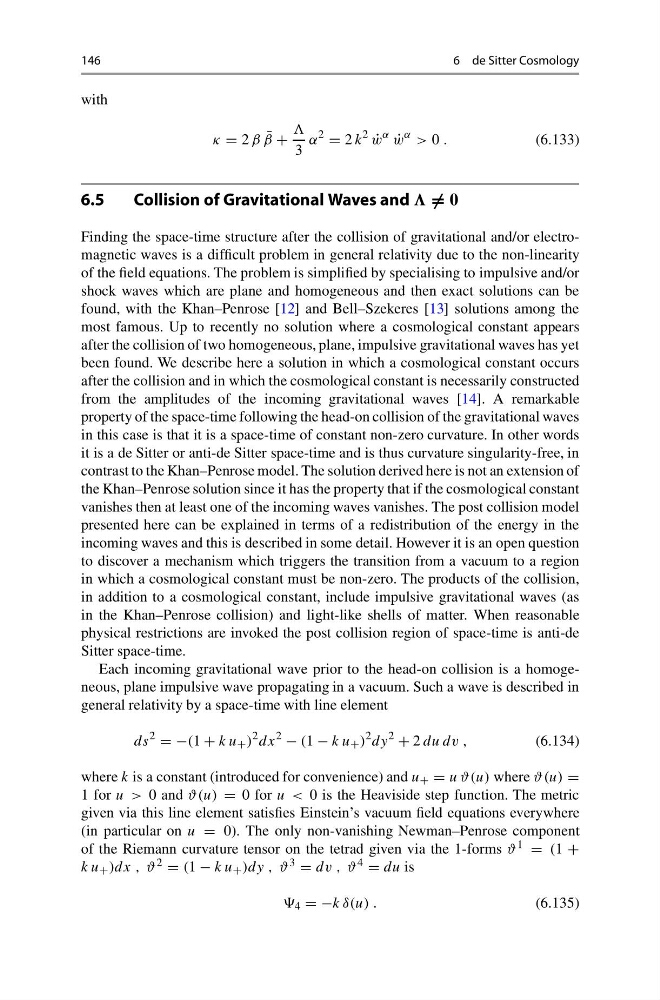
κ = 2 β ¯
β +
3
α
2
= 2 k
2
˙
w
α
˙
w
α > 0 .
(6.133)
6.5
Collision of Gravitational Waves and = 0
Finding the space-time structure after the collision of gravitational and/or electromagnetic waves is a difficult problem in general relativity due to the non-linearity
of the field equations. The problem is simplified by specialising to impulsive and/or
shock waves which are plane and homogeneous and then exact solutions can be
found, with the Khan–Penrose [12] and Bell–Szekeres [13] solutions among the
most famous. Up to recently no solution where a cosmological constant appears
after the collision of two homogeneous, plane, impulsive gravitational waves has yet
been found. We describe here a solution in which a cosmological constant occurs
after the collision and in which the cosmological constant is necessarily constructed
from the amplitudes of the incoming gravitational waves [14]. A remarkable
property of the space-time following the head-on collision of the gravitational waves
in this case is that it is a space-time of constant non-zero curvature. In other words
it is a de Sitter or anti-de Sitter space-time and is thus curvature singularity-free, in
contrast to the Khan–Penrose model. The solution derived here is not an extension of
the Khan–Penrose solution since it has the property that if the cosmological constant
vanishes then at least one of the incoming waves vanishes. The post collision model
presented here can be explained in terms of a redistribution of the energy in the
incoming waves and this is described in some detail. However it is an open question
to discover a mechanism which triggers the transition from a vacuum to a region
in which a cosmological constant must be non-zero. The products of the collision,
in addition to a cosmological constant, include impulsive gravitational waves (as
in the Khan–Penrose collision) and light-like shells of matter. When reasonable
physical restrictions are invoked the post collision region of space-time is anti-de
Sitter space-time.
Each incoming gravitational wave prior to the head-on collision is a homogeneous, plane impulsive wave propagating in a vacuum. Such a wave is described in
general relativity by a space-time with line element
ds
2
= −(1 + k u + )
2 dx
2
− (1 − k u + )
2 dy
2
+ 2 du dv ,
(6.134)
where k is a constant (introduced for convenience) and u + = u ϑ(u) where ϑ(u) =
1 for u > 0 and ϑ(u) = 0 for u < 0 is the Heaviside step function. The metric
given via this line element satisfies Einstein’s vacuum field equations everywhere
(in particular on u = 0). The only non-vanishing Newman–Penrose component
of the Riemann curvature tensor on the tetrad given via the 1-forms ϑ 1 = (1 +
k u + )dx , ϑ 2 = (1 − k u + )dy , ϑ 3 = dv , ϑ 4 = du is
4 = −k δ(u) .
(6.135)
6 de Sitter Cosmology
with
κ = 2 β ¯
β +
3
α
2
= 2 k
2
˙
w
α
˙
w
α > 0 .
(6.133)
6.5
Collision of Gravitational Waves and = 0
Finding the space-time structure after the collision of gravitational and/or electromagnetic waves is a difficult problem in general relativity due to the non-linearity
of the field equations. The problem is simplified by specialising to impulsive and/or
shock waves which are plane and homogeneous and then exact solutions can be
found, with the Khan–Penrose [12] and Bell–Szekeres [13] solutions among the
most famous. Up to recently no solution where a cosmological constant appears
after the collision of two homogeneous, plane, impulsive gravitational waves has yet
been found. We describe here a solution in which a cosmological constant occurs
after the collision and in which the cosmological constant is necessarily constructed
from the amplitudes of the incoming gravitational waves [14]. A remarkable
property of the space-time following the head-on collision of the gravitational waves
in this case is that it is a space-time of constant non-zero curvature. In other words
it is a de Sitter or anti-de Sitter space-time and is thus curvature singularity-free, in
contrast to the Khan–Penrose model. The solution derived here is not an extension of
the Khan–Penrose solution since it has the property that if the cosmological constant
vanishes then at least one of the incoming waves vanishes. The post collision model
presented here can be explained in terms of a redistribution of the energy in the
incoming waves and this is described in some detail. However it is an open question
to discover a mechanism which triggers the transition from a vacuum to a region
in which a cosmological constant must be non-zero. The products of the collision,
in addition to a cosmological constant, include impulsive gravitational waves (as
in the Khan–Penrose collision) and light-like shells of matter. When reasonable
physical restrictions are invoked the post collision region of space-time is anti-de
Sitter space-time.
Each incoming gravitational wave prior to the head-on collision is a homogeneous, plane impulsive wave propagating in a vacuum. Such a wave is described in
general relativity by a space-time with line element
ds
2
= −(1 + k u + )
2 dx
2
− (1 − k u + )
2 dy
2
+ 2 du dv ,
(6.134)
where k is a constant (introduced for convenience) and u + = u ϑ(u) where ϑ(u) =
1 for u > 0 and ϑ(u) = 0 for u < 0 is the Heaviside step function. The metric
given via this line element satisfies Einstein’s vacuum field equations everywhere
(in particular on u = 0). The only non-vanishing Newman–Penrose component
of the Riemann curvature tensor on the tetrad given via the 1-forms ϑ 1 = (1 +
k u + )dx , ϑ 2 = (1 − k u + )dy , ϑ 3 = dv , ϑ 4 = du is
4 = −k δ(u) .
(6.135)