

130
6 de Sitter Cosmology
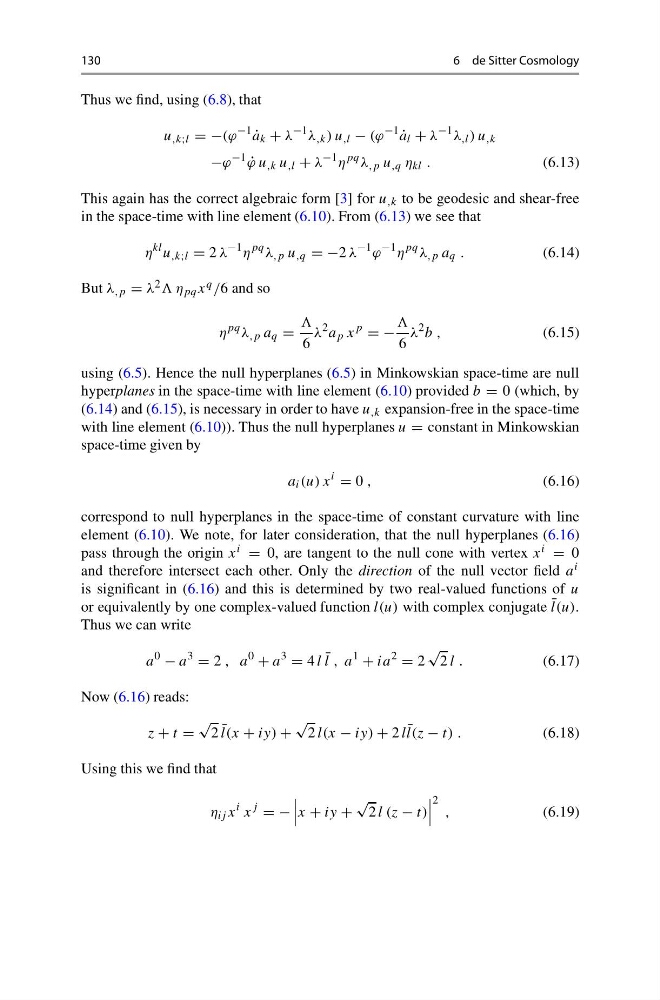
Thus we find, using (6.8), that
u ,k;l = −(ϕ
−1
˙
a k + λ
−1 λ ,k ) u ,l − (ϕ
−1
˙
a l + λ
−1 λ ,l ) u ,k
−ϕ
−1
˙
ϕ u ,k u ,l + λ
−1 η
pq λ ,p u ,q η kl .
(6.13)
This again has the correct algebraic form [3] for u ,k to be geodesic and shear-free
in the space-time with line element (6.10). From (6.13) we see that
η
kl u ,k;l = 2 λ
−1 η
pq λ ,p u ,q = −2 λ
−1 ϕ
−1 η
pq λ ,p a q .
(6.14)
But λ ,p = λ 2 η pq x q /6 and so
η
pq λ ,p a q =
6
λ
2 a p x
p
= −
6
λ
2 b ,
(6.15)
using (6.5). Hence the null hyperplanes (6.5) in Minkowskian space-time are null
hyperplanes in the space-time with line element (6.10) provided b = 0 (which, by
(6.14) and (6.15), is necessary in order to have u ,k expansion-free in the space-time
with line element (6.10)). Thus the null hyperplanes u = constant in Minkowskian
space-time given by
a i (u) x
i
= 0 ,
(6.16)
correspond to null hyperplanes in the space-time of constant curvature with line
element (6.10). We note, for later consideration, that the null hyperplanes (6.16)
pass through the origin x i = 0, are tangent to the null cone with vertex x i = 0
and therefore intersect each other. Only the direction of the null vector field a i
is significant in (6.16) and this is determined by two real-valued functions of u
or equivalently by one complex-valued function l(u) with complex conjugate ¯
l(u).
Thus we can write
a
0
− a
3
= 2 , a
0
+ a
3
= 4 l ¯
l , a
1
+ ia
2
= 2
√
2 l .
(6.17)
Now (6.16) reads:
z + t =
√
2 ¯
l(x + iy) +
√
2 l(x − iy) + 2 l ¯
l(z − t) .
(6.18)
Using this we find that
η ij x
i x
j
= −
x + iy +
√
2 l (z − t)
2
,
(6.19)
6 de Sitter Cosmology
Thus we find, using (6.8), that
u ,k;l = −(ϕ
−1
˙
a k + λ
−1 λ ,k ) u ,l − (ϕ
−1
˙
a l + λ
−1 λ ,l ) u ,k
−ϕ
−1
˙
ϕ u ,k u ,l + λ
−1 η
pq λ ,p u ,q η kl .
(6.13)
This again has the correct algebraic form [3] for u ,k to be geodesic and shear-free
in the space-time with line element (6.10). From (6.13) we see that
η
kl u ,k;l = 2 λ
−1 η
pq λ ,p u ,q = −2 λ
−1 ϕ
−1 η
pq λ ,p a q .
(6.14)
But λ ,p = λ 2 η pq x q /6 and so
η
pq λ ,p a q =
6
λ
2 a p x
p
= −
6
λ
2 b ,
(6.15)
using (6.5). Hence the null hyperplanes (6.5) in Minkowskian space-time are null
hyperplanes in the space-time with line element (6.10) provided b = 0 (which, by
(6.14) and (6.15), is necessary in order to have u ,k expansion-free in the space-time
with line element (6.10)). Thus the null hyperplanes u = constant in Minkowskian
space-time given by
a i (u) x
i
= 0 ,
(6.16)
correspond to null hyperplanes in the space-time of constant curvature with line
element (6.10). We note, for later consideration, that the null hyperplanes (6.16)
pass through the origin x i = 0, are tangent to the null cone with vertex x i = 0
and therefore intersect each other. Only the direction of the null vector field a i
is significant in (6.16) and this is determined by two real-valued functions of u
or equivalently by one complex-valued function l(u) with complex conjugate ¯
l(u).
Thus we can write
a
0
− a
3
= 2 , a
0
+ a
3
= 4 l ¯
l , a
1
+ ia
2
= 2
√
2 l .
(6.17)
Now (6.16) reads:
z + t =
√
2 ¯
l(x + iy) +
√
2 l(x − iy) + 2 l ¯
l(z − t) .
(6.18)
Using this we find that
η ij x
i x
j
= −
x + iy +
√
2 l (z − t)
2
,
(6.19)