

6.1 Null Hyperplanes in Space-Times of Constant Curvature
129
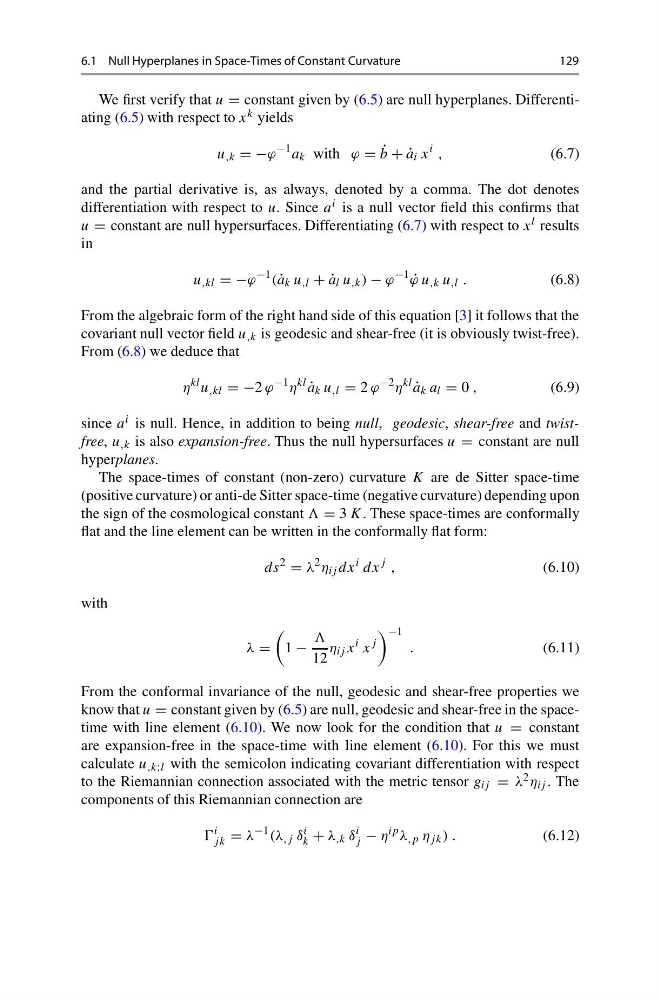
We first verify that u = constant given by (6.5) are null hyperplanes. Differentiating (6.5) with respect to x k yields
u ,k = −ϕ
−1 a k with ϕ = ˙
b + ˙
a i x
i ,
(6.7)
and the partial derivative is, as always, denoted by a comma. The dot denotes
differentiation with respect to u. Since a i is a null vector field this confirms that
u = constant are null hypersurfaces. Differentiating (6.7) with respect to x l results
in
u ,kl = −ϕ
−1 ( ˙
a k u ,l + ˙
a l u ,k ) − ϕ
−1
˙
ϕ u ,k u ,l .
(6.8)
From the algebraic form of the right hand side of this equation [3] it follows that the
covariant null vector field u ,k is geodesic and shear-free (it is obviously twist-free).
From (6.8) we deduce that
η
kl u ,kl = −2 ϕ
−1 η
kl
˙
a k u ,l = 2 ϕ
−2 η
kl
˙
a k a l = 0 ,
(6.9)
since a i is null. Hence, in addition to being null, geodesic, shear-free and twistfree, u ,k is also expansion-free. Thus the null hypersurfaces u = constant are null
hyperplanes.
The space-times of constant (non-zero) curvature K are de Sitter space-time
(positive curvature) or anti-de Sitter space-time (negative curvature) depending upon
the sign of the cosmological constant = 3 K. These space-times are conformally
flat and the line element can be written in the conformally flat form:
ds
2
= λ
2 η ij dx
i dx
j ,
(6.10)
with
λ =
1 −
12
η ij x
i x
j
−1
.
(6.11)
From the conformal invariance of the null, geodesic and shear-free properties we
know that u = constant given by (6.5) are null, geodesic and shear-free in the spacetime with line element (6.10). We now look for the condition that u = constant
are expansion-free in the space-time with line element (6.10). For this we must
calculate u ,k;l with the semicolon indicating covariant differentiation with respect
to the Riemannian connection associated with the metric tensor g ij = λ 2 η ij . The
components of this Riemannian connection are
i
jk = λ
−1 (λ ,j δ
i
k + λ ,k δ
i
j − η
ip λ ,p η jk ) .
(6.12)
129
We first verify that u = constant given by (6.5) are null hyperplanes. Differentiating (6.5) with respect to x k yields
u ,k = −ϕ
−1 a k with ϕ = ˙
b + ˙
a i x
i ,
(6.7)
and the partial derivative is, as always, denoted by a comma. The dot denotes
differentiation with respect to u. Since a i is a null vector field this confirms that
u = constant are null hypersurfaces. Differentiating (6.7) with respect to x l results
in
u ,kl = −ϕ
−1 ( ˙
a k u ,l + ˙
a l u ,k ) − ϕ
−1
˙
ϕ u ,k u ,l .
(6.8)
From the algebraic form of the right hand side of this equation [3] it follows that the
covariant null vector field u ,k is geodesic and shear-free (it is obviously twist-free).
From (6.8) we deduce that
η
kl u ,kl = −2 ϕ
−1 η
kl
˙
a k u ,l = 2 ϕ
−2 η
kl
˙
a k a l = 0 ,
(6.9)
since a i is null. Hence, in addition to being null, geodesic, shear-free and twistfree, u ,k is also expansion-free. Thus the null hypersurfaces u = constant are null
hyperplanes.
The space-times of constant (non-zero) curvature K are de Sitter space-time
(positive curvature) or anti-de Sitter space-time (negative curvature) depending upon
the sign of the cosmological constant = 3 K. These space-times are conformally
flat and the line element can be written in the conformally flat form:
ds
2
= λ
2 η ij dx
i dx
j ,
(6.10)
with
λ =
1 −
12
η ij x
i x
j
−1
.
(6.11)
From the conformal invariance of the null, geodesic and shear-free properties we
know that u = constant given by (6.5) are null, geodesic and shear-free in the spacetime with line element (6.10). We now look for the condition that u = constant
are expansion-free in the space-time with line element (6.10). For this we must
calculate u ,k;l with the semicolon indicating covariant differentiation with respect
to the Riemannian connection associated with the metric tensor g ij = λ 2 η ij . The
components of this Riemannian connection are
i
jk = λ
−1 (λ ,j δ
i
k + λ ,k δ
i
j − η
ip λ ,p η jk ) .
(6.12)