

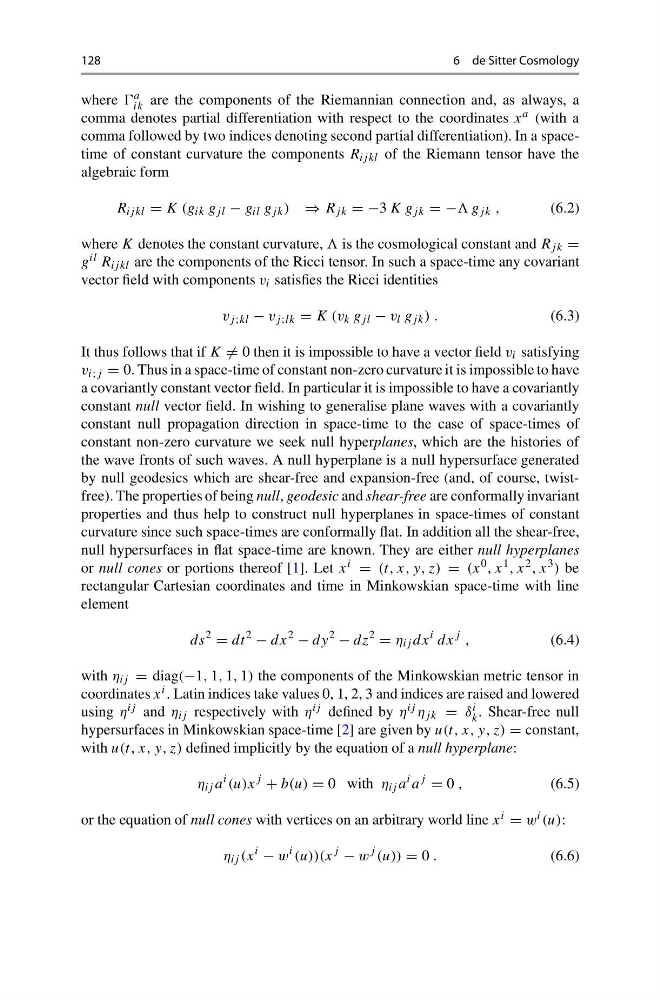
128
6 de Sitter Cosmology
where a
ik are the components of the Riemannian connection and, as always, a
comma denotes partial differentiation with respect to the coordinates x a (with a
comma followed by two indices denoting second partial differentiation). In a spacetime of constant curvature the components R ij kl of the Riemann tensor have the
algebraic form
R ij kl = K (g ik g jl − g il g jk ) ⇒ R jk = −3 K g jk = − g jk ,
(6.2)
where K denotes the constant curvature, is the cosmological constant and R jk =
g il R ij kl are the components of the Ricci tensor. In such a space-time any covariant
vector field with components v i satisfies the Ricci identities
v j ;kl − v j ;lk = K (v k g jl − v l g jk ) .
(6.3)
It thus follows that if K = 0 then it is impossible to have a vector field v i satisfying
v i;j = 0. Thus in a space-time of constant non-zero curvature it is impossible to have
a covariantly constant vector field. In particular it is impossible to have a covariantly
constant null vector field. In wishing to generalise plane waves with a covariantly
constant null propagation direction in space-time to the case of space-times of
constant non-zero curvature we seek null hyperplanes, which are the histories of
the wave fronts of such waves. A null hyperplane is a null hypersurface generated
by null geodesics which are shear-free and expansion-free (and, of course, twistfree). The properties of being null, geodesic and shear-free are conformally invariant
properties and thus help to construct null hyperplanes in space-times of constant
curvature since such space-times are conformally flat. In addition all the shear-free,
null hypersurfaces in flat space-time are known. They are either null hyperplanes
or null cones or portions thereof [1]. Let x i = (t, x, y, z) = (x 0 , x 1 , x 2 , x 3 ) be
rectangular Cartesian coordinates and time in Minkowskian space-time with line
element
ds
2
= dt
2
− dx
2
− dy
2
− dz
2
= η ij dx
i dx
j ,
(6.4)
with η ij = diag(−1, 1, 1, 1) the components of the Minkowskian metric tensor in
coordinates x i . Latin indices take values 0, 1, 2, 3 and indices are raised and lowered
using η ij and η ij respectively with η ij defined by η ij η jk = δ
i
k . Shear-free null
hypersurfaces in Minkowskian space-time [2] are given by u(t, x, y, z) = constant,
with u(t, x, y, z) defined implicitly by the equation of a null hyperplane:
η ij a
i (u)x
j
+ b(u) = 0 with η ij a
i a
j
= 0 ,
(6.5)
or the equation of null cones with vertices on an arbitrary world line x i = w i (u):
η ij (x
i
− w
i (u))(x
j
− w
j (u)) = 0 .
(6.6)
6 de Sitter Cosmology
where a
ik are the components of the Riemannian connection and, as always, a
comma denotes partial differentiation with respect to the coordinates x a (with a
comma followed by two indices denoting second partial differentiation). In a spacetime of constant curvature the components R ij kl of the Riemann tensor have the
algebraic form
R ij kl = K (g ik g jl − g il g jk ) ⇒ R jk = −3 K g jk = − g jk ,
(6.2)
where K denotes the constant curvature, is the cosmological constant and R jk =
g il R ij kl are the components of the Ricci tensor. In such a space-time any covariant
vector field with components v i satisfies the Ricci identities
v j ;kl − v j ;lk = K (v k g jl − v l g jk ) .
(6.3)
It thus follows that if K = 0 then it is impossible to have a vector field v i satisfying
v i;j = 0. Thus in a space-time of constant non-zero curvature it is impossible to have
a covariantly constant vector field. In particular it is impossible to have a covariantly
constant null vector field. In wishing to generalise plane waves with a covariantly
constant null propagation direction in space-time to the case of space-times of
constant non-zero curvature we seek null hyperplanes, which are the histories of
the wave fronts of such waves. A null hyperplane is a null hypersurface generated
by null geodesics which are shear-free and expansion-free (and, of course, twistfree). The properties of being null, geodesic and shear-free are conformally invariant
properties and thus help to construct null hyperplanes in space-times of constant
curvature since such space-times are conformally flat. In addition all the shear-free,
null hypersurfaces in flat space-time are known. They are either null hyperplanes
or null cones or portions thereof [1]. Let x i = (t, x, y, z) = (x 0 , x 1 , x 2 , x 3 ) be
rectangular Cartesian coordinates and time in Minkowskian space-time with line
element
ds
2
= dt
2
− dx
2
− dy
2
− dz
2
= η ij dx
i dx
j ,
(6.4)
with η ij = diag(−1, 1, 1, 1) the components of the Minkowskian metric tensor in
coordinates x i . Latin indices take values 0, 1, 2, 3 and indices are raised and lowered
using η ij and η ij respectively with η ij defined by η ij η jk = δ
i
k . Shear-free null
hypersurfaces in Minkowskian space-time [2] are given by u(t, x, y, z) = constant,
with u(t, x, y, z) defined implicitly by the equation of a null hyperplane:
η ij a
i (u)x
j
+ b(u) = 0 with η ij a
i a
j
= 0 ,
(6.5)
or the equation of null cones with vertices on an arbitrary world line x i = w i (u):
η ij (x
i
− w
i (u))(x
j
− w
j (u)) = 0 .
(6.6)